

7.1.5 The Gene Families of Vertebrate Haemoglobins
261
.l!lc
-
>-0
00·Q)eca
~£E
~o
(IJc
:.0", 0._
50
40
-
(J) 30
O>(IJ
-J:: m_
- c
~ iii' 20
Spleen
Bone marrow
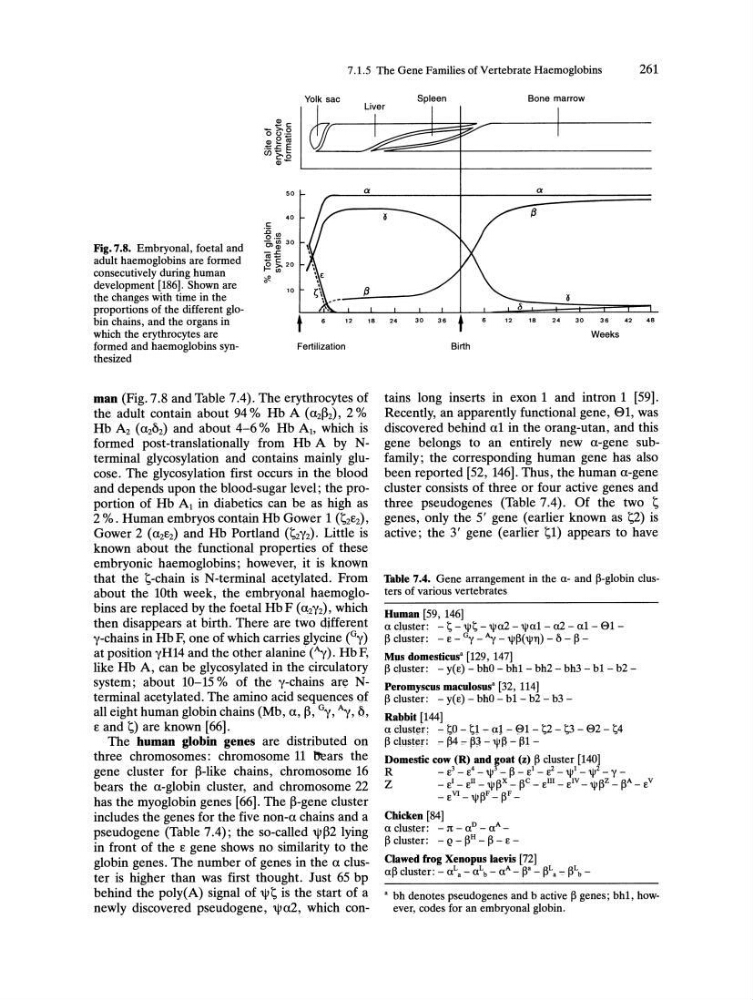
Fig.7.8. Embryonal, foetal and
adult haemoglobins are formed
consecutively during human
development [186]. Shown are
the changes with time in the
proportions of the different globin chains, and the organs in
which the erythrocytes are
formed and haemoglobins synthesized
10
_....!{3=----12
18
Fertilization
man (Fig. 7.8 and Table 7.4). The erythrocytes of
the adult contain about 94 % Hb A (az~z), 2 %
Hb Az (azoz) and about 4-6 % Hb Ab which is
formed post-translation ally from Hb A by Nterminal glycosylation and contains mainly glucose. The glycosylation first occurs in the blood
and depends upon the blood-sugar level; the proportion of Hb Al in diabetics can be as high as
2 %. Human embryos contain Hb Gower 1 (~z£z),
Gower 2 (az£z) and Hb Portland (~zyz). Little is
known about the functional properties of these
embryonic haemoglobins; however, it is known
that the ~-chain is N-terminal acetylated. From
about the 10th week, the embryonal haemoglobins are replaced by the foetal Hb F (o,zyz), which
then disappears at birth. There are two different
y-chains in Hb F, one of which carries glycine (1y)
at position yH14 and the other alanine (Ay). HbF,
like Hb A, can be glycosylated in the circulatory
system; about 10-15 % of the y-chains an; Nterminal acetylated. The amino acid sequences of
all eight human globin chains (Mb, a, ~, Gy, Ay, b,
£ and ~) are known [66].
The human globin genes are distributed on
three chromosomes: chromosome 11 ~ars the
gene cluster for ~-like chains, chromosome 16
bears the a-globin cluster, and chromosome 22
has the myoglobin genes [66]. The ~-gene cluster
includes the genes for the five non-a chains and a
pseudo gene (Table 7.4); the so-called ' ljJ ~2 lying
in front of the £ gene shows no similarity to the
globin genes. The number of genes in the a cluster is higher than was first thought. Just 65 bp
behind the poly(A) signal of 'ljJ~ is the start of a
newly discovered pseudo gene , 'ljJa2, which conWeeks
24
30
36
t
24
30
36
42
48
12
18
Birth
tains long inserts in exon 1 and intron 1 [59].
Recently, an apparently functional gene, EH, was
discovered behind al in the orang-utan, and this
gene belongs to an entirely new a-gene subfamily; the corresponding human gene has also
been reported [52, 146]. Thus, the human a-gene
cluster consists of three or four active genes and
three pseudo genes (Table 7.4). Of the two ~
genes, only the 5' gene (earlier known as ~2) is
active; the 3' gene (earlier ~1) appears to have
Table 7.4. Gene arrangement in the a- and ~-globin clusters of various vertebrates
Human [59, 146]
a cluster: -1; - ' Ij11; - 'Ij1a2 - 'Ij1a1 - a2 - a1 - 01 -
~ cluster: - E - Gy - Ay - 'Ij1~( 'Ij1T]) - 0 - ~ -
Mus domesticus' [129, 147]
~ cluster: - y(E) - bhO - bh1- bh2 - bh3 - b1- b2Peromyscus maculosus' [32, 114]
~ cluster: - y(E) - bhO - b1 - b2 - b3 -
Rabbit [144]
a clust~r: - 1;0 - 1;1 -,- al ~ ~1 -1;2 -1;3 - 02 -1;4
~ cll.\st~f: ,.. ~4 "" ~3, - 'I'~ - ~1 -
Domestic cow (R) and goat (z) ~ cluster [140]
R
_ E3 _ E4 _ ' Ij13 _ ~ _ El _ E2 _ ' Ij11 _ ' Ij12 _ Y _
Z
_ EI- En _'Ij1~X_ ~c_ EIII_ EIV _'Ij1~Z_ ~A_ EV
_EV1_'Ij1~F_~F_
Chicken [84]
a cluster: - Jt - aD - a A _
~ cluster: - Q - ~H - ~ - E -
Clawed frog Xenopus laevis [72]
a~ cluster: - a\ - a\ - a A - W - ~La .,.. ~\a bh denotes pseudogenes and b active ~ genes; bh1, however, codes for an embryonal globin.
261
.l!lc
-
>-0
00·Q)eca
~£E
~o
(IJc
:.0", 0._
50
40
-
(J) 30
O>(IJ
-J:: m_
- c
~ iii' 20
Spleen
Bone marrow
Fig.7.8. Embryonal, foetal and
adult haemoglobins are formed
consecutively during human
development [186]. Shown are
the changes with time in the
proportions of the different globin chains, and the organs in
which the erythrocytes are
formed and haemoglobins synthesized
10
_....!{3=----12
18
Fertilization
man (Fig. 7.8 and Table 7.4). The erythrocytes of
the adult contain about 94 % Hb A (az~z), 2 %
Hb Az (azoz) and about 4-6 % Hb Ab which is
formed post-translation ally from Hb A by Nterminal glycosylation and contains mainly glucose. The glycosylation first occurs in the blood
and depends upon the blood-sugar level; the proportion of Hb Al in diabetics can be as high as
2 %. Human embryos contain Hb Gower 1 (~z£z),
Gower 2 (az£z) and Hb Portland (~zyz). Little is
known about the functional properties of these
embryonic haemoglobins; however, it is known
that the ~-chain is N-terminal acetylated. From
about the 10th week, the embryonal haemoglobins are replaced by the foetal Hb F (o,zyz), which
then disappears at birth. There are two different
y-chains in Hb F, one of which carries glycine (1y)
at position yH14 and the other alanine (Ay). HbF,
like Hb A, can be glycosylated in the circulatory
system; about 10-15 % of the y-chains an; Nterminal acetylated. The amino acid sequences of
all eight human globin chains (Mb, a, ~, Gy, Ay, b,
£ and ~) are known [66].
The human globin genes are distributed on
three chromosomes: chromosome 11 ~ars the
gene cluster for ~-like chains, chromosome 16
bears the a-globin cluster, and chromosome 22
has the myoglobin genes [66]. The ~-gene cluster
includes the genes for the five non-a chains and a
pseudo gene (Table 7.4); the so-called ' ljJ ~2 lying
in front of the £ gene shows no similarity to the
globin genes. The number of genes in the a cluster is higher than was first thought. Just 65 bp
behind the poly(A) signal of 'ljJ~ is the start of a
newly discovered pseudo gene , 'ljJa2, which conWeeks
24
30
36
t
24
30
36
42
48
12
18
Birth
tains long inserts in exon 1 and intron 1 [59].
Recently, an apparently functional gene, EH, was
discovered behind al in the orang-utan, and this
gene belongs to an entirely new a-gene subfamily; the corresponding human gene has also
been reported [52, 146]. Thus, the human a-gene
cluster consists of three or four active genes and
three pseudo genes (Table 7.4). Of the two ~
genes, only the 5' gene (earlier known as ~2) is
active; the 3' gene (earlier ~1) appears to have
Table 7.4. Gene arrangement in the a- and ~-globin clusters of various vertebrates
Human [59, 146]
a cluster: -1; - ' Ij11; - 'Ij1a2 - 'Ij1a1 - a2 - a1 - 01 -
~ cluster: - E - Gy - Ay - 'Ij1~( 'Ij1T]) - 0 - ~ -
Mus domesticus' [129, 147]
~ cluster: - y(E) - bhO - bh1- bh2 - bh3 - b1- b2Peromyscus maculosus' [32, 114]
~ cluster: - y(E) - bhO - b1 - b2 - b3 -
Rabbit [144]
a clust~r: - 1;0 - 1;1 -,- al ~ ~1 -1;2 -1;3 - 02 -1;4
~ cll.\st~f: ,.. ~4 "" ~3, - 'I'~ - ~1 -
Domestic cow (R) and goat (z) ~ cluster [140]
R
_ E3 _ E4 _ ' Ij13 _ ~ _ El _ E2 _ ' Ij11 _ ' Ij12 _ Y _
Z
_ EI- En _'Ij1~X_ ~c_ EIII_ EIV _'Ij1~Z_ ~A_ EV
_EV1_'Ij1~F_~F_
Chicken [84]
a cluster: - Jt - aD - a A _
~ cluster: - Q - ~H - ~ - E -
Clawed frog Xenopus laevis [72]
a~ cluster: - a\ - a\ - a A - W - ~La .,.. ~\a bh denotes pseudogenes and b active ~ genes; bh1, however, codes for an embryonal globin.