

10
2 Nucleic Acids and Nuclear Proteins
to the next, not only through single base substitutions but also by rearrangement, transposition,
amplification and the deletion of longer sequences. In accordance with the aims of this book, the
main concern of the following chapter will be the
structural variety in the nucleic acids that results
from such processes. The reader is referred to the
relevant literature for general information on
molecular biology and related methods.
2.1.1 Conformation and Composition
The DNA that is organized together with histones
and other nuclear proteins into the supramolecular structure of chromatin does not always have
the well-known Watson and Crick conformation
of a right-handed double helix (B form); the lefthanded Z form is also quite often found in chromosomes. Longer sequences with purines on one
strand and pyrimidines on the opposite strand
(YiRn) can also form triple helices [256]. The
double helix of the Z form has a diameter of
1,8 om compared with 2.0 nm for the B-DNA, 12
instead of 10.5 bases per turn, and one turn per
4.46 instead of per 3.4 nm. Whereas the bases of
B-DNA all have the same (antiparallel) polarity
in terms of the sugar-phosphate chain, the
orientation in Z-DNAis alternatively parallel and
antiparallel. As the parallel orientation is more
stable for purines than for pyrimidines, the Z
conformation is favoured where purines and pyrimidines alternate. Thus, the widespread middle
repetitive DNA components of mammals with the
sequence (CAlGT)n, i.e. with (CA)n on one
strand and (GT)n on the other, should readily
assume the Z conformation; this may perhaps be
related to their function [186, 358]. Such sequences are never found in bacteria and are seldom
found in protozoans; a comparative investigation
into their origin would be interesting [308]. An
equilibrium exists between B- and Z-DNA, with
the B form being favoured thermodynamically.
The Z conformation is stabilized by negative
supercoiling and by methylation of CG to m 5 CG.
Changes from B to Z lead to far-reaching changes
in the structural and functional character of the
chromatin, e.g. in protein binding. Changes in
DNA conformation are possibly involved in the
regulation of transcription [358].
In contrast to B-DNA, Z-DNA is immune
reactive. Z-DNA-specific fluorescent antibodies
have shown a positive reaction with e.g. the
polytene chromosomes of the dipterans Drosophila and Chironomus, the interphase nucleus of
the ciliate Stylonycha mytilus, and the metaphase
chromosomes of the primates. However, the solvents used (ethanol and acetic acid) promote the
transformation of B to Z, and thus the in vivo
existence of Z-DNA is questionable. In some
cases, immunological evidence for Z-DNA has
been obtained with more suitable methods, e.g.
in transcriptionally active chromosomes of Drosophila hydei and in (TG)n sequences in the third
intron of the a-lactalbumin gene of the rat
[249,297]. A biological role for Z-DNA is, furthermore, suggested by the existence of specific
Z-DNA-binding proteins, e.g. in SV40 virus,
Escherichia coli, wheat germ, Drosophila and
rats. Three Z-DNA-specific proteins of 3158 kDa have been isolated from bull testis, and a
protein of 56 kDa has been isolated from HeLa
cells [170, 241, 261, 367].
In addition to such far-reaching structural differences between different DNA regions, there is
finer, more localized variation in helix parameters
that probably represents the functional subdivision
of the DNA into discrete units with characteristic
properties. DNA molecules are not rigid and
undergo thermal fluctuation in conformation that
can be shown, for example, by the tritium
exchange method. Such internal movements of the
DNA and other macromolecules have been vividly
described as "breathing reactions" [293, 444].
In order to describe the base composition of
the DNA, it is only necessary, according to the
Chargaff rule which states that AIT and Gtc exist
in equal proportions, to know the G+C content.
Whilst in mammalian DNA this is always
40-50 %, values for the DNA of the Protozoa and
those of the prokaryotes and lower eukaryotes
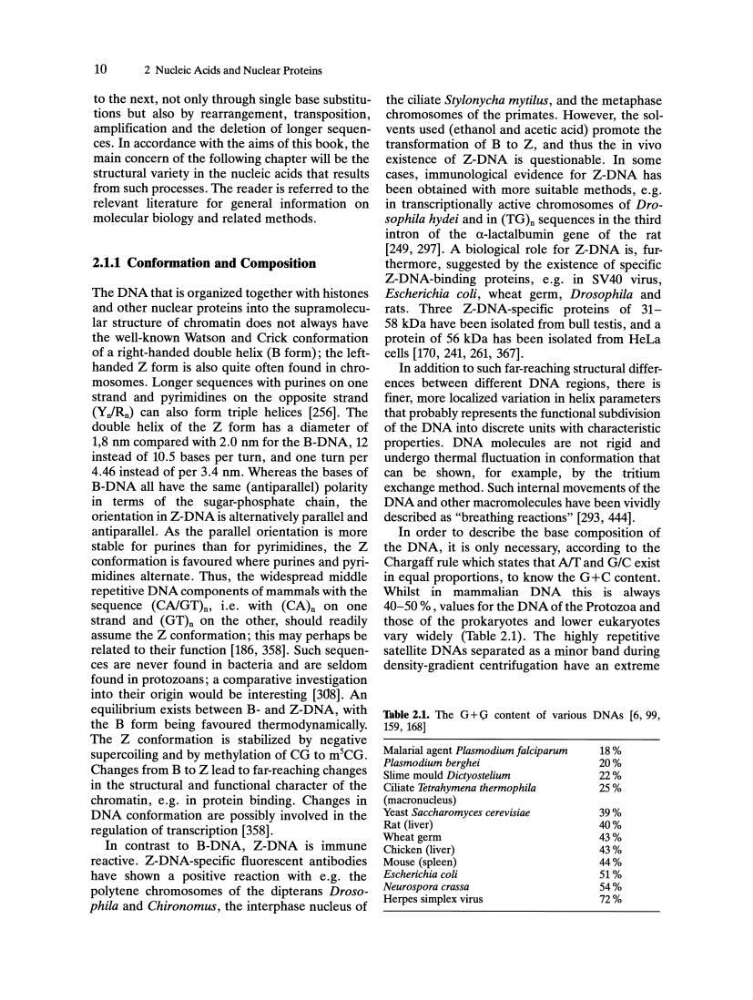
vary widely (Table 2.1). The highly repetitive
satellite DNAs separated as a minor band during
density-gradient centrifugation have an extreme
Thble 2.1. The G+O content of various DNAs [6,99,
159, 168]
Malarial agent Plasmodium falciparum
18 %
. Plasmodium berghei
20 %
Slime mould Dictyostelium
22 %
Ciliate Tetrahymena thermophila
25 %
(macronucleus)
Yeast Saccharomyces cerevisiae
39 %
Rat (liver)
40 %
Wheat germ
43 %
Chicken (liver)
43 %
Mouse (spleen)
44 %
Escherichia coli
51 %
Neurospora crassa
54 %
Herpes simplex virus
72 %
2 Nucleic Acids and Nuclear Proteins
to the next, not only through single base substitutions but also by rearrangement, transposition,
amplification and the deletion of longer sequences. In accordance with the aims of this book, the
main concern of the following chapter will be the
structural variety in the nucleic acids that results
from such processes. The reader is referred to the
relevant literature for general information on
molecular biology and related methods.
2.1.1 Conformation and Composition
The DNA that is organized together with histones
and other nuclear proteins into the supramolecular structure of chromatin does not always have
the well-known Watson and Crick conformation
of a right-handed double helix (B form); the lefthanded Z form is also quite often found in chromosomes. Longer sequences with purines on one
strand and pyrimidines on the opposite strand
(YiRn) can also form triple helices [256]. The
double helix of the Z form has a diameter of
1,8 om compared with 2.0 nm for the B-DNA, 12
instead of 10.5 bases per turn, and one turn per
4.46 instead of per 3.4 nm. Whereas the bases of
B-DNA all have the same (antiparallel) polarity
in terms of the sugar-phosphate chain, the
orientation in Z-DNAis alternatively parallel and
antiparallel. As the parallel orientation is more
stable for purines than for pyrimidines, the Z
conformation is favoured where purines and pyrimidines alternate. Thus, the widespread middle
repetitive DNA components of mammals with the
sequence (CAlGT)n, i.e. with (CA)n on one
strand and (GT)n on the other, should readily
assume the Z conformation; this may perhaps be
related to their function [186, 358]. Such sequences are never found in bacteria and are seldom
found in protozoans; a comparative investigation
into their origin would be interesting [308]. An
equilibrium exists between B- and Z-DNA, with
the B form being favoured thermodynamically.
The Z conformation is stabilized by negative
supercoiling and by methylation of CG to m 5 CG.
Changes from B to Z lead to far-reaching changes
in the structural and functional character of the
chromatin, e.g. in protein binding. Changes in
DNA conformation are possibly involved in the
regulation of transcription [358].
In contrast to B-DNA, Z-DNA is immune
reactive. Z-DNA-specific fluorescent antibodies
have shown a positive reaction with e.g. the
polytene chromosomes of the dipterans Drosophila and Chironomus, the interphase nucleus of
the ciliate Stylonycha mytilus, and the metaphase
chromosomes of the primates. However, the solvents used (ethanol and acetic acid) promote the
transformation of B to Z, and thus the in vivo
existence of Z-DNA is questionable. In some
cases, immunological evidence for Z-DNA has
been obtained with more suitable methods, e.g.
in transcriptionally active chromosomes of Drosophila hydei and in (TG)n sequences in the third
intron of the a-lactalbumin gene of the rat
[249,297]. A biological role for Z-DNA is, furthermore, suggested by the existence of specific
Z-DNA-binding proteins, e.g. in SV40 virus,
Escherichia coli, wheat germ, Drosophila and
rats. Three Z-DNA-specific proteins of 3158 kDa have been isolated from bull testis, and a
protein of 56 kDa has been isolated from HeLa
cells [170, 241, 261, 367].
In addition to such far-reaching structural differences between different DNA regions, there is
finer, more localized variation in helix parameters
that probably represents the functional subdivision
of the DNA into discrete units with characteristic
properties. DNA molecules are not rigid and
undergo thermal fluctuation in conformation that
can be shown, for example, by the tritium
exchange method. Such internal movements of the
DNA and other macromolecules have been vividly
described as "breathing reactions" [293, 444].
In order to describe the base composition of
the DNA, it is only necessary, according to the
Chargaff rule which states that AIT and Gtc exist
in equal proportions, to know the G+C content.
Whilst in mammalian DNA this is always
40-50 %, values for the DNA of the Protozoa and
those of the prokaryotes and lower eukaryotes
vary widely (Table 2.1). The highly repetitive
satellite DNAs separated as a minor band during
density-gradient centrifugation have an extreme
Thble 2.1. The G+O content of various DNAs [6,99,
159, 168]
Malarial agent Plasmodium falciparum
18 %
. Plasmodium berghei
20 %
Slime mould Dictyostelium
22 %
Ciliate Tetrahymena thermophila
25 %
(macronucleus)
Yeast Saccharomyces cerevisiae
39 %
Rat (liver)
40 %
Wheat germ
43 %
Chicken (liver)
43 %
Mouse (spleen)
44 %
Escherichia coli
51 %
Neurospora crassa
54 %
Herpes simplex virus
72 %