

a homodimer with 200-kDa subunits, and as such
has a completely different structure to the vertebrate fibrinogen with its three chains. The
amino-terminal sequence is homologous to vertebrate and invertebrate vitellogenin. The clotting reaction is not a proteolytic process but involves the transglutaminase-catalysed formation of
pseudopeptide bonding between glutamate and
lysine residues (Fig. 5.2) [64].
Amongst the insects there is a wide spectrum
of blood clotting phenotypes, but in every case
specific types of blood cell (coagulocytes) are
involved. In some species an aggregate of coagulocyte is formed and surrounded by a network of
granular fibrils; in other species single coagulocytes appear to send out thread-like processes; and
in some cases, there is no indication of any
plasma clotting [26]. The proteins involved have
been investigated in a few cockroach and locust
species and in most detail in the cockroach Leucophaea maderae and the migratory locust
Locusta migratoria. Two proteins are active here:
a haemocyte coagulant (HC) secreted from the
blood cells forms an insoluble clot by interacting
with the plasma coagulant (PC) already present in
the haemolymph. In reducing medium, HC alone
produces a soluble gel which is not solidified by
later addition of PC. The plasma coagulant of
both species mentioned above is identical to the
lipid-transporting protein lipophorin [17, 26].
5.9 Antifreeze Proteins
The blood plasma of teleosts in the polar oceans
and in the coastal waters, which are cold in winter, of the northern temperate zone contains large
quantities of special proteins that depress the
freezing point of the plasma by several degrees.
Because seawater freezes at about -1.9 °C and the
blood plasma of most marine teleosts freezes at
approximately -0.8 °C, depending on the solute
concentration, large areas of cold seas would be
inaccessible to teleosts without this remarkable
adaptive mechanism. Surprisingly, there are several types of such antifreeze proteins with the
same function but very different structures [58].
The first type to be discovered was the "antifreeze glycoproteins" (AFGPs), which were isolated from two species of the antarctic Nototheniidae, Pagothenia (formerly Trematomus borchgrevinki and Dissostichus mawsoni, and from five
Gadidae of the Northern Hemisphere, Eleginus
gracilis, Boreogadus siada, Gadus ogac, G. mor5.9 Antifreeze Proteins
207
rhua and Microgadus tomcod; these were characterized in detail [58]. They consist of a series of
(mostly) eight polypeptides varying in size
between 2.4 and 34 kDa, of which the larger
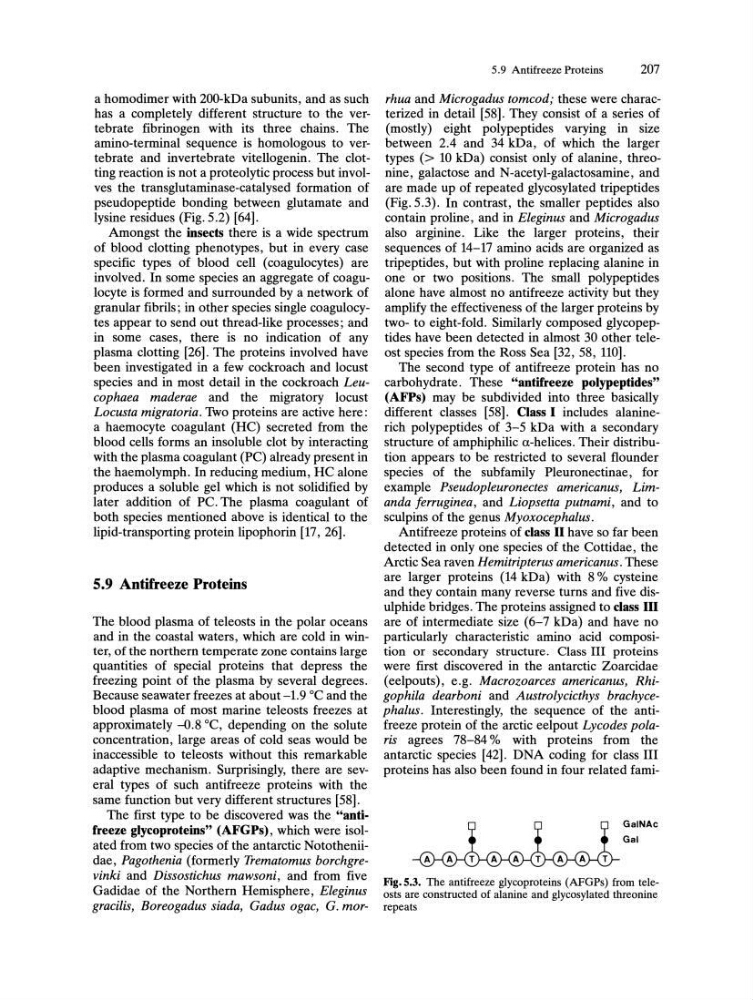
types (> 10 kDa) consist only of alanine, threonine, galactose and N-acetyl-galactosamine, and
are made up of repeated glycosylated tripeptides
(Fig. 5.3). In contrast, the smaller peptides also
contain proline, and in Eleginus and Microgadus
also arginine. Like the larger proteins, their
sequences of 14-17 amino acids are organized as
tripeptides, but with proline replacing alanine in
one or two positions. The small polypeptides
alone have almost no antifreeze activity but they
amplify the effectiveness of the larger proteins by
two- to eight-fold. Similarly composed glycopeptides have been detected in almost 30 other teleost species from the Ross Sea [32, 58, 110].
The second type of antifreeze protein has no
carbohydrate. These "antifreeze polypeptides"
(AFPs) may be subdivided into three basically
different classes [58]. Class I includes alaninerich polypeptides of 3-5 kDa with a secondary
structure of amphiphilic a-helices. Their distribution appears to be restricted to several flounder
species of the subfamily Pleuronectinae, for
example Pseudopleuronectes americanus, Limanda ferruginea, and Liopsetta putnami, and to
sculpins of the genus Myoxocephalus.
Antifreeze proteins of class II have so far been
detected in only one species of the Cottidae, the
Arctic Sea raven Hemitripterus americanus. These
are larger proteins (14 kDa) with 8 % cysteine
and they contain many reverse turns and five disulphide bridges. The proteins assigned to class III
are of intermediate size (6-7 kDa) and have no
particularly characteristic amino acid composition or secondary structure. Class III proteins
were first discovered in the antarctic Zoarcidae
(eelpouts), e.g. Macrozoarces americanus, Rhigophila dearboni and Austrolycicthys brachycephalus. Interestingly, the sequence of the antifreeze protein of the arctic eelpout Lycodes polaris agrees 78-84 % with proteins from the
antarctic species [42]. DNA coding for class III
proteins has also been found in four related famiGalNAc
Gal
Fig.5.3. The antifreeze glycoproteins (AFGPs) from teleosts are constructed of alanine and glycosylated threonine
repeats
has a completely different structure to the vertebrate fibrinogen with its three chains. The
amino-terminal sequence is homologous to vertebrate and invertebrate vitellogenin. The clotting reaction is not a proteolytic process but involves the transglutaminase-catalysed formation of
pseudopeptide bonding between glutamate and
lysine residues (Fig. 5.2) [64].
Amongst the insects there is a wide spectrum
of blood clotting phenotypes, but in every case
specific types of blood cell (coagulocytes) are
involved. In some species an aggregate of coagulocyte is formed and surrounded by a network of
granular fibrils; in other species single coagulocytes appear to send out thread-like processes; and
in some cases, there is no indication of any
plasma clotting [26]. The proteins involved have
been investigated in a few cockroach and locust
species and in most detail in the cockroach Leucophaea maderae and the migratory locust
Locusta migratoria. Two proteins are active here:
a haemocyte coagulant (HC) secreted from the
blood cells forms an insoluble clot by interacting
with the plasma coagulant (PC) already present in
the haemolymph. In reducing medium, HC alone
produces a soluble gel which is not solidified by
later addition of PC. The plasma coagulant of
both species mentioned above is identical to the
lipid-transporting protein lipophorin [17, 26].
5.9 Antifreeze Proteins
The blood plasma of teleosts in the polar oceans
and in the coastal waters, which are cold in winter, of the northern temperate zone contains large
quantities of special proteins that depress the
freezing point of the plasma by several degrees.
Because seawater freezes at about -1.9 °C and the
blood plasma of most marine teleosts freezes at
approximately -0.8 °C, depending on the solute
concentration, large areas of cold seas would be
inaccessible to teleosts without this remarkable
adaptive mechanism. Surprisingly, there are several types of such antifreeze proteins with the
same function but very different structures [58].
The first type to be discovered was the "antifreeze glycoproteins" (AFGPs), which were isolated from two species of the antarctic Nototheniidae, Pagothenia (formerly Trematomus borchgrevinki and Dissostichus mawsoni, and from five
Gadidae of the Northern Hemisphere, Eleginus
gracilis, Boreogadus siada, Gadus ogac, G. mor5.9 Antifreeze Proteins
207
rhua and Microgadus tomcod; these were characterized in detail [58]. They consist of a series of
(mostly) eight polypeptides varying in size
between 2.4 and 34 kDa, of which the larger
types (> 10 kDa) consist only of alanine, threonine, galactose and N-acetyl-galactosamine, and
are made up of repeated glycosylated tripeptides
(Fig. 5.3). In contrast, the smaller peptides also
contain proline, and in Eleginus and Microgadus
also arginine. Like the larger proteins, their
sequences of 14-17 amino acids are organized as
tripeptides, but with proline replacing alanine in
one or two positions. The small polypeptides
alone have almost no antifreeze activity but they
amplify the effectiveness of the larger proteins by
two- to eight-fold. Similarly composed glycopeptides have been detected in almost 30 other teleost species from the Ross Sea [32, 58, 110].
The second type of antifreeze protein has no
carbohydrate. These "antifreeze polypeptides"
(AFPs) may be subdivided into three basically
different classes [58]. Class I includes alaninerich polypeptides of 3-5 kDa with a secondary
structure of amphiphilic a-helices. Their distribution appears to be restricted to several flounder
species of the subfamily Pleuronectinae, for
example Pseudopleuronectes americanus, Limanda ferruginea, and Liopsetta putnami, and to
sculpins of the genus Myoxocephalus.
Antifreeze proteins of class II have so far been
detected in only one species of the Cottidae, the
Arctic Sea raven Hemitripterus americanus. These
are larger proteins (14 kDa) with 8 % cysteine
and they contain many reverse turns and five disulphide bridges. The proteins assigned to class III
are of intermediate size (6-7 kDa) and have no
particularly characteristic amino acid composition or secondary structure. Class III proteins
were first discovered in the antarctic Zoarcidae
(eelpouts), e.g. Macrozoarces americanus, Rhigophila dearboni and Austrolycicthys brachycephalus. Interestingly, the sequence of the antifreeze protein of the arctic eelpout Lycodes polaris agrees 78-84 % with proteins from the
antarctic species [42]. DNA coding for class III
proteins has also been found in four related famiGalNAc
Gal
Fig.5.3. The antifreeze glycoproteins (AFGPs) from teleosts are constructed of alanine and glycosylated threonine
repeats