

5.8.1 Blood Clotting in Vertebrates
203
Intrinsic path
Extrinsic path
Contact with non-endothelial surface
Tissue damage
K=::eK~'
t Prekallikrein
.. \
Thromboplastin
X I I - X l l a _
I
1
- - - - - - - - - - - Vlla.-l- VII
HMWK
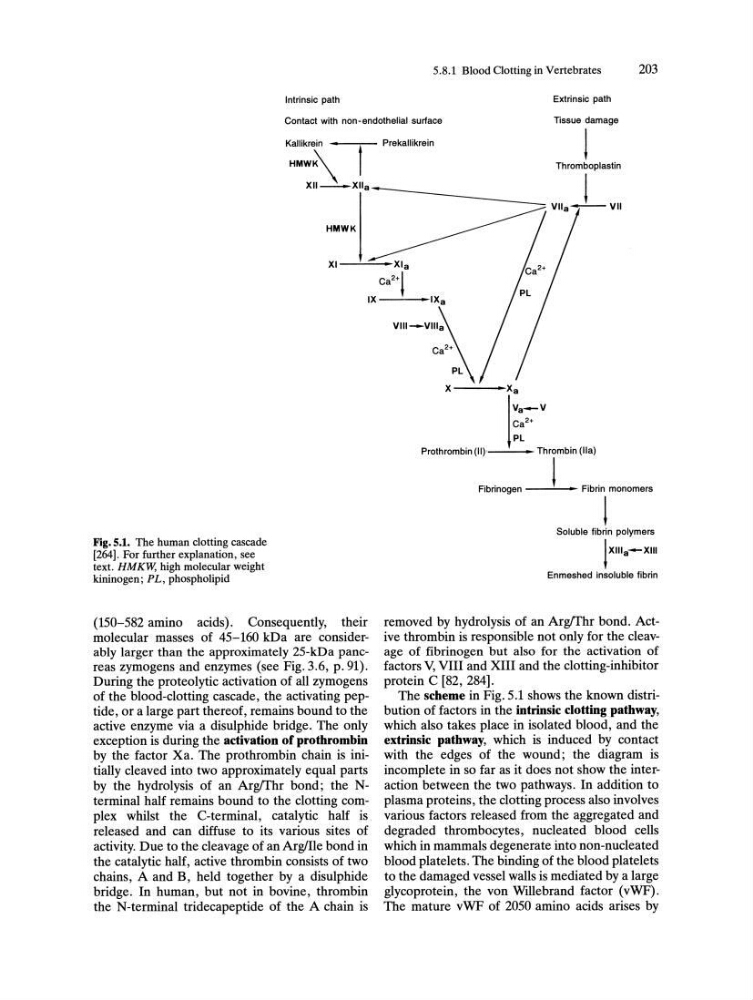
XI-"':"":;::'-Fig. 5.1. The human clotting cascade
[264]. For further explanation, see
text. HMKW, high molecular weight
kininogen; PL, phospholipid
(150-582 amino acids). Consequently, their
molecular masses of 45-160 kDa are considerably larger than the approximately 25-kDa pancreas zymogens and enzymes (see Fig. 3.6, p.91).
During the proteolytic activation of all zymogens
of the blood-clotting cascade, the activating peptide, or a large part thereof, remains bound to the
active enzyme via a disulphide bridge. The only
exception is during the activation of prothrombin
by the factor Xa. The prothrombin chain is initially cleaved into two approximately equal parts
by the hydrolysis of an Arg/Thr bond; the Nterminal half remains bound to the clotting complex whilst the C-terminal, catalytic half is.
released and can diffuse to its various sites of
activity. Due to the cleavage of an Arg/Ile bond in
the catalytic half, active thrombin consists of two
chains, A and B, held together by a disulphide
bridge. In human, but not in bovine, thrombin
the N-terminal tridecapeptide of the A chain is
-~-'-IXa
VIII--VIII\
Ca 2 +
PL
X - - - - X a
Prothrombin (11)"----'-._ Thrombin (1Ia)
1
Fibrinogen -----'-- Fibrin monomers
Soluble fibrin polymers
!Xllla-XIII
Enmeshed insoluble fibrin
removed by hydrolysis of an Arg/Thr bond. Active thrombin is responsible not only for the cleavage of fibrinogen but also for the activation of
factors V, VIII and XIII and the clotting-inhibitor
protein C [82, 284].
The scheme in Fig. 5.1 shows the known distribution of factors in the intrinsic clotting pathway,
which also takes place in isolated blood, and the
extrinsic pathway, which is induced by contact
with the edges of the wound; the diagram is
incomplete in so far as it does not show the interaction between the two pathways. In addition to
plasma proteins, the clotting process also involves
various factors released from the aggregated and
degraded thrombocytes, nucleated blood cells
which in mammals degenerate into non-nucleated
blood platelets. The binding of the blood platelets
to the damaged vessel walls is mediated by a large
glycoprotein, the von Willebrand factor (vWF).
The mature vWF of 2050 amino acids arises by
203
Intrinsic path
Extrinsic path
Contact with non-endothelial surface
Tissue damage
K=::eK~'
t Prekallikrein
.. \
Thromboplastin
X I I - X l l a _
I
1
- - - - - - - - - - - Vlla.-l- VII
HMWK
XI-"':"":;::'-Fig. 5.1. The human clotting cascade
[264]. For further explanation, see
text. HMKW, high molecular weight
kininogen; PL, phospholipid
(150-582 amino acids). Consequently, their
molecular masses of 45-160 kDa are considerably larger than the approximately 25-kDa pancreas zymogens and enzymes (see Fig. 3.6, p.91).
During the proteolytic activation of all zymogens
of the blood-clotting cascade, the activating peptide, or a large part thereof, remains bound to the
active enzyme via a disulphide bridge. The only
exception is during the activation of prothrombin
by the factor Xa. The prothrombin chain is initially cleaved into two approximately equal parts
by the hydrolysis of an Arg/Thr bond; the Nterminal half remains bound to the clotting complex whilst the C-terminal, catalytic half is.
released and can diffuse to its various sites of
activity. Due to the cleavage of an Arg/Ile bond in
the catalytic half, active thrombin consists of two
chains, A and B, held together by a disulphide
bridge. In human, but not in bovine, thrombin
the N-terminal tridecapeptide of the A chain is
-~-'-IXa
VIII--VIII\
Ca 2 +
PL
X - - - - X a
Prothrombin (11)"----'-._ Thrombin (1Ia)
1
Fibrinogen -----'-- Fibrin monomers
Soluble fibrin polymers
!Xllla-XIII
Enmeshed insoluble fibrin
removed by hydrolysis of an Arg/Thr bond. Active thrombin is responsible not only for the cleavage of fibrinogen but also for the activation of
factors V, VIII and XIII and the clotting-inhibitor
protein C [82, 284].
The scheme in Fig. 5.1 shows the known distribution of factors in the intrinsic clotting pathway,
which also takes place in isolated blood, and the
extrinsic pathway, which is induced by contact
with the edges of the wound; the diagram is
incomplete in so far as it does not show the interaction between the two pathways. In addition to
plasma proteins, the clotting process also involves
various factors released from the aggregated and
degraded thrombocytes, nucleated blood cells
which in mammals degenerate into non-nucleated
blood platelets. The binding of the blood platelets
to the damaged vessel walls is mediated by a large
glycoprotein, the von Willebrand factor (vWF).
The mature vWF of 2050 amino acids arises by