

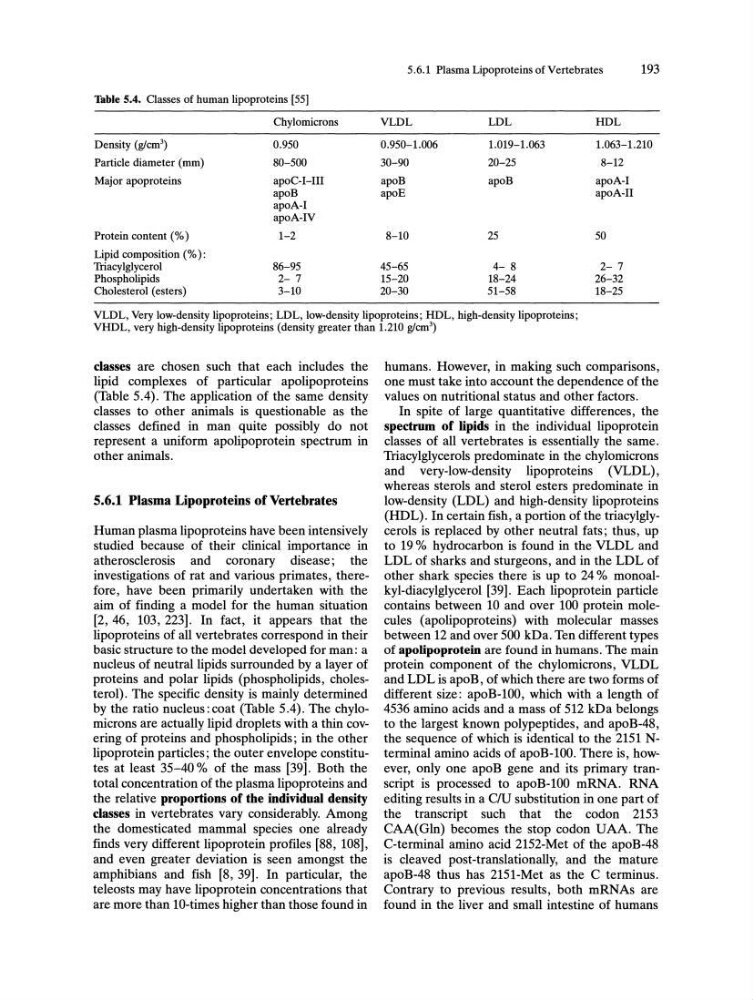
Table 5.4. Classes of human lipoproteins [55]
Chylomicrons
Density (glcm 3 )
0.950
Particle diameter (mm)
80-500
Major apoproteins
apoC-I-II1
apoB
apoA-I
apoA-IV
Protein content (% )
1-2
Lipid composition (% ):
Triacylglycerol
86-95
Phospholipids
2- 7
Cholesterol (esters)
3-10
5.6.1 Plasma Lipoproteins of Vertebrates
193
VLDL
0.950-1.006
30-90
apoB
apoE
8-10
45-65
15-20
20-30
LDL
1.019-1.063
20-25
apoB
25
4- 8
18-24
51-58
HDL
1.063-1.210
8-12
apoA-I
apoA-II
50
2- 7
26-32
18-25
VLDL, Very low-density lipoproteins; LDL, low-density lipoproteins; HDL, high-density lipoproteins;
VHDL, very high-density lipoproteins (density greater than 1.210 glcm 3 )
classes are chosen such that each includes the
lipid complexes of particular apolipoproteins
(Table 5.4). The application of the same density
classes to other animals is questionable as the
classes defined in man quite possibly do not
represent a uniform apolipoprotein spectrum in
other animals.
5.6.1 Plasma Lipoproteins of Vertebrates
Human plasma lipoproteins have been intensively
studied because of their clinical importance in
atherosclerosis and coronary disease; the
investigations of rat and various primates, therefore, have been primarily undertaken with the
aim of finding a model for the human situation
[2, 46, 103, 223]. In fact, it appears that the
lipoproteins of all vertebrates correspond in their
basic structure to the model developed for man: a
nucleus of neutral lipids surrounded by a layer of
proteins and polar lipids (phospholipids, cholesterol). The specific density is mainly determined
by the ratio nucleus: coat (Table 5.4). The chylomicrons are actually lipid droplets with a thin covering of proteins and phospholipids; in the other
lipoprotein particles; the outer envelope constitutes at least 35-40 % of the mass [39]. Both the
total concentration of the plasma lipoproteins and
the relative proportions of the individual density
classes in vertebrates vary considerably. Among
the domesticated mammal species one already
finds very different lipoprotein profiles [88, 108],
and even greater deviation is seen amongst the
amphibians and fish [8, 39]. In particular, the
teleosts may have lipoprotein concentrations that
are more than lO-times higher than those found in
humans. However, in making such comparisons,
one must take into account the dependence of the
values on nutritional status and other factors.
In spite of large quantitative differences, the
spectrum of lipids in the individual lipoprotein
classes of all vertebrates is essentially the same.
Triacylglycerols predominate in the chylomicrons
and very-low-density lipoproteins (VLDL) ,
whereas sterols and sterol esters predominate in
low-density (LDL) and high-density lipoproteins
(HDL). In certain fish, a portion of the triacylglycerols is replaced by other neutral fats; thus, up
to 19 % hydrocarbon is found in the VLDL and
LDL of sharks and sturgeons, and in the LDL of
other shark species there is up to 24 % monoalkyl-diacylglycerol [39]. Each lipoprotein particle
contains between 10 and over 100 protein molecules (apolipoproteins) with molecular masses
between 12 and over 500 kDa. Ten different types
of apolipoprotein are found in humans. The main
protein component of the chylomicrons, VLDL
and LD L is apoB, of which there are two forms of
different size: apoB-l00, which with a length of
4536 amino acids and a mass of 512 kDa belongs
to the largest known polypeptides, and apoB-48,
the sequence of which is identical to the 2151 Nterminal amino acids of apoB-l00. There is, however, only one apoB gene and its primary transcript is processed to apoB-100 mRNA. RNA
editing results in a C/U substitution in one part of
the transcript such that the codon 2153
CAA(Gln) becomes the stop codon UAA. The
C-terminal amino acid 2152-Met of the apoB-48
is cleaved post-translationally, and the mature
apoB-48 thus has 2151-Met as the C terminus.
Contrary to previous results, both mRNAs are
found in the liver and small intestine of humans
Chylomicrons
Density (glcm 3 )
0.950
Particle diameter (mm)
80-500
Major apoproteins
apoC-I-II1
apoB
apoA-I
apoA-IV
Protein content (% )
1-2
Lipid composition (% ):
Triacylglycerol
86-95
Phospholipids
2- 7
Cholesterol (esters)
3-10
5.6.1 Plasma Lipoproteins of Vertebrates
193
VLDL
0.950-1.006
30-90
apoB
apoE
8-10
45-65
15-20
20-30
LDL
1.019-1.063
20-25
apoB
25
4- 8
18-24
51-58
HDL
1.063-1.210
8-12
apoA-I
apoA-II
50
2- 7
26-32
18-25
VLDL, Very low-density lipoproteins; LDL, low-density lipoproteins; HDL, high-density lipoproteins;
VHDL, very high-density lipoproteins (density greater than 1.210 glcm 3 )
classes are chosen such that each includes the
lipid complexes of particular apolipoproteins
(Table 5.4). The application of the same density
classes to other animals is questionable as the
classes defined in man quite possibly do not
represent a uniform apolipoprotein spectrum in
other animals.
5.6.1 Plasma Lipoproteins of Vertebrates
Human plasma lipoproteins have been intensively
studied because of their clinical importance in
atherosclerosis and coronary disease; the
investigations of rat and various primates, therefore, have been primarily undertaken with the
aim of finding a model for the human situation
[2, 46, 103, 223]. In fact, it appears that the
lipoproteins of all vertebrates correspond in their
basic structure to the model developed for man: a
nucleus of neutral lipids surrounded by a layer of
proteins and polar lipids (phospholipids, cholesterol). The specific density is mainly determined
by the ratio nucleus: coat (Table 5.4). The chylomicrons are actually lipid droplets with a thin covering of proteins and phospholipids; in the other
lipoprotein particles; the outer envelope constitutes at least 35-40 % of the mass [39]. Both the
total concentration of the plasma lipoproteins and
the relative proportions of the individual density
classes in vertebrates vary considerably. Among
the domesticated mammal species one already
finds very different lipoprotein profiles [88, 108],
and even greater deviation is seen amongst the
amphibians and fish [8, 39]. In particular, the
teleosts may have lipoprotein concentrations that
are more than lO-times higher than those found in
humans. However, in making such comparisons,
one must take into account the dependence of the
values on nutritional status and other factors.
In spite of large quantitative differences, the
spectrum of lipids in the individual lipoprotein
classes of all vertebrates is essentially the same.
Triacylglycerols predominate in the chylomicrons
and very-low-density lipoproteins (VLDL) ,
whereas sterols and sterol esters predominate in
low-density (LDL) and high-density lipoproteins
(HDL). In certain fish, a portion of the triacylglycerols is replaced by other neutral fats; thus, up
to 19 % hydrocarbon is found in the VLDL and
LDL of sharks and sturgeons, and in the LDL of
other shark species there is up to 24 % monoalkyl-diacylglycerol [39]. Each lipoprotein particle
contains between 10 and over 100 protein molecules (apolipoproteins) with molecular masses
between 12 and over 500 kDa. Ten different types
of apolipoprotein are found in humans. The main
protein component of the chylomicrons, VLDL
and LD L is apoB, of which there are two forms of
different size: apoB-l00, which with a length of
4536 amino acids and a mass of 512 kDa belongs
to the largest known polypeptides, and apoB-48,
the sequence of which is identical to the 2151 Nterminal amino acids of apoB-l00. There is, however, only one apoB gene and its primary transcript is processed to apoB-100 mRNA. RNA
editing results in a C/U substitution in one part of
the transcript such that the codon 2153
CAA(Gln) becomes the stop codon UAA. The
C-terminal amino acid 2152-Met of the apoB-48
is cleaved post-translationally, and the mature
apoB-48 thus has 2151-Met as the C terminus.
Contrary to previous results, both mRNAs are
found in the liver and small intestine of humans