

154
4 Molecular Evolution
o ,
HAWAII
0,3
0,2
heteroneura
silvestris
..--_ _ _ planitibia
L...----differens
0,'
o D
r--------heteroneura
L-------silvestris
r-------planltibia
L...--_ _ _ _ differen5
,
,
I
,
!
,
,
1,2
1,0
0,8
0,6
0,4
0,2
0
f:l. TmoC
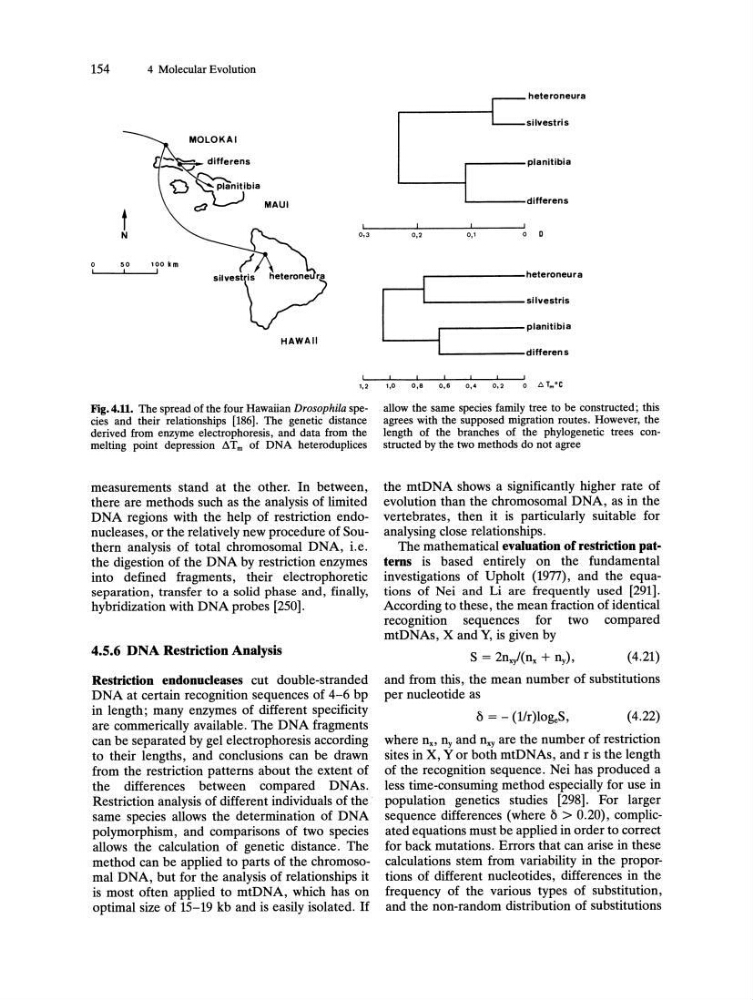
Fig.4.ll. The spread of the four Hawaiian Drosophila species and their relationships [186]. The genetic distance
derived from enzyme electrophoresis, and data from the
melting point depression LlTm of DNA heteroduplices
measurements stand at the other. In between,
there are methods such as the analysis of limited
DNA regions with the help of restriction endonucleases, or the relatively new procedure of Southern analysis of total chromosomal DNA, i.e.
the digestion of the DNA by restriction enzymes
into defined fragments, their electrophoretic
separation, transfer to a solid phase and, finally,
hybridization with DNA probes [250].
4.5.6 DNA Restriction Analysis
Restriction endonucleases cut double-stranded
DNA at certain recognition sequences of 4-6 bp
in length; many enzymes of different specificity
are commerically available. The DNA fragments
can be separated by gel electrophoresis according
to their lengths, and conclusions can be drawn
from the restriction patterns about the extent of
the differences between compared DNAs.
Restriction analysis of different individuals of the·
same species allows the determination of DNA
polymorphism, and comparisons of two species
allows the calculation of genetic distance. The
method can be applied to parts of the chromosomal DNA, but for the analysis of relationships it
is most often applied to mtDNA, which has on
optimal size of 15-19 kb and is easily isolated. If
allow the same species family tree to be constructed; this
agrees with the supposed migration routes. However, the
length of the branches of the phylogenetic trees constructed by the two methods do not agree
the mtDNA shows a significantly higher rate of
evolution than the chromosomal DNA, as in the
vertebrates, then it is particularly suitable for
analysing close relationships.
The mathematical evaluation of restriction patterns is based entirely on the fundamental
investigations of Upholt (19n) , and the equations of Nei and Li are frequently used [291].
According to these, the mean fraction of identical
recognition sequences for two compared
mtDNAs, X and Y, is given by
S = 2nxy/(nx + ny),
(4.21)
and from this, the mean number of substitutions
per nucleotide as
b = - (1/r)logeS,
(4.22)
where nx, ny and nxy are the number of restriction
sites in X, Y or both mtDNAs, and r is the length
of the recognition sequence. Nei has produced a
less time-consuming method especially for use in
population genetics studies [298]. For larger
sequence differences (where b > 0.20), complicated equations must be applied in order to correct
for back mutations. Errors that can arise in these
calculations stem from variability in the proportions of different nucleotides, differences in the
frequency of the various types of substitution,
and the non-random distribution of substitutions
4 Molecular Evolution
o ,
HAWAII
0,3
0,2
heteroneura
silvestris
..--_ _ _ planitibia
L...----differens
0,'
o D
r--------heteroneura
L-------silvestris
r-------planltibia
L...--_ _ _ _ differen5
,
,
I
,
!
,
,
1,2
1,0
0,8
0,6
0,4
0,2
0
f:l. TmoC
Fig.4.ll. The spread of the four Hawaiian Drosophila species and their relationships [186]. The genetic distance
derived from enzyme electrophoresis, and data from the
melting point depression LlTm of DNA heteroduplices
measurements stand at the other. In between,
there are methods such as the analysis of limited
DNA regions with the help of restriction endonucleases, or the relatively new procedure of Southern analysis of total chromosomal DNA, i.e.
the digestion of the DNA by restriction enzymes
into defined fragments, their electrophoretic
separation, transfer to a solid phase and, finally,
hybridization with DNA probes [250].
4.5.6 DNA Restriction Analysis
Restriction endonucleases cut double-stranded
DNA at certain recognition sequences of 4-6 bp
in length; many enzymes of different specificity
are commerically available. The DNA fragments
can be separated by gel electrophoresis according
to their lengths, and conclusions can be drawn
from the restriction patterns about the extent of
the differences between compared DNAs.
Restriction analysis of different individuals of the·
same species allows the determination of DNA
polymorphism, and comparisons of two species
allows the calculation of genetic distance. The
method can be applied to parts of the chromosomal DNA, but for the analysis of relationships it
is most often applied to mtDNA, which has on
optimal size of 15-19 kb and is easily isolated. If
allow the same species family tree to be constructed; this
agrees with the supposed migration routes. However, the
length of the branches of the phylogenetic trees constructed by the two methods do not agree
the mtDNA shows a significantly higher rate of
evolution than the chromosomal DNA, as in the
vertebrates, then it is particularly suitable for
analysing close relationships.
The mathematical evaluation of restriction patterns is based entirely on the fundamental
investigations of Upholt (19n) , and the equations of Nei and Li are frequently used [291].
According to these, the mean fraction of identical
recognition sequences for two compared
mtDNAs, X and Y, is given by
S = 2nxy/(nx + ny),
(4.21)
and from this, the mean number of substitutions
per nucleotide as
b = - (1/r)logeS,
(4.22)
where nx, ny and nxy are the number of restriction
sites in X, Y or both mtDNAs, and r is the length
of the recognition sequence. Nei has produced a
less time-consuming method especially for use in
population genetics studies [298]. For larger
sequence differences (where b > 0.20), complicated equations must be applied in order to correct
for back mutations. Errors that can arise in these
calculations stem from variability in the proportions of different nucleotides, differences in the
frequency of the various types of substitution,
and the non-random distribution of substitutions