

4.4.3 The Controversy Between Neutralism and Selectionism
145
flight performance. Breeding at 15°C selects for
the S allele and at 30°C selects for the F allele
[18]. Systematic investigations of the influence of
the alleloenzyme spectrum on mechanical flight
performance in D. melanogaster showed no clear
effects of any of the 15 enzymes of energyconverting metabolism tested [227]. In Mytilus
edulis, the rate at which the intracellular concentration of free amino acids in the mid-gut gland is
osmotically increased after transfer to 120 % sea
water is significantly higher in animals with leucine aminopeptidase (Lap94) than in animals with
any other allele [173]. In erythrocytes of the teleost Fundulus heteroclitus, found on the Atlantic
coast of North America, there are two allelic variants of the lactate B subunit, whose kinetic properties involve different temperature sensitivities.
Thus, Ldh-BbB b animals are superior to Ldh-BaBa
animals in swimming performance and developmental rate at 10°C but not at 25 0c. The frequency of Ldh-b b alleles increases from south to
north, reaching 100 % in the cold waters off
Maine [92].
It should be possible to demonstrate direct
selection for allelic enzyme variants that show differences in vivo, and the prime example here is
that of the alcohol dehydrogenase (ADH) of
Drosophila melanogaster [166]. This is a homodimer coded by a single gene, for which at least
eight alleles can be distinguished by electrophoresis and heat inactivation. Predominant in natural
populations are the variants S (slow) and F (fast),
which differ in only one amino acid; the rarer
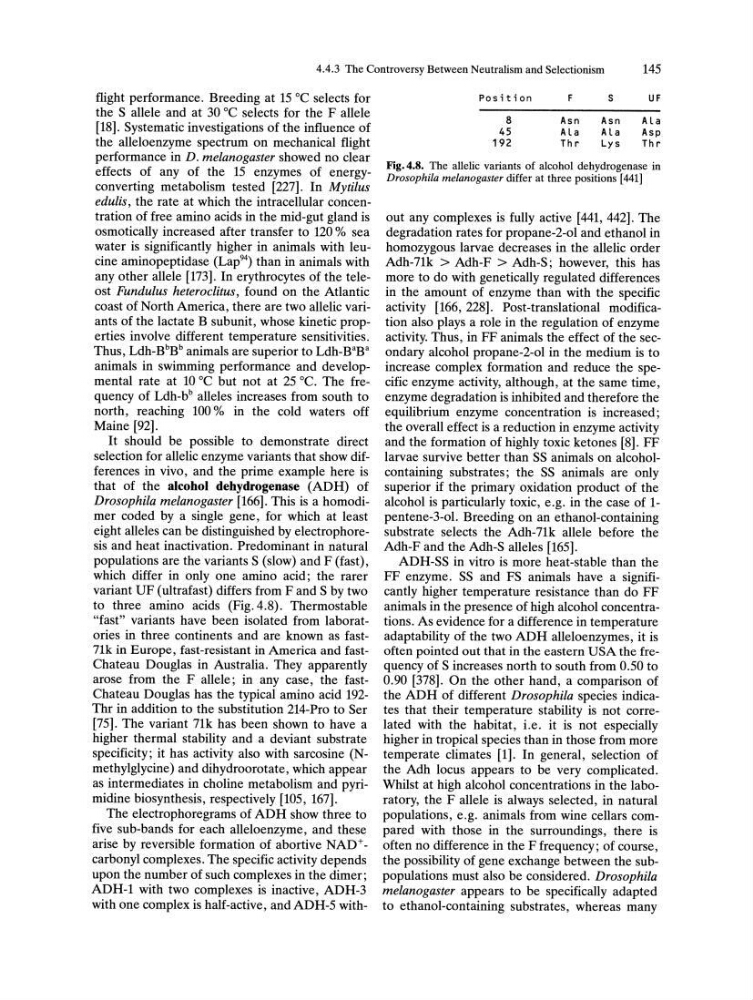
variant UF (ultrafast) differs from F and S by two
to three amino acids (Fig. 4.8). Thermostable
"fast" variants have been isolated from laboratories in three continents and are known as fast71k in Europe, fast-resistant in America and fastChateau Douglas in Australia. They apparently
arose from the F allele; in any case, the fastChateau Douglas has the typical amino acid 192Thr in addition to the substitution 214-Pro to Ser
[75]. The variant 71k has been shown to have a
higher thermal stability and a deviant substrate
specificity; it has activity also with sarcosine (Nmethylglycine) and dihydroorotate, which appear
as intermediates in choline metabolism and pyrimidine biosynthesis, respectively [105, 167].
The electrophoregrams of ADH show three to
five sub-bands for each alleloenzyme, and these
arise by reversible formation of abortive NAD+carbonyl complexes. The specific activity depends
upon the number of such complexes in the dimer;
ADH-1 with two complexes is inactive, ADH-3
with one complex is half-active, and ADH-5 withPosition
8
45
192
F
Asn
ALa
Thr
s
Asn
ALa
Lys
UF
ALa
Asp
Thr
Fig. 4.8. The allelic variants of alcohol dehydrogenase in
Drosophila melanogaster differ at three positions [441]
out any complexes is fully active [441,442]. The
degradation rates for propane-2-01 and ethanol in
homozygous larvae decreases in the allelic order
Adh-71k > Adh-F > Adh-S; however, this has
more to do with genetically regulated differences
in the amount of enzyme than with the specific
activity [166, 228]. Post-translational modification also plays a role in the regulation of enzyme
activity. Thus, in FF animals the effect of the secondary alcohol propane-2-01 in the medium is to
increase complex formation and reduce the specific enzyme activity, although, at the same time,
enzyme degradation is inhibited and therefore the
eqUilibrium enzyme concentration is increased;
the overall effect is a reduction in enzyme activity
and the formation of highly toxic ketones [8]. FF
larvae survive better than SS animals on alcoholcontaining substrates; the SS animals are only
superior if the primary oxidation product of the
alcohol is particularly toxic, e.g. in the case of 1pentene-3-01. Breeding on an ethanol-containing
substrate selects the Adh-71k allele before the
Adh-F and the Adh-S alleles [165].
ADH-SS in vitro is more heat-stable than the
FF enzyme. SS and FS animals have a significantly higher temperature resistance than do FF
animals in the presence of high alcohol concentrations. As evidence for a difference in temperature
adaptability of the two ADH alleloenzymes, it is
often pointed out that in the eastern USA the frequency of S increases north to south from 0.50 to
0.90 [378]. On the other hand, a comparison of
the ADH of different Drosophila species indicates that their temperature stability is not correlated with the habitat, i.e. it is not especially
higher in tropical species than in those from more
temperate climates [1]. In general, selection of
the Adh locus appears to be very complicated.
Whilst at high alcohol concentrations in the laboratory, the F allele is always selected, in natural
populations, e.g. animals from wine cellars compared with those in the surroundings, there is
often no difference in the F frequency; of course,
the possibility of gene exchange between the subpopulations must also be considered. Drosophila
melanogaster appears to be specifically adapted
to ethanol-containing substrates, whereas many
145
flight performance. Breeding at 15°C selects for
the S allele and at 30°C selects for the F allele
[18]. Systematic investigations of the influence of
the alleloenzyme spectrum on mechanical flight
performance in D. melanogaster showed no clear
effects of any of the 15 enzymes of energyconverting metabolism tested [227]. In Mytilus
edulis, the rate at which the intracellular concentration of free amino acids in the mid-gut gland is
osmotically increased after transfer to 120 % sea
water is significantly higher in animals with leucine aminopeptidase (Lap94) than in animals with
any other allele [173]. In erythrocytes of the teleost Fundulus heteroclitus, found on the Atlantic
coast of North America, there are two allelic variants of the lactate B subunit, whose kinetic properties involve different temperature sensitivities.
Thus, Ldh-BbB b animals are superior to Ldh-BaBa
animals in swimming performance and developmental rate at 10°C but not at 25 0c. The frequency of Ldh-b b alleles increases from south to
north, reaching 100 % in the cold waters off
Maine [92].
It should be possible to demonstrate direct
selection for allelic enzyme variants that show differences in vivo, and the prime example here is
that of the alcohol dehydrogenase (ADH) of
Drosophila melanogaster [166]. This is a homodimer coded by a single gene, for which at least
eight alleles can be distinguished by electrophoresis and heat inactivation. Predominant in natural
populations are the variants S (slow) and F (fast),
which differ in only one amino acid; the rarer
variant UF (ultrafast) differs from F and S by two
to three amino acids (Fig. 4.8). Thermostable
"fast" variants have been isolated from laboratories in three continents and are known as fast71k in Europe, fast-resistant in America and fastChateau Douglas in Australia. They apparently
arose from the F allele; in any case, the fastChateau Douglas has the typical amino acid 192Thr in addition to the substitution 214-Pro to Ser
[75]. The variant 71k has been shown to have a
higher thermal stability and a deviant substrate
specificity; it has activity also with sarcosine (Nmethylglycine) and dihydroorotate, which appear
as intermediates in choline metabolism and pyrimidine biosynthesis, respectively [105, 167].
The electrophoregrams of ADH show three to
five sub-bands for each alleloenzyme, and these
arise by reversible formation of abortive NAD+carbonyl complexes. The specific activity depends
upon the number of such complexes in the dimer;
ADH-1 with two complexes is inactive, ADH-3
with one complex is half-active, and ADH-5 withPosition
8
45
192
F
Asn
ALa
Thr
s
Asn
ALa
Lys
UF
ALa
Asp
Thr
Fig. 4.8. The allelic variants of alcohol dehydrogenase in
Drosophila melanogaster differ at three positions [441]
out any complexes is fully active [441,442]. The
degradation rates for propane-2-01 and ethanol in
homozygous larvae decreases in the allelic order
Adh-71k > Adh-F > Adh-S; however, this has
more to do with genetically regulated differences
in the amount of enzyme than with the specific
activity [166, 228]. Post-translational modification also plays a role in the regulation of enzyme
activity. Thus, in FF animals the effect of the secondary alcohol propane-2-01 in the medium is to
increase complex formation and reduce the specific enzyme activity, although, at the same time,
enzyme degradation is inhibited and therefore the
eqUilibrium enzyme concentration is increased;
the overall effect is a reduction in enzyme activity
and the formation of highly toxic ketones [8]. FF
larvae survive better than SS animals on alcoholcontaining substrates; the SS animals are only
superior if the primary oxidation product of the
alcohol is particularly toxic, e.g. in the case of 1pentene-3-01. Breeding on an ethanol-containing
substrate selects the Adh-71k allele before the
Adh-F and the Adh-S alleles [165].
ADH-SS in vitro is more heat-stable than the
FF enzyme. SS and FS animals have a significantly higher temperature resistance than do FF
animals in the presence of high alcohol concentrations. As evidence for a difference in temperature
adaptability of the two ADH alleloenzymes, it is
often pointed out that in the eastern USA the frequency of S increases north to south from 0.50 to
0.90 [378]. On the other hand, a comparison of
the ADH of different Drosophila species indicates that their temperature stability is not correlated with the habitat, i.e. it is not especially
higher in tropical species than in those from more
temperate climates [1]. In general, selection of
the Adh locus appears to be very complicated.
Whilst at high alcohol concentrations in the laboratory, the F allele is always selected, in natural
populations, e.g. animals from wine cellars compared with those in the surroundings, there is
often no difference in the F frequency; of course,
the possibility of gene exchange between the subpopulations must also be considered. Drosophila
melanogaster appears to be specifically adapted
to ethanol-containing substrates, whereas many