

124
4 Molecular Evolution
c=:
c:::m=
===
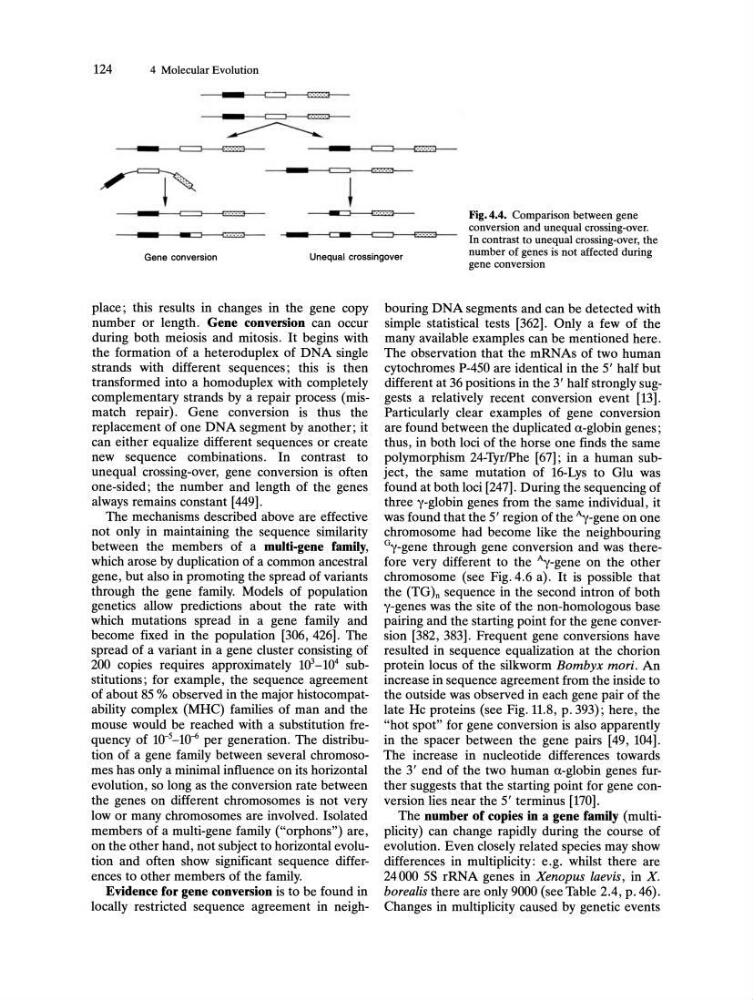
Gene conversion
Unequal crossingover
Fig.4.4. Comparison between gene
conversion and unequal crossing-over.
In contrast to unequal crossing-over, the
number of genes is not affected during
gene conversion
place; this results in changes in the gene copy
number or length. Gene conversion can occur
during both meiosis and mitosis. It begins with
the formation of a heteroduplex of DNA single
strands with different sequences; this is then
transformed into a homo duplex with completely
complementary strands by a repair process (mismatch repair). Gene conversion is thus the
replacement of one DNA segment by another; it
can either equalize different sequences or create
new sequence combinations. In contrast to
unequal crossing-over, gene conversion is often
one-sided; the number and length of the genes
always remains constant [449] .
The mechanisms described above are effective
not only in maintaining the sequence similarity
between the members of a mUlti-gene family,
which arose by duplication of a common ancestral
gene, but also in promoting the spread of variants
through the gene family. Models of population
genetics allow predictions about the rate with
which mutations spread in a gene family and
become fixed in the population [306, 426]. The
spread of a variant in a gene cluster consisting of
200 copies requires approximately 10 3 -10 4 substitutions; for example, the sequence agreement
of about 85 % observed in the major histocompatability complex (MHC) families of man and the
mouse would be reached with a substitution frequency of 10- 5 -1O-Q per generation. The distribution of a gene family between several chromosomes has only a minimal influence on its horizontal
evolution, so long as the conversion rate between
the genes on different chromosomes is not very
low or many chromosomes are involved. Isolated
members of a multi-gene family ("orphons") are,
on the other hand, not subject to horizontal evolution and often show significant sequence differences to other members of the family.
Evidence for gene conversion is to be found in
locally restricted sequence agreement in neighbouring DNA segments and can be detected with
simple statistical tests [362]. Only a few of the
many available examples can be mentioned here.
The observation that the mRNAs of two human
cytochromes P-450 are identical in the 5' half but
different at 36 positions in the 3' half strongly suggests a relatively recent conversion event [13].
Particularly clear examples of gene conversion
are found between the duplicated a-globin genes;
thus, in both loci of the horse one finds the same
polymorphism 24-TyrlPhe [67]; in a human subject, the same mutation of 16-Lys to Glu was
found at both loci [247]. During the sequencing of
three y-globin genes from the same individual, it
was found that the 5' region of the Ay-gene on one
chromosome had become like the neighbouring
Gy-gene through gene conversion and was therefore very different to the Ay-gene on the other
chromosome (see Fig. 4.6 a). It is possible that
the (TG)n sequence in the second intron of both
y-genes was the site of the non-homologous base
pairing and the starting point for the gene conversion [382, 383]. Frequent gene conversions have
resulted in sequence equalization at the chorion
protein locus of the silkworm Bombyx mori. An
increase in sequence agreement from the inside to
the outside was observed in each gene pair of the
late Hc proteins (see Fig. 11.8, p. 393); here, the
"hot spot" for gene conversion is also apparently
in the spacer between the gene pairs [49, 104].
The increase in nucleotide differences towards
the 3' end of the two human a-globin genes further suggests that the starting point for gene conversion lies near the 5' terminus [170].
The number of copies in a gene family (multiplicity) can change rapidly during the course of
evolution. Even closely related species may show
differences in multiplicity: e.g. whilst there are
24000 5S rRNA genes in Xenopus laevis, in X.
borealis there are only 9000 (see Table 2.4, p. 46).
Changes in multiplicity caused by genetic events
4 Molecular Evolution
c=:
c:::m=
===
Gene conversion
Unequal crossingover
Fig.4.4. Comparison between gene
conversion and unequal crossing-over.
In contrast to unequal crossing-over, the
number of genes is not affected during
gene conversion
place; this results in changes in the gene copy
number or length. Gene conversion can occur
during both meiosis and mitosis. It begins with
the formation of a heteroduplex of DNA single
strands with different sequences; this is then
transformed into a homo duplex with completely
complementary strands by a repair process (mismatch repair). Gene conversion is thus the
replacement of one DNA segment by another; it
can either equalize different sequences or create
new sequence combinations. In contrast to
unequal crossing-over, gene conversion is often
one-sided; the number and length of the genes
always remains constant [449] .
The mechanisms described above are effective
not only in maintaining the sequence similarity
between the members of a mUlti-gene family,
which arose by duplication of a common ancestral
gene, but also in promoting the spread of variants
through the gene family. Models of population
genetics allow predictions about the rate with
which mutations spread in a gene family and
become fixed in the population [306, 426]. The
spread of a variant in a gene cluster consisting of
200 copies requires approximately 10 3 -10 4 substitutions; for example, the sequence agreement
of about 85 % observed in the major histocompatability complex (MHC) families of man and the
mouse would be reached with a substitution frequency of 10- 5 -1O-Q per generation. The distribution of a gene family between several chromosomes has only a minimal influence on its horizontal
evolution, so long as the conversion rate between
the genes on different chromosomes is not very
low or many chromosomes are involved. Isolated
members of a multi-gene family ("orphons") are,
on the other hand, not subject to horizontal evolution and often show significant sequence differences to other members of the family.
Evidence for gene conversion is to be found in
locally restricted sequence agreement in neighbouring DNA segments and can be detected with
simple statistical tests [362]. Only a few of the
many available examples can be mentioned here.
The observation that the mRNAs of two human
cytochromes P-450 are identical in the 5' half but
different at 36 positions in the 3' half strongly suggests a relatively recent conversion event [13].
Particularly clear examples of gene conversion
are found between the duplicated a-globin genes;
thus, in both loci of the horse one finds the same
polymorphism 24-TyrlPhe [67]; in a human subject, the same mutation of 16-Lys to Glu was
found at both loci [247]. During the sequencing of
three y-globin genes from the same individual, it
was found that the 5' region of the Ay-gene on one
chromosome had become like the neighbouring
Gy-gene through gene conversion and was therefore very different to the Ay-gene on the other
chromosome (see Fig. 4.6 a). It is possible that
the (TG)n sequence in the second intron of both
y-genes was the site of the non-homologous base
pairing and the starting point for the gene conversion [382, 383]. Frequent gene conversions have
resulted in sequence equalization at the chorion
protein locus of the silkworm Bombyx mori. An
increase in sequence agreement from the inside to
the outside was observed in each gene pair of the
late Hc proteins (see Fig. 11.8, p. 393); here, the
"hot spot" for gene conversion is also apparently
in the spacer between the gene pairs [49, 104].
The increase in nucleotide differences towards
the 3' end of the two human a-globin genes further suggests that the starting point for gene conversion lies near the 5' terminus [170].
The number of copies in a gene family (multiplicity) can change rapidly during the course of
evolution. Even closely related species may show
differences in multiplicity: e.g. whilst there are
24000 5S rRNA genes in Xenopus laevis, in X.
borealis there are only 9000 (see Table 2.4, p. 46).
Changes in multiplicity caused by genetic events