

4.2.2 Deletion, Insertion and Duplication of DNA Sequences
121
selection pressure against A and T in synonymous
positions [411].
4.2.2 Deletion, Insertion and Duplication
of DNA Sequences
Deletions, insertions and duplications arise by
mispairiug of DNA strands and this results in
unequal crossing-over at meiosis or in error-prone
replication or repair of DNA. Here, in contrast to
nucleotide substitution, a single mutational event
changes a large number of nucleotides. The
paired sequences show complementary bases but
belong to different DNA regions; short, repetitive sequences are most often involved. Hence,
deletions and duplications are sequencedependent mutations which occur particularly
frequently in regions with several repetitive
sequences ("hot spots"). For example, regions of
15 human interferon genes containing several
deletions or insertions always have neighbouring
normal or inverted repeats at which mismatching
or loop formation could occur [137]. The gene for
the LDL receptor in humans has inverted repeats
in exon 13 and intron 15, and these allow the
formation of a DNA loop and deletion of the loop
sequence; the resulting defect in the LDL receptor is the cause of heritable hypercholesterinaemia [230].
The deletion or duplication of shorter sequences, so-called segment mutations, are apparently
very frequent genetic events and form important
genetic mechanisms of molecular evolution. The
spontaneous duplication rate at the male
"maroon-like" locus of Drosophila melanogaster
was found, using genetic methods, to be 2.7 . 10-6;
that at the "rosy" locus was even higher at
1. 7 . 10-4 [372]. Many segment mutations are
known for the vertebrate globin genes; however,
a particularly good example is the multi-gene
family of the chorion proteins of the silkworms.
Because of their close relationship the evolution
of this mUlti-gene family has not been complicated by multiple mutations [195]. Segment mutations as genetic events are just as frequent as nucleotide substitutions but become fixed less often
in populations. In the chorion genes, nucleotide
substitutions outweigh segment mutations in noncoding regions by 4.5: 1, and in coding regions by
as much as 10:1 [195]. Segment mutations in coding sequences can lead to elongation or shortening of the polypeptides and are eliminated by
selection if they result in frame-shifts, disturbances in protein conformation or changes in essential protein functions [195, 455].
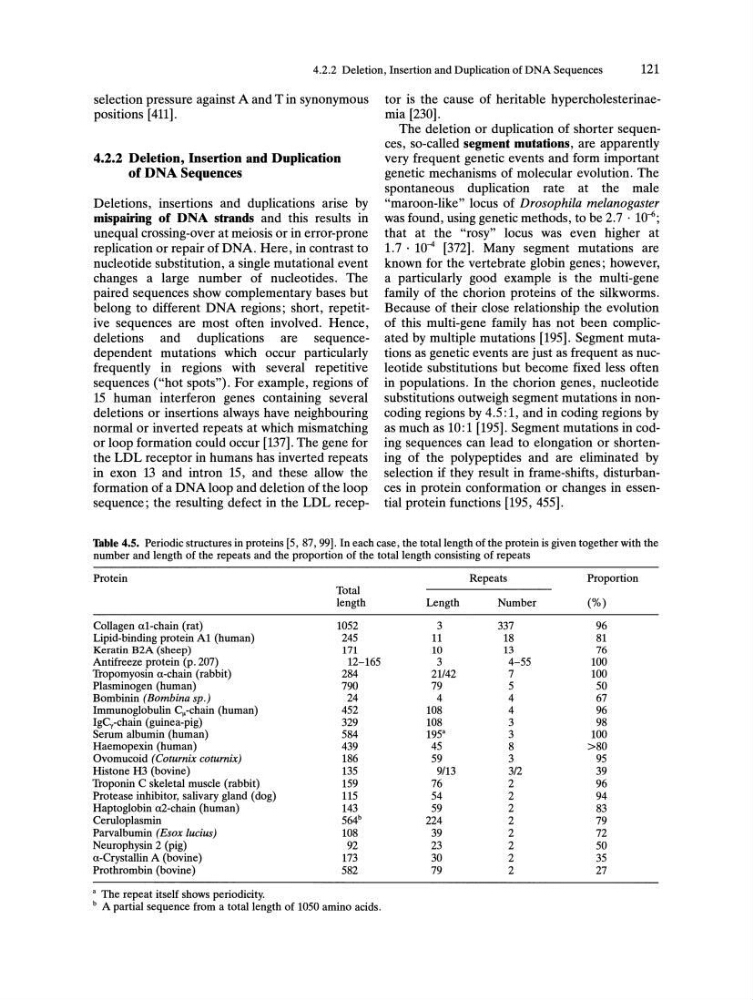
Table 4.5. Periodic structures in proteins [5, 87,99]. In each case, the total length of the protein is given together with the
number and length of the repeats and the proportion of the total length consisting of repeats
Protein
Repeats
Proportion
Total
length
Length
Number
(%)
Collagen aI-chain (rat)
1052
3
337
96
Lipid-binding protein Al (human)
245
11
18
81
Keratin B2A (sheep)
171
10
13
76
Antifreeze protein (p. 207)
12-165
3
4-55
100
Tropomyosin a-chain (rabbit)
284
21/42
7
100
Plasminogen (human)
790
79
5
50
Bombinin (Bombina sp.)
24
4
4
67
Immunoglobulin C~-chain (human)
452
108
4
96
IgCy-chain (guinea-pig)
329
108
3
98
Serum albumin (human)
584
195"
3
100
Haemopexin (human)
439
45
8
>80
Ovomucoid (Cotumix cotumix)
186
59
3
95
Histone H3 (bovine)
135
9/13
3/2
39
Troponin C skeletal muscle (rabbit)
159
76
2
96
Protease inhibitor, salivary gland (dog)
115
54
2
94
Haptoglobin a2-chain (human)
143
59
2
83
Ceruloplasmin
564 b
224
2
79
Parvalbumin (Esox lucius)
108
39
2
72
Neurophysin 2 (pig)
92
23
2
50
a-Crystallin A (bovine)
173
30
2
35
Prothrombin (bovine)
582
79
2
27
" The repeat itself shows periodicity.
b A partial sequence from a total length of 1050 amino acids.
121
selection pressure against A and T in synonymous
positions [411].
4.2.2 Deletion, Insertion and Duplication
of DNA Sequences
Deletions, insertions and duplications arise by
mispairiug of DNA strands and this results in
unequal crossing-over at meiosis or in error-prone
replication or repair of DNA. Here, in contrast to
nucleotide substitution, a single mutational event
changes a large number of nucleotides. The
paired sequences show complementary bases but
belong to different DNA regions; short, repetitive sequences are most often involved. Hence,
deletions and duplications are sequencedependent mutations which occur particularly
frequently in regions with several repetitive
sequences ("hot spots"). For example, regions of
15 human interferon genes containing several
deletions or insertions always have neighbouring
normal or inverted repeats at which mismatching
or loop formation could occur [137]. The gene for
the LDL receptor in humans has inverted repeats
in exon 13 and intron 15, and these allow the
formation of a DNA loop and deletion of the loop
sequence; the resulting defect in the LDL receptor is the cause of heritable hypercholesterinaemia [230].
The deletion or duplication of shorter sequences, so-called segment mutations, are apparently
very frequent genetic events and form important
genetic mechanisms of molecular evolution. The
spontaneous duplication rate at the male
"maroon-like" locus of Drosophila melanogaster
was found, using genetic methods, to be 2.7 . 10-6;
that at the "rosy" locus was even higher at
1. 7 . 10-4 [372]. Many segment mutations are
known for the vertebrate globin genes; however,
a particularly good example is the multi-gene
family of the chorion proteins of the silkworms.
Because of their close relationship the evolution
of this mUlti-gene family has not been complicated by multiple mutations [195]. Segment mutations as genetic events are just as frequent as nucleotide substitutions but become fixed less often
in populations. In the chorion genes, nucleotide
substitutions outweigh segment mutations in noncoding regions by 4.5: 1, and in coding regions by
as much as 10:1 [195]. Segment mutations in coding sequences can lead to elongation or shortening of the polypeptides and are eliminated by
selection if they result in frame-shifts, disturbances in protein conformation or changes in essential protein functions [195, 455].
Table 4.5. Periodic structures in proteins [5, 87,99]. In each case, the total length of the protein is given together with the
number and length of the repeats and the proportion of the total length consisting of repeats
Protein
Repeats
Proportion
Total
length
Length
Number
(%)
Collagen aI-chain (rat)
1052
3
337
96
Lipid-binding protein Al (human)
245
11
18
81
Keratin B2A (sheep)
171
10
13
76
Antifreeze protein (p. 207)
12-165
3
4-55
100
Tropomyosin a-chain (rabbit)
284
21/42
7
100
Plasminogen (human)
790
79
5
50
Bombinin (Bombina sp.)
24
4
4
67
Immunoglobulin C~-chain (human)
452
108
4
96
IgCy-chain (guinea-pig)
329
108
3
98
Serum albumin (human)
584
195"
3
100
Haemopexin (human)
439
45
8
>80
Ovomucoid (Cotumix cotumix)
186
59
3
95
Histone H3 (bovine)
135
9/13
3/2
39
Troponin C skeletal muscle (rabbit)
159
76
2
96
Protease inhibitor, salivary gland (dog)
115
54
2
94
Haptoglobin a2-chain (human)
143
59
2
83
Ceruloplasmin
564 b
224
2
79
Parvalbumin (Esox lucius)
108
39
2
72
Neurophysin 2 (pig)
92
23
2
50
a-Crystallin A (bovine)
173
30
2
35
Prothrombin (bovine)
582
79
2
27
" The repeat itself shows periodicity.
b A partial sequence from a total length of 1050 amino acids.