

112
4 Molecular Evolution
of the many positions in a sequence corresponds
to a character with 20 (protein) or 4 (nucleic acid)
different variants; (7) in contrast to morphological characters, they can usually be widely compared, often among all organisms; and (8) the
convergence of long sequences is very unlikely
and, therefore, numerical methods can be used to
determine genetic relationships; derived phenotypic (e.g. morphological) characters are more
uncertain of the possibility of convergence.
DNA variability is a prerequisite of evolution.
According to the synthetic (neo-Darwinian) theory of evolution, a change in, or the emergence of
a species is based upon the different effects of
selection on genetic variation already available in
the population. Alterations to the DNA as the
carrier of genetic information in the germline
arise because DNA replication and repair are not
error-free [215]. Corresponding changes in
somatic cells may have serious consequences for
cell function and the fate of the whole organism -
one has only to think of the genetic mechanisms
of tumour formation - but are of negligible
importance in evolution. The frequency of error
during DNA replication and repair clearly must
satisfy the need for correctly functioning gene
products but, on the other hand, it should ensure
sufficient variation to allow adaptation to changing conditions. The error frequency itself is quite
clearly the result of selection. Gene duplication
and an excess of non-coding sequences allow a
relatively high variability in the DNA without
endangering the supply of usable gene products.
Mutations arise as genetic events in individuals.
Only after the genetic change has spread through
a population to the extent that it is present in
many individuals, i.e. it is "fixed" in the population, does it have any importance for evolution;
the genetic alterations occurring in the germline
of single individuals become evolutionary events
through their fixation in the population. In nucleotide substitution, for example, it is therefore necessary to distinguish clearly between "mutations"
(genetic) and "substitutions" ( evolutionary).
Whether a newly occurring mutation becomes
fixed in the population or is eliminated depends
upon the effects of selection and change (drift).
Selection affects organisms rather than single
genes. Its effects, however, can be detected in the
whole cascade of gene function, from the nucleic
acids via the proteins to the most complicated
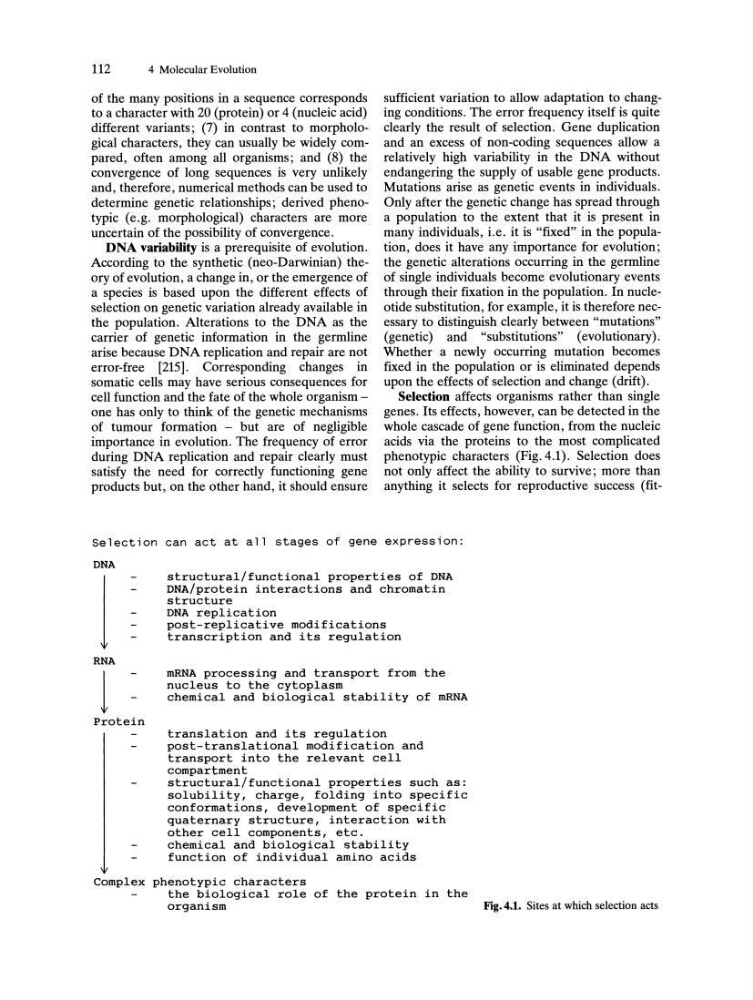
phenotypic characters (Fig. 4.1). Selection does
not only affect the ability to survive; more than
anything it selects for reproductive success (fitSelection can act at all stages of gene expression:
DNA
j
RNA
1
Protein
structural/functional properties of DNA
DNA/protein interactions and chromatin
structure
DNA replication
post-replicative modifications
transcription and its regulation
mRNA processing and transport from the
nucleus to the cytoplasm
chemical and biological stability of mRNA
translation and its regulation
post-translational modification and
transport into the relevant cell
compartment
structural/functional properties such as:
solubility, charge, folding into specific
conformations, development of specific
quaternary structure, interaction with
other cell components, etc.
chemical and biological stability
function of individual amino acids
Complex phenotypic characters
the biological role of the protein in the
organism
Fig.4.1. Sites at which selection acts
4 Molecular Evolution
of the many positions in a sequence corresponds
to a character with 20 (protein) or 4 (nucleic acid)
different variants; (7) in contrast to morphological characters, they can usually be widely compared, often among all organisms; and (8) the
convergence of long sequences is very unlikely
and, therefore, numerical methods can be used to
determine genetic relationships; derived phenotypic (e.g. morphological) characters are more
uncertain of the possibility of convergence.
DNA variability is a prerequisite of evolution.
According to the synthetic (neo-Darwinian) theory of evolution, a change in, or the emergence of
a species is based upon the different effects of
selection on genetic variation already available in
the population. Alterations to the DNA as the
carrier of genetic information in the germline
arise because DNA replication and repair are not
error-free [215]. Corresponding changes in
somatic cells may have serious consequences for
cell function and the fate of the whole organism -
one has only to think of the genetic mechanisms
of tumour formation - but are of negligible
importance in evolution. The frequency of error
during DNA replication and repair clearly must
satisfy the need for correctly functioning gene
products but, on the other hand, it should ensure
sufficient variation to allow adaptation to changing conditions. The error frequency itself is quite
clearly the result of selection. Gene duplication
and an excess of non-coding sequences allow a
relatively high variability in the DNA without
endangering the supply of usable gene products.
Mutations arise as genetic events in individuals.
Only after the genetic change has spread through
a population to the extent that it is present in
many individuals, i.e. it is "fixed" in the population, does it have any importance for evolution;
the genetic alterations occurring in the germline
of single individuals become evolutionary events
through their fixation in the population. In nucleotide substitution, for example, it is therefore necessary to distinguish clearly between "mutations"
(genetic) and "substitutions" ( evolutionary).
Whether a newly occurring mutation becomes
fixed in the population or is eliminated depends
upon the effects of selection and change (drift).
Selection affects organisms rather than single
genes. Its effects, however, can be detected in the
whole cascade of gene function, from the nucleic
acids via the proteins to the most complicated
phenotypic characters (Fig. 4.1). Selection does
not only affect the ability to survive; more than
anything it selects for reproductive success (fitSelection can act at all stages of gene expression:
DNA
j
RNA
1
Protein
structural/functional properties of DNA
DNA/protein interactions and chromatin
structure
DNA replication
post-replicative modifications
transcription and its regulation
mRNA processing and transport from the
nucleus to the cytoplasm
chemical and biological stability of mRNA
translation and its regulation
post-translational modification and
transport into the relevant cell
compartment
structural/functional properties such as:
solubility, charge, folding into specific
conformations, development of specific
quaternary structure, interaction with
other cell components, etc.
chemical and biological stability
function of individual amino acids
Complex phenotypic characters
the biological role of the protein in the
organism
Fig.4.1. Sites at which selection acts