

84
G. Lericolais
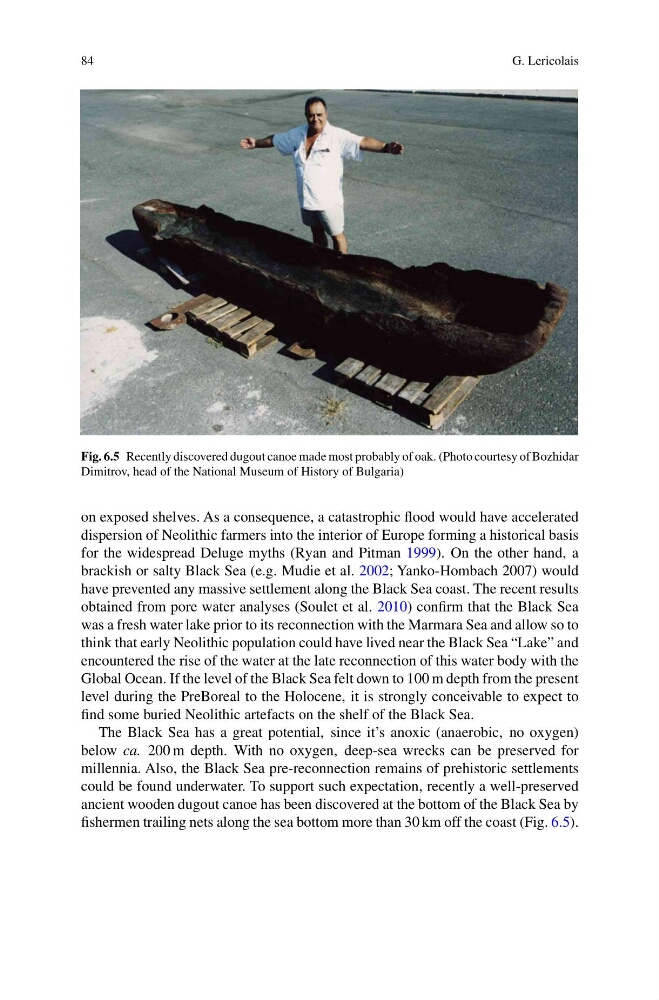
Fig. 6.5 Recently discovered dugout canoe made most probably of oak. (Photo courtesy of Bozhidar
Dimitrov, head of the National Museum of History of Bulgaria)
on exposed shelves. As a consequence, a catastrophic flood would have accelerated
dispersion of Neolithic farmers into the interior of Europe forming a historical basis
for the widespread Deluge myths (Ryan and Pitman 1999). On the other hand, a
brackish or salty Black Sea (e.g. Mudie et al. 2002; Yanko-Hombach 2007) would
have prevented any massive settlement along the Black Sea coast. The recent results
obtained from pore water analyses (Soulet et al. 2010) confirm that the Black Sea
was a fresh water lake prior to its reconnection with the Marmara Sea and allow so to
think that early Neolithic population could have lived near the Black Sea “Lake” and
encountered the rise of the water at the late reconnection of this water body with the
Global Ocean. If the level of the Black Sea felt down to 100 m depth from the present
level during the PreBoreal to the Holocene, it is strongly conceivable to expect to
find some buried Neolithic artefacts on the shelf of the Black Sea.
The Black Sea has a great potential, since it’s anoxic (anaerobic, no oxygen)
below ca. 200 m depth. With no oxygen, deep-sea wrecks can be preserved for
millennia. Also, the Black Sea pre-reconnection remains of prehistoric settlements
could be found underwater. To support such expectation, recently a well-preserved
ancient wooden dugout canoe has been discovered at the bottom of the Black Sea by
fishermen trailing nets along the sea bottom more than 30 km off the coast (Fig. 6.5).
G. Lericolais
Fig. 6.5 Recently discovered dugout canoe made most probably of oak. (Photo courtesy of Bozhidar
Dimitrov, head of the National Museum of History of Bulgaria)
on exposed shelves. As a consequence, a catastrophic flood would have accelerated
dispersion of Neolithic farmers into the interior of Europe forming a historical basis
for the widespread Deluge myths (Ryan and Pitman 1999). On the other hand, a
brackish or salty Black Sea (e.g. Mudie et al. 2002; Yanko-Hombach 2007) would
have prevented any massive settlement along the Black Sea coast. The recent results
obtained from pore water analyses (Soulet et al. 2010) confirm that the Black Sea
was a fresh water lake prior to its reconnection with the Marmara Sea and allow so to
think that early Neolithic population could have lived near the Black Sea “Lake” and
encountered the rise of the water at the late reconnection of this water body with the
Global Ocean. If the level of the Black Sea felt down to 100 m depth from the present
level during the PreBoreal to the Holocene, it is strongly conceivable to expect to
find some buried Neolithic artefacts on the shelf of the Black Sea.
The Black Sea has a great potential, since it’s anoxic (anaerobic, no oxygen)
below ca. 200 m depth. With no oxygen, deep-sea wrecks can be preserved for
millennia. Also, the Black Sea pre-reconnection remains of prehistoric settlements
could be found underwater. To support such expectation, recently a well-preserved
ancient wooden dugout canoe has been discovered at the bottom of the Black Sea by
fishermen trailing nets along the sea bottom more than 30 km off the coast (Fig. 6.5).