

260
A. Collin et al.
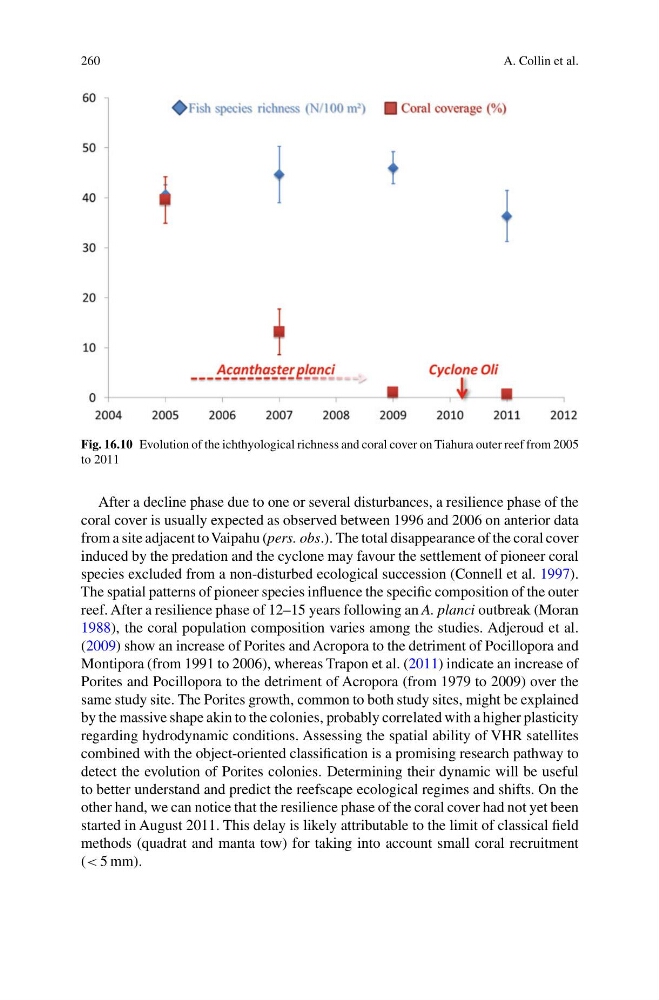
Fig. 16.10 Evolution of the ichthyological richness and coral cover on Tiahura outer reef from 2005
to 2011
After a decline phase due to one or several disturbances, a resilience phase of the
coral cover is usually expected as observed between 1996 and 2006 on anterior data
from a site adjacent to Vaipahu (pers. obs.). The total disappearance of the coral cover
induced by the predation and the cyclone may favour the settlement of pioneer coral
species excluded from a non-disturbed ecological succession (Connell et al. 1997).
The spatial patterns of pioneer species influence the specific composition of the outer
reef. After a resilience phase of 12–15 years following an A. planci outbreak (Moran
1988), the coral population composition varies among the studies. Adjeroud et al.
(2009) show an increase of Porites and Acropora to the detriment of Pocillopora and
Montipora (from 1991 to 2006), whereas Trapon et al. (2011) indicate an increase of
Porites and Pocillopora to the detriment of Acropora (from 1979 to 2009) over the
same study site. The Porites growth, common to both study sites, might be explained
by the massive shape akin to the colonies, probably correlated with a higher plasticity
regarding hydrodynamic conditions. Assessing the spatial ability of VHR satellites
combined with the object-oriented classification is a promising research pathway to
detect the evolution of Porites colonies. Determining their dynamic will be useful
to better understand and predict the reefscape ecological regimes and shifts. On the
other hand, we can notice that the resilience phase of the coral cover had not yet been
started in August 2011. This delay is likely attributable to the limit of classical field
methods (quadrat and manta tow) for taking into account small coral recruitment
(< 5 mm).
A. Collin et al.
Fig. 16.10 Evolution of the ichthyological richness and coral cover on Tiahura outer reef from 2005
to 2011
After a decline phase due to one or several disturbances, a resilience phase of the
coral cover is usually expected as observed between 1996 and 2006 on anterior data
from a site adjacent to Vaipahu (pers. obs.). The total disappearance of the coral cover
induced by the predation and the cyclone may favour the settlement of pioneer coral
species excluded from a non-disturbed ecological succession (Connell et al. 1997).
The spatial patterns of pioneer species influence the specific composition of the outer
reef. After a resilience phase of 12–15 years following an A. planci outbreak (Moran
1988), the coral population composition varies among the studies. Adjeroud et al.
(2009) show an increase of Porites and Acropora to the detriment of Pocillopora and
Montipora (from 1991 to 2006), whereas Trapon et al. (2011) indicate an increase of
Porites and Pocillopora to the detriment of Acropora (from 1979 to 2009) over the
same study site. The Porites growth, common to both study sites, might be explained
by the massive shape akin to the colonies, probably correlated with a higher plasticity
regarding hydrodynamic conditions. Assessing the spatial ability of VHR satellites
combined with the object-oriented classification is a promising research pathway to
detect the evolution of Porites colonies. Determining their dynamic will be useful
to better understand and predict the reefscape ecological regimes and shifts. On the
other hand, we can notice that the resilience phase of the coral cover had not yet been
started in August 2011. This delay is likely attributable to the limit of classical field
methods (quadrat and manta tow) for taking into account small coral recruitment
(< 5 mm).