

13 Can We use a Landscape Approach to Assess Natural and Anthropogenic . . .
207
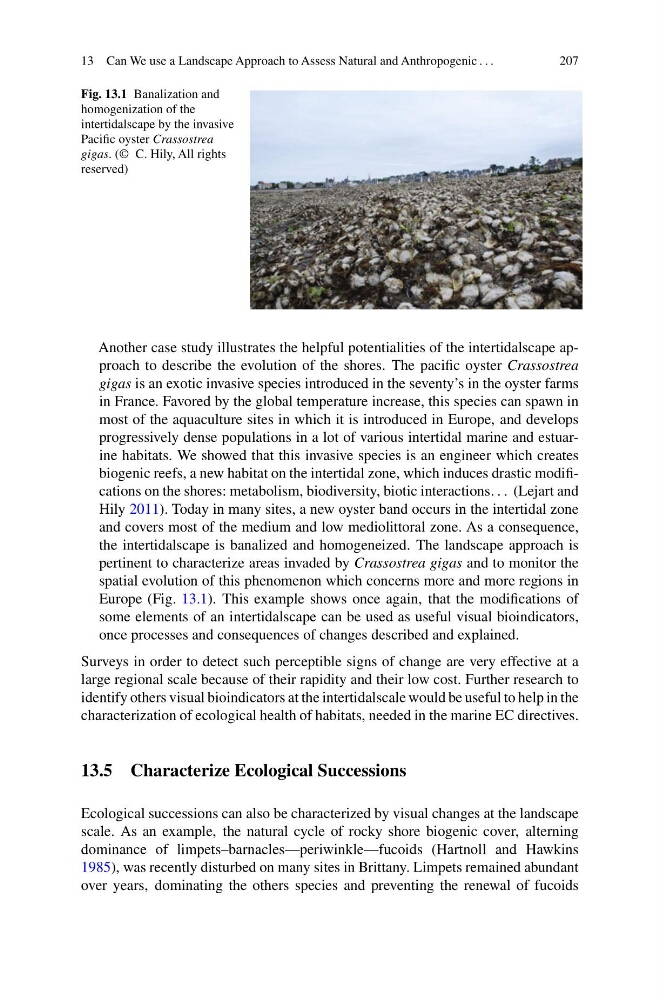
Fig. 13.1 Banalization and
homogenization of the
intertidalscape by the invasive
Pacific oyster Crassostrea
gigas. (© C. Hily, All rights
reserved)
Another case study illustrates the helpful potentialities of the intertidalscape approach to describe the evolution of the shores. The pacific oyster Crassostrea
gigas is an exotic invasive species introduced in the seventy’s in the oyster farms
in France. Favored by the global temperature increase, this species can spawn in
most of the aquaculture sites in which it is introduced in Europe, and develops
progressively dense populations in a lot of various intertidal marine and estuarine habitats. We showed that this invasive species is an engineer which creates
biogenic reefs, a new habitat on the intertidal zone, which induces drastic modifications on the shores: metabolism, biodiversity, biotic interactions. . . (Lejart and
Hily 2011). Today in many sites, a new oyster band occurs in the intertidal zone
and covers most of the medium and low mediolittoral zone. As a consequence,
the intertidalscape is banalized and homogeneized. The landscape approach is
pertinent to characterize areas invaded by Crassostrea gigas and to monitor the
spatial evolution of this phenomenon which concerns more and more regions in
Europe (Fig. 13.1). This example shows once again, that the modifications of
some elements of an intertidalscape can be used as useful visual bioindicators,
once processes and consequences of changes described and explained.
Surveys in order to detect such perceptible signs of change are very effective at a
large regional scale because of their rapidity and their low cost. Further research to
identify others visual bioindicators at the intertidalscale would be useful to help in the
characterization of ecological health of habitats, needed in the marine EC directives.
13.5 Characterize Ecological Successions
Ecological successions can also be characterized by visual changes at the landscape
scale. As an example, the natural cycle of rocky shore biogenic cover, alterning
dominance of limpets–barnacles—periwinkle—fucoids (Hartnoll and Hawkins
1985), was recently disturbed on many sites in Brittany. Limpets remained abundant
over years, dominating the others species and preventing the renewal of fucoids
207
Fig. 13.1 Banalization and
homogenization of the
intertidalscape by the invasive
Pacific oyster Crassostrea
gigas. (© C. Hily, All rights
reserved)
Another case study illustrates the helpful potentialities of the intertidalscape approach to describe the evolution of the shores. The pacific oyster Crassostrea
gigas is an exotic invasive species introduced in the seventy’s in the oyster farms
in France. Favored by the global temperature increase, this species can spawn in
most of the aquaculture sites in which it is introduced in Europe, and develops
progressively dense populations in a lot of various intertidal marine and estuarine habitats. We showed that this invasive species is an engineer which creates
biogenic reefs, a new habitat on the intertidal zone, which induces drastic modifications on the shores: metabolism, biodiversity, biotic interactions. . . (Lejart and
Hily 2011). Today in many sites, a new oyster band occurs in the intertidal zone
and covers most of the medium and low mediolittoral zone. As a consequence,
the intertidalscape is banalized and homogeneized. The landscape approach is
pertinent to characterize areas invaded by Crassostrea gigas and to monitor the
spatial evolution of this phenomenon which concerns more and more regions in
Europe (Fig. 13.1). This example shows once again, that the modifications of
some elements of an intertidalscape can be used as useful visual bioindicators,
once processes and consequences of changes described and explained.
Surveys in order to detect such perceptible signs of change are very effective at a
large regional scale because of their rapidity and their low cost. Further research to
identify others visual bioindicators at the intertidalscale would be useful to help in the
characterization of ecological health of habitats, needed in the marine EC directives.
13.5 Characterize Ecological Successions
Ecological successions can also be characterized by visual changes at the landscape
scale. As an example, the natural cycle of rocky shore biogenic cover, alterning
dominance of limpets–barnacles—periwinkle—fucoids (Hartnoll and Hawkins
1985), was recently disturbed on many sites in Brittany. Limpets remained abundant
over years, dominating the others species and preventing the renewal of fucoids