

12 Habitat 3D Complexity Effects on the Processes Structuring . . .
189
Box 2: The nursery role of Mediteranean Cystoseira forests—from
Cheminée et al. (2013)
In 2009, Cheminée et al. (2013) compared the nursery value of distinct states
of the biocenosis “photophilic macrophytes of the Mediterranean rocky infralittoral biotope”. The study considered two Cystoseira forests (C. crinita
[cr] and C. balearica [ba]) and the less complex bushy assemblage dominated
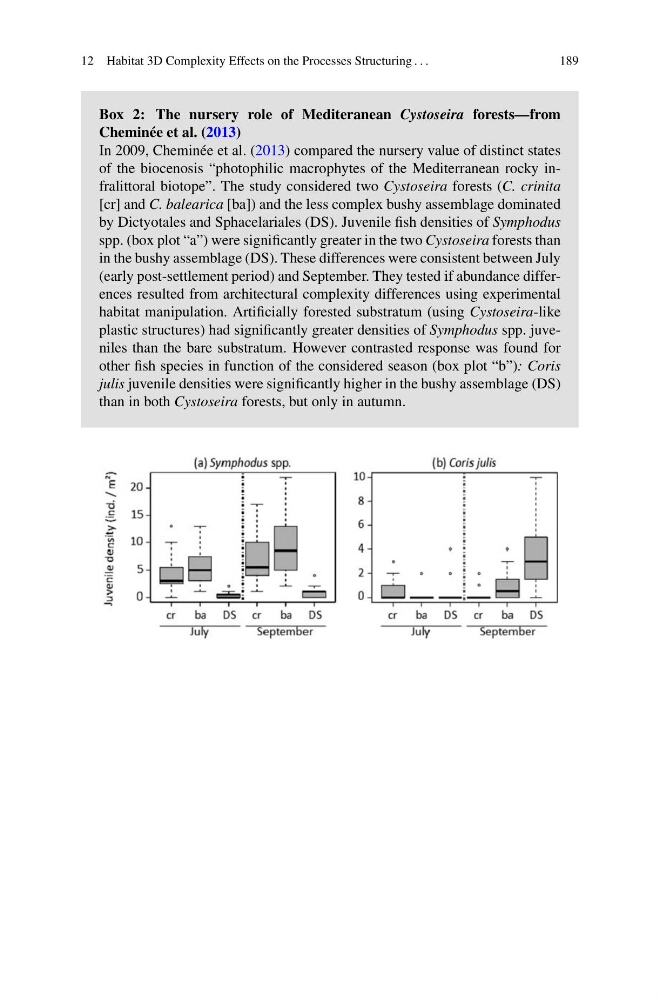
by Dictyotales and Sphacelariales (DS). Juvenile fish densities of Symphodus
spp. (box plot “a”) were significantly greater in the two Cystoseira forests than
in the bushy assemblage (DS). These differences were consistent between July
(early post-settlement period) and September. They tested if abundance differences resulted from architectural complexity differences using experimental
habitat manipulation. Artificially forested substratum (using Cystoseira-like
plastic structures) had significantly greater densities of Symphodus spp. juveniles than the bare substratum. However contrasted response was found for
other fish species in function of the considered season (box plot “b”): Coris
julis juvenile densities were significantly higher in the bushy assemblage (DS)
than in both Cystoseira forests, but only in autumn.
189
Box 2: The nursery role of Mediteranean Cystoseira forests—from
Cheminée et al. (2013)
In 2009, Cheminée et al. (2013) compared the nursery value of distinct states
of the biocenosis “photophilic macrophytes of the Mediterranean rocky infralittoral biotope”. The study considered two Cystoseira forests (C. crinita
[cr] and C. balearica [ba]) and the less complex bushy assemblage dominated
by Dictyotales and Sphacelariales (DS). Juvenile fish densities of Symphodus
spp. (box plot “a”) were significantly greater in the two Cystoseira forests than
in the bushy assemblage (DS). These differences were consistent between July
(early post-settlement period) and September. They tested if abundance differences resulted from architectural complexity differences using experimental
habitat manipulation. Artificially forested substratum (using Cystoseira-like
plastic structures) had significantly greater densities of Symphodus spp. juveniles than the bare substratum. However contrasted response was found for
other fish species in function of the considered season (box plot “b”): Coris
julis juvenile densities were significantly higher in the bushy assemblage (DS)
than in both Cystoseira forests, but only in autumn.