

9 The Underwater Landscape
147
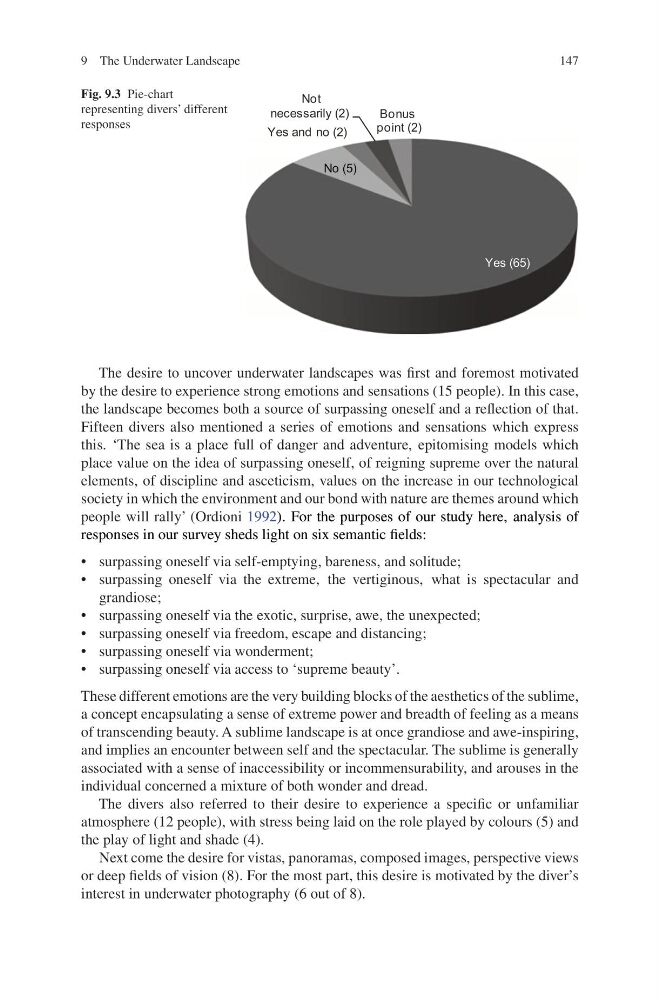
Fig. 9.3 Pie-chart
representing divers’ different
responses
Yes (65)
No (5)
Yes and no (2)
Not
necessarily (2)
Bonus
point (2)
The desire to uncover underwater landscapes was first and foremost motivated
by the desire to experience strong emotions and sensations (15 people). In this case,
the landscape becomes both a source of surpassing oneself and a reflection of that.
Fifteen divers also mentioned a series of emotions and sensations which express
this. ‘The sea is a place full of danger and adventure, epitomising models which
place value on the idea of surpassing oneself, of reigning supreme over the natural
elements, of discipline and asceticism, values on the increase in our technological
society in which the environment and our bond with nature are themes around which
people will rally’ (Ordioni 1992). For the purposes of our study here, analysis of
responses in our survey sheds light on six semantic fields:
• surpassing oneself via self-emptying, bareness, and solitude;
• surpassing oneself via the extreme, the vertiginous, what is spectacular and
grandiose;
• surpassing oneself via the exotic, surprise, awe, the unexpected;
• surpassing oneself via freedom, escape and distancing;
• surpassing oneself via wonderment;
• surpassing oneself via access to ‘supreme beauty’.
These different emotions are the very building blocks of the aesthetics of the sublime,
a concept encapsulating a sense of extreme power and breadth of feeling as a means
of transcending beauty. A sublime landscape is at once grandiose and awe-inspiring,
and implies an encounter between self and the spectacular. The sublime is generally
associated with a sense of inaccessibility or incommensurability, and arouses in the
individual concerned a mixture of both wonder and dread.
The divers also referred to their desire to experience a specific or unfamiliar
atmosphere (12 people), with stress being laid on the role played by colours (5) and
the play of light and shade (4).
Next come the desire for vistas, panoramas, composed images, perspective views
or deep fields of vision (8). For the most part, this desire is motivated by the diver’s
interest in underwater photography (6 out of 8).
147
Fig. 9.3 Pie-chart
representing divers’ different
responses
Yes (65)
No (5)
Yes and no (2)
Not
necessarily (2)
Bonus
point (2)
The desire to uncover underwater landscapes was first and foremost motivated
by the desire to experience strong emotions and sensations (15 people). In this case,
the landscape becomes both a source of surpassing oneself and a reflection of that.
Fifteen divers also mentioned a series of emotions and sensations which express
this. ‘The sea is a place full of danger and adventure, epitomising models which
place value on the idea of surpassing oneself, of reigning supreme over the natural
elements, of discipline and asceticism, values on the increase in our technological
society in which the environment and our bond with nature are themes around which
people will rally’ (Ordioni 1992). For the purposes of our study here, analysis of
responses in our survey sheds light on six semantic fields:
• surpassing oneself via self-emptying, bareness, and solitude;
• surpassing oneself via the extreme, the vertiginous, what is spectacular and
grandiose;
• surpassing oneself via the exotic, surprise, awe, the unexpected;
• surpassing oneself via freedom, escape and distancing;
• surpassing oneself via wonderment;
• surpassing oneself via access to ‘supreme beauty’.
These different emotions are the very building blocks of the aesthetics of the sublime,
a concept encapsulating a sense of extreme power and breadth of feeling as a means
of transcending beauty. A sublime landscape is at once grandiose and awe-inspiring,
and implies an encounter between self and the spectacular. The sublime is generally
associated with a sense of inaccessibility or incommensurability, and arouses in the
individual concerned a mixture of both wonder and dread.
The divers also referred to their desire to experience a specific or unfamiliar
atmosphere (12 people), with stress being laid on the role played by colours (5) and
the play of light and shade (4).
Next come the desire for vistas, panoramas, composed images, perspective views
or deep fields of vision (8). For the most part, this desire is motivated by the diver’s
interest in underwater photography (6 out of 8).