

7 Gaze into the Landscape: Can Sensory Immersion, Landscape Reading and . . .
113
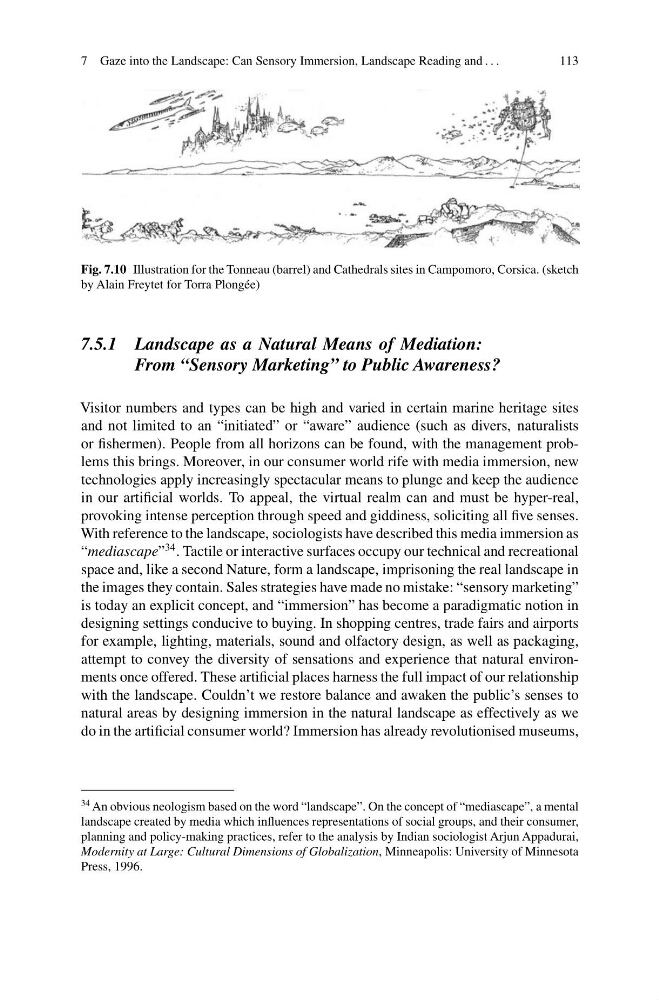
Fig. 7.10 Illustration for the Tonneau (barrel) and Cathedrals sites in Campomoro, Corsica. (sketch
by Alain Freytet for Torra Plongée)
7.5.1 Landscape as a Natural Means of Mediation:
From “Sensory Marketing” to Public Awareness?
Visitor numbers and types can be high and varied in certain marine heritage sites
and not limited to an “initiated” or “aware” audience (such as divers, naturalists
or fishermen). People from all horizons can be found, with the management problems this brings. Moreover, in our consumer world rife with media immersion, new
technologies apply increasingly spectacular means to plunge and keep the audience
in our artificial worlds. To appeal, the virtual realm can and must be hyper-real,
provoking intense perception through speed and giddiness, soliciting all five senses.
With reference to the landscape, sociologists have described this media immersion as
“mediascape”
34 . Tactile or interactive surfaces occupy our technical and recreational
space and, like a second Nature, form a landscape, imprisoning the real landscape in
the images they contain. Sales strategies have made no mistake: “sensory marketing”
is today an explicit concept, and “immersion” has become a paradigmatic notion in
designing settings conducive to buying. In shopping centres, trade fairs and airports
for example, lighting, materials, sound and olfactory design, as well as packaging,
attempt to convey the diversity of sensations and experience that natural environments once offered. These artificial places harness the full impact of our relationship
with the landscape. Couldn’t we restore balance and awaken the public’s senses to
natural areas by designing immersion in the natural landscape as effectively as we
do in the artificial consumer world? Immersion has already revolutionised museums,
34 An obvious neologism based on the word “landscape”. On the concept of “mediascape”, a mental
landscape created by media which influences representations of social groups, and their consumer,
planning and policy-making practices, refer to the analysis by Indian sociologist Arjun Appadurai,
Modernity at Large: Cultural Dimensions of Globalization, Minneapolis: University of Minnesota
Press, 1996.
113
Fig. 7.10 Illustration for the Tonneau (barrel) and Cathedrals sites in Campomoro, Corsica. (sketch
by Alain Freytet for Torra Plongée)
7.5.1 Landscape as a Natural Means of Mediation:
From “Sensory Marketing” to Public Awareness?
Visitor numbers and types can be high and varied in certain marine heritage sites
and not limited to an “initiated” or “aware” audience (such as divers, naturalists
or fishermen). People from all horizons can be found, with the management problems this brings. Moreover, in our consumer world rife with media immersion, new
technologies apply increasingly spectacular means to plunge and keep the audience
in our artificial worlds. To appeal, the virtual realm can and must be hyper-real,
provoking intense perception through speed and giddiness, soliciting all five senses.
With reference to the landscape, sociologists have described this media immersion as
“mediascape”
34 . Tactile or interactive surfaces occupy our technical and recreational
space and, like a second Nature, form a landscape, imprisoning the real landscape in
the images they contain. Sales strategies have made no mistake: “sensory marketing”
is today an explicit concept, and “immersion” has become a paradigmatic notion in
designing settings conducive to buying. In shopping centres, trade fairs and airports
for example, lighting, materials, sound and olfactory design, as well as packaging,
attempt to convey the diversity of sensations and experience that natural environments once offered. These artificial places harness the full impact of our relationship
with the landscape. Couldn’t we restore balance and awaken the public’s senses to
natural areas by designing immersion in the natural landscape as effectively as we
do in the artificial consumer world? Immersion has already revolutionised museums,
34 An obvious neologism based on the word “landscape”. On the concept of “mediascape”, a mental
landscape created by media which influences representations of social groups, and their consumer,
planning and policy-making practices, refer to the analysis by Indian sociologist Arjun Appadurai,
Modernity at Large: Cultural Dimensions of Globalization, Minneapolis: University of Minnesota
Press, 1996.