

80
J. Kuo and C. den Hartog
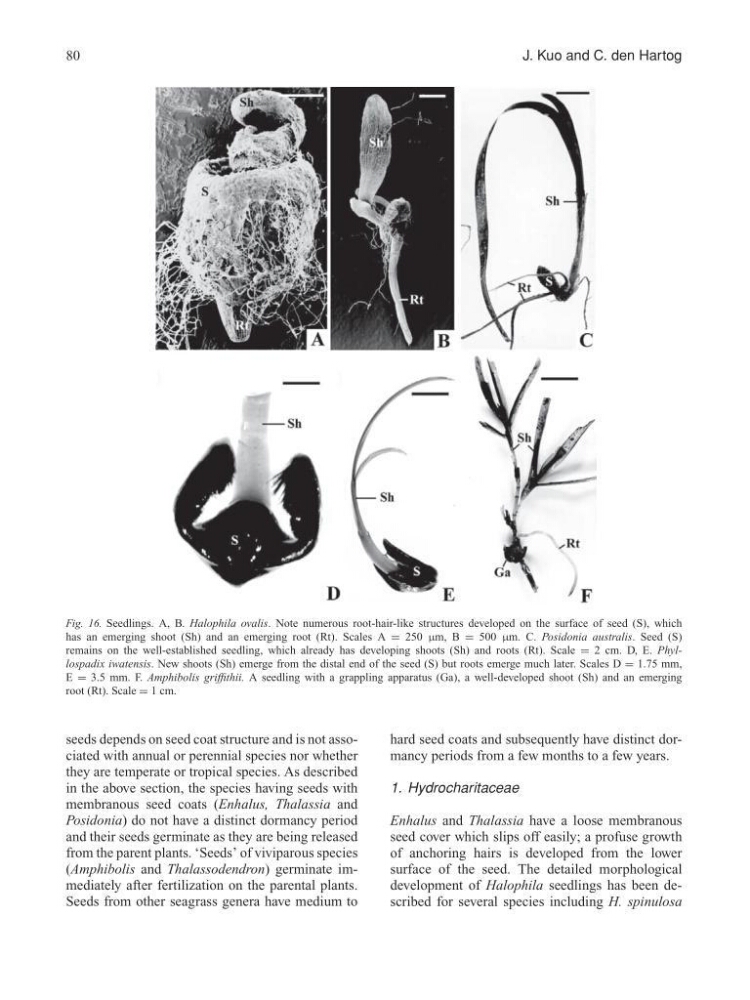
Fig. 16. Seedlings. A, B. Halophila ovalis. Note numerous root-hair-like structures developed on the surface of seed (S), which
has an emerging shoot (Sh) and an emerging root (Rt). Scales A = 250 µm, B = 500 µm. C. Posidonia australis. Seed (S)
remains on the well-established seedling, which already has developing shoots (Sh) and roots (Rt). Scale = 2 cm. D, E. Phyllospadix iwatensis. New shoots (Sh) emerge from the distal end of the seed (S) but roots emerge much later. Scales D = 1.75 mm,
E = 3.5 mm. F. Amphibolis griffithii. A seedling with a grappling apparatus (Ga), a well-developed shoot (Sh) and an emerging
root (Rt). Scale = 1 cm.
seeds depends on seed coat structure and is not associated with annual or perennial species nor whether
they are temperate or tropical species. As described
in the above section, the species having seeds with
membranous seed coats (Enhalus, Thalassia and
Posidonia) do not have a distinct dormancy period
and their seeds germinate as they are being released
from the parent plants. ‘Seeds’ of viviparous species
(Amphibolis and Thalassodendron) germinate immediately after fertilization on the parental plants.
Seeds from other seagrass genera have medium to
hard seed coats and subsequently have distinct dormancy periods from a few months to a few years.
1. Hydrocharitaceae
Enhalus and Thalassia have a loose membranous
seed cover which slips off easily; a profuse growth
of anchoring hairs is developed from the lower
surface of the seed. The detailed morphological
development of Halophila seedlings has been described for several species including H. spinulosa
J. Kuo and C. den Hartog
Fig. 16. Seedlings. A, B. Halophila ovalis. Note numerous root-hair-like structures developed on the surface of seed (S), which
has an emerging shoot (Sh) and an emerging root (Rt). Scales A = 250 µm, B = 500 µm. C. Posidonia australis. Seed (S)
remains on the well-established seedling, which already has developing shoots (Sh) and roots (Rt). Scale = 2 cm. D, E. Phyllospadix iwatensis. New shoots (Sh) emerge from the distal end of the seed (S) but roots emerge much later. Scales D = 1.75 mm,
E = 3.5 mm. F. Amphibolis griffithii. A seedling with a grappling apparatus (Ga), a well-developed shoot (Sh) and an emerging
root (Rt). Scale = 1 cm.
seeds depends on seed coat structure and is not associated with annual or perennial species nor whether
they are temperate or tropical species. As described
in the above section, the species having seeds with
membranous seed coats (Enhalus, Thalassia and
Posidonia) do not have a distinct dormancy period
and their seeds germinate as they are being released
from the parent plants. ‘Seeds’ of viviparous species
(Amphibolis and Thalassodendron) germinate immediately after fertilization on the parental plants.
Seeds from other seagrass genera have medium to
hard seed coats and subsequently have distinct dormancy periods from a few months to a few years.
1. Hydrocharitaceae
Enhalus and Thalassia have a loose membranous
seed cover which slips off easily; a profuse growth
of anchoring hairs is developed from the lower
surface of the seed. The detailed morphological
development of Halophila seedlings has been described for several species including H. spinulosa