

74
J. Kuo and C. den Hartog
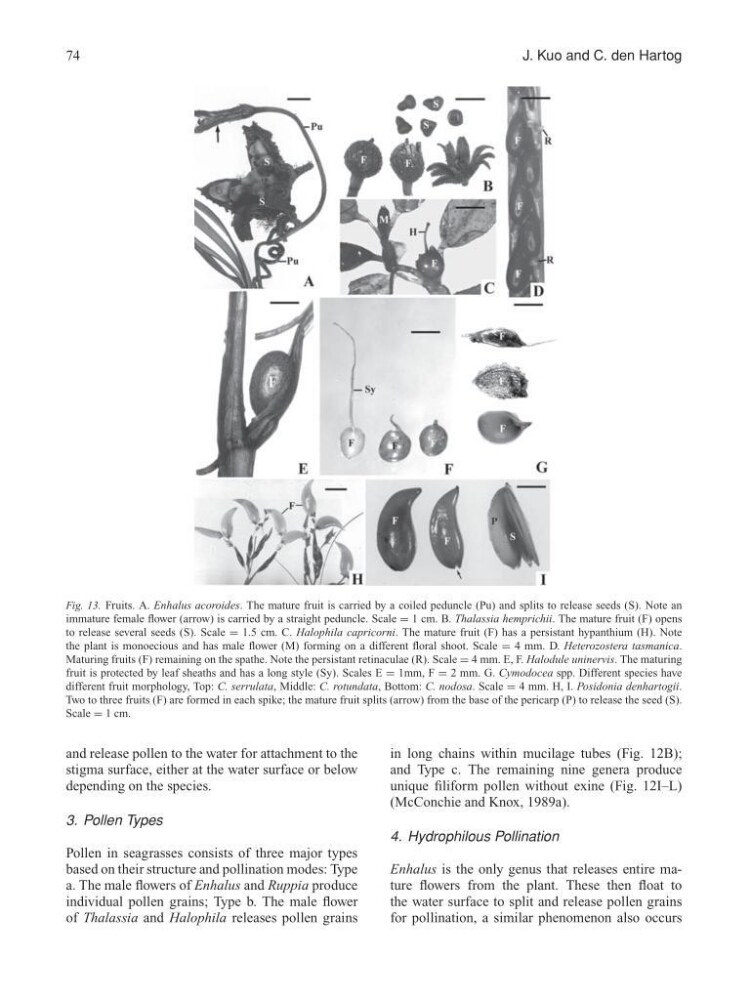
Fig. 13. Fruits. A. Enhalus acoroides. The mature fruit is carried by a coiled peduncle (Pu) and splits to release seeds (S). Note an
immature female flower (arrow) is carried by a straight peduncle. Scale = 1 cm. B. Thalassia hemprichii. The mature fruit (F) opens
to release several seeds (S). Scale = 1.5 cm. C. Halophila capricorni. The mature fruit (F) has a persistant hypanthium (H). Note
the plant is monoecious and has male flower (M) forming on a different floral shoot. Scale = 4 mm. D. Heterozostera tasmanica.
Maturing fruits (F) remaining on the spathe. Note the persistant retinaculae (R). Scale = 4 mm. E, F. Halodule uninervis. The maturing
fruit is protected by leaf sheaths and has a long style (Sy). Scales E = 1mm, F = 2 mm. G. Cymodocea spp. Different species have
different fruit morphology, Top: C. serrulata, Middle: C. rotundata, Bottom: C. nodosa. Scale = 4 mm. H, I. Posidonia denhartogii.
Two to three fruits (F) are formed in each spike; the mature fruit splits (arrow) from the base of the pericarp (P) to release the seed (S).
Scale = 1 cm.
and release pollen to the water for attachment to the
stigma surface, either at the water surface or below
depending on the species.
3. Pollen Types
Pollen in seagrasses consists of three major types
based on their structure and pollination modes: Type
a. The male flowers of Enhalus and Ruppia produce
individual pollen grains; Type b. The male flower
of Thalassia and Halophila releases pollen grains
in long chains within mucilage tubes (Fig. 12B);
and Type c. The remaining nine genera produce
unique filiform pollen without exine (Fig. 12I–L)
(McConchie and Knox, 1989a).
4. Hydrophilous Pollination
Enhalus is the only genus that releases entire mature flowers from the plant. These then float to
the water surface to split and release pollen grains
for pollination, a similar phenomenon also occurs
J. Kuo and C. den Hartog
Fig. 13. Fruits. A. Enhalus acoroides. The mature fruit is carried by a coiled peduncle (Pu) and splits to release seeds (S). Note an
immature female flower (arrow) is carried by a straight peduncle. Scale = 1 cm. B. Thalassia hemprichii. The mature fruit (F) opens
to release several seeds (S). Scale = 1.5 cm. C. Halophila capricorni. The mature fruit (F) has a persistant hypanthium (H). Note
the plant is monoecious and has male flower (M) forming on a different floral shoot. Scale = 4 mm. D. Heterozostera tasmanica.
Maturing fruits (F) remaining on the spathe. Note the persistant retinaculae (R). Scale = 4 mm. E, F. Halodule uninervis. The maturing
fruit is protected by leaf sheaths and has a long style (Sy). Scales E = 1mm, F = 2 mm. G. Cymodocea spp. Different species have
different fruit morphology, Top: C. serrulata, Middle: C. rotundata, Bottom: C. nodosa. Scale = 4 mm. H, I. Posidonia denhartogii.
Two to three fruits (F) are formed in each spike; the mature fruit splits (arrow) from the base of the pericarp (P) to release the seed (S).
Scale = 1 cm.
and release pollen to the water for attachment to the
stigma surface, either at the water surface or below
depending on the species.
3. Pollen Types
Pollen in seagrasses consists of three major types
based on their structure and pollination modes: Type
a. The male flowers of Enhalus and Ruppia produce
individual pollen grains; Type b. The male flower
of Thalassia and Halophila releases pollen grains
in long chains within mucilage tubes (Fig. 12B);
and Type c. The remaining nine genera produce
unique filiform pollen without exine (Fig. 12I–L)
(McConchie and Knox, 1989a).
4. Hydrophilous Pollination
Enhalus is the only genus that releases entire mature flowers from the plant. These then float to
the water surface to split and release pollen grains
for pollination, a similar phenomenon also occurs