

Chapter 3 Seagrass Morphology, Anatomy, and Ultrastructure
71
A
G
H
E
D
F
B
C
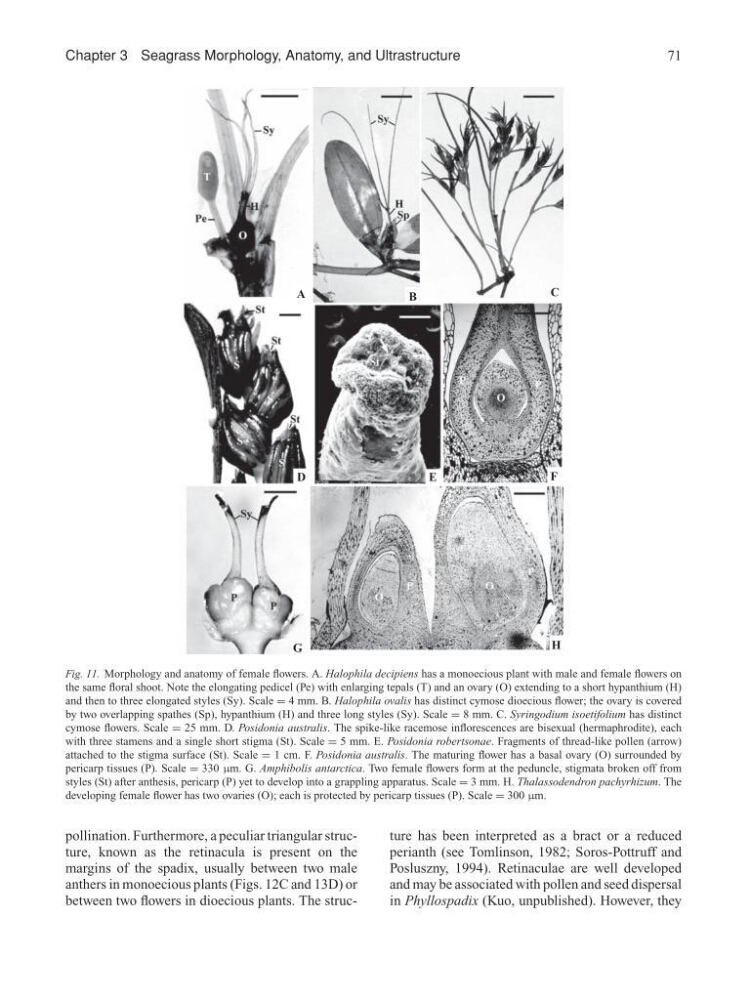
Fig. 11. Morphology and anatomy of female flowers. A. Halophila decipiens has a monoecious plant with male and female flowers on
the same floral shoot. Note the elongating pedicel (Pe) with enlarging tepals (T) and an ovary (O) extending to a short hypanthium (H)
and then to three elongated styles (Sy). Scale = 4 mm. B. Halophila ovalis has distinct cymose dioecious flower; the ovary is covered
by two overlapping spathes (Sp), hypanthium (H) and three long styles (Sy). Scale = 8 mm. C. Syringodium isoetifolium has distinct
cymose flowers. Scale = 25 mm. D. Posidonia australis. The spike-like racemose inflorescences are bisexual (hermaphrodite), each
with three stamens and a single short stigma (St). Scale = 5 mm. E. Posidonia robertsonae. Fragments of thread-like pollen (arrow)
attached to the stigma surface (St). Scale = 1 cm. F. Posidonia australis. The maturing flower has a basal ovary (O) surrounded by
pericarp tissues (P). Scale = 330 µm. G. Amphibolis antarctica. Two female flowers form at the peduncle, stigmata broken off from
styles (St) after anthesis, pericarp (P) yet to develop into a grappling apparatus. Scale = 3 mm. H. Thalassodendron pachyrhizum. The
developing female flower has two ovaries (O); each is protected by pericarp tissues (P). Scale = 300 µm.
pollination. Furthermore, a peculiar triangular structure, known as the retinacula is present on the
margins of the spadix, usually between two male
anthers in monoecious plants (Figs. 12C and 13D) or
between two flowers in dioecious plants. The structure has been interpreted as a bract or a reduced
perianth (see Tomlinson, 1982; Soros-Pottruff and
Posluszny, 1994). Retinaculae are well developed
and may be associated with pollen and seed dispersal
in Phyllospadix (Kuo, unpublished). However, they
71
A
G
H
E
D
F
B
C
Fig. 11. Morphology and anatomy of female flowers. A. Halophila decipiens has a monoecious plant with male and female flowers on
the same floral shoot. Note the elongating pedicel (Pe) with enlarging tepals (T) and an ovary (O) extending to a short hypanthium (H)
and then to three elongated styles (Sy). Scale = 4 mm. B. Halophila ovalis has distinct cymose dioecious flower; the ovary is covered
by two overlapping spathes (Sp), hypanthium (H) and three long styles (Sy). Scale = 8 mm. C. Syringodium isoetifolium has distinct
cymose flowers. Scale = 25 mm. D. Posidonia australis. The spike-like racemose inflorescences are bisexual (hermaphrodite), each
with three stamens and a single short stigma (St). Scale = 5 mm. E. Posidonia robertsonae. Fragments of thread-like pollen (arrow)
attached to the stigma surface (St). Scale = 1 cm. F. Posidonia australis. The maturing flower has a basal ovary (O) surrounded by
pericarp tissues (P). Scale = 330 µm. G. Amphibolis antarctica. Two female flowers form at the peduncle, stigmata broken off from
styles (St) after anthesis, pericarp (P) yet to develop into a grappling apparatus. Scale = 3 mm. H. Thalassodendron pachyrhizum. The
developing female flower has two ovaries (O); each is protected by pericarp tissues (P). Scale = 300 µm.
pollination. Furthermore, a peculiar triangular structure, known as the retinacula is present on the
margins of the spadix, usually between two male
anthers in monoecious plants (Figs. 12C and 13D) or
between two flowers in dioecious plants. The structure has been interpreted as a bract or a reduced
perianth (see Tomlinson, 1982; Soros-Pottruff and
Posluszny, 1994). Retinaculae are well developed
and may be associated with pollen and seed dispersal
in Phyllospadix (Kuo, unpublished). However, they