

58
J. Kuo and C. den Hartog
A
C
E
G
H
F
D
B
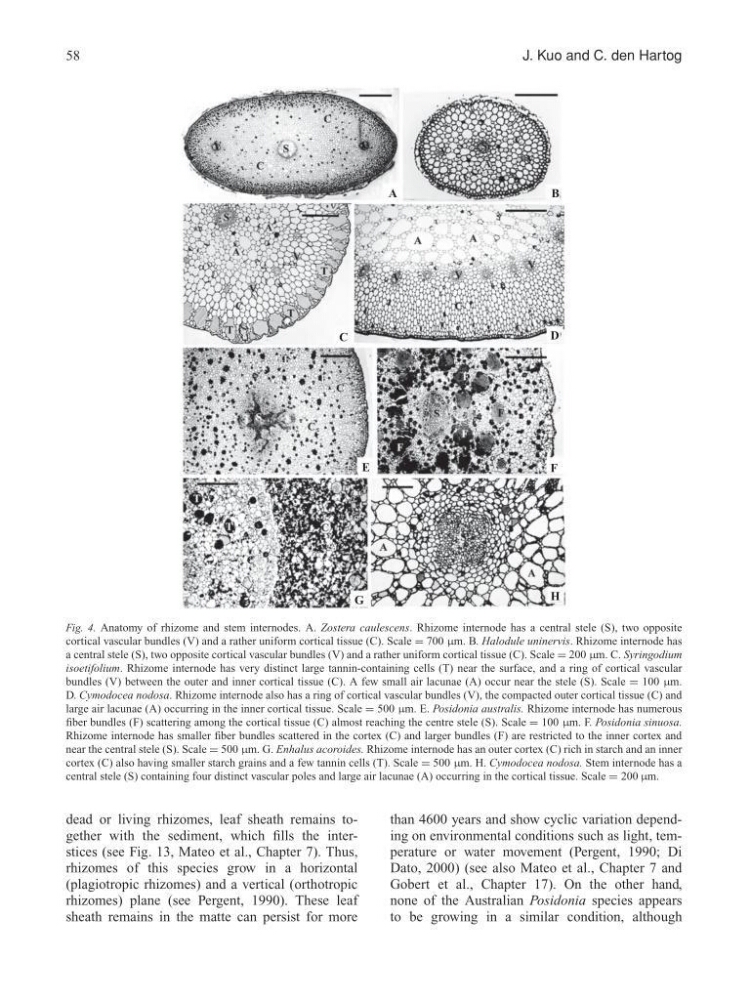
Fig. 4. Anatomy of rhizome and stem internodes. A. Zostera caulescens. Rhizome internode has a central stele (S), two opposite
cortical vascular bundles (V) and a rather uniform cortical tissue (C). Scale = 700 µm. B. Halodule uninervis. Rhizome internode has
a central stele (S), two opposite cortical vascular bundles (V) and a rather uniform cortical tissue (C). Scale = 200 µm. C. Syringodium
isoetifolium. Rhizome internode has very distinct large tannin-containing cells (T) near the surface, and a ring of cortical vascular
bundles (V) between the outer and inner cortical tissue (C). A few small air lacunae (A) occur near the stele (S). Scale = 100 µm.
D. Cymodocea nodosa. Rhizome internode also has a ring of cortical vascular bundles (V), the compacted outer cortical tissue (C) and
large air lacunae (A) occurring in the inner cortical tissue. Scale = 500 µm. E. Posidonia australis. Rhizome internode has numerous
fiber bundles (F) scattering among the cortical tissue (C) almost reaching the centre stele (S). Scale = 100 µm. F. Posidonia sinuosa.
Rhizome internode has smaller fiber bundles scattered in the cortex (C) and larger bundles (F) are restricted to the inner cortex and
near the central stele (S). Scale = 500 µm. G. Enhalus acoroides. Rhizome internode has an outer cortex (C) rich in starch and an inner
cortex (C) also having smaller starch grains and a few tannin cells (T). Scale = 500 µm. H. Cymodocea nodosa. Stem internode has a
central stele (S) containing four distinct vascular poles and large air lacunae (A) occurring in the cortical tissue. Scale = 200 µm.
dead or living rhizomes, leaf sheath remains together with the sediment, which fills the interstices (see Fig. 13, Mateo et al., Chapter 7). Thus,
rhizomes of this species grow in a horizontal
(plagiotropic rhizomes) and a vertical (orthotropic
rhizomes) plane (see Pergent, 1990). These leaf
sheath remains in the matte can persist for more
than 4600 years and show cyclic variation depending on environmental conditions such as light, temperature or water movement (Pergent, 1990; Di
Dato, 2000) (see also Mateo et al., Chapter 7 and
Gobert et al., Chapter 17). On the other hand,
none of the Australian Posidonia species appears
to be growing in a similar condition, although
J. Kuo and C. den Hartog
A
C
E
G
H
F
D
B
Fig. 4. Anatomy of rhizome and stem internodes. A. Zostera caulescens. Rhizome internode has a central stele (S), two opposite
cortical vascular bundles (V) and a rather uniform cortical tissue (C). Scale = 700 µm. B. Halodule uninervis. Rhizome internode has
a central stele (S), two opposite cortical vascular bundles (V) and a rather uniform cortical tissue (C). Scale = 200 µm. C. Syringodium
isoetifolium. Rhizome internode has very distinct large tannin-containing cells (T) near the surface, and a ring of cortical vascular
bundles (V) between the outer and inner cortical tissue (C). A few small air lacunae (A) occur near the stele (S). Scale = 100 µm.
D. Cymodocea nodosa. Rhizome internode also has a ring of cortical vascular bundles (V), the compacted outer cortical tissue (C) and
large air lacunae (A) occurring in the inner cortical tissue. Scale = 500 µm. E. Posidonia australis. Rhizome internode has numerous
fiber bundles (F) scattering among the cortical tissue (C) almost reaching the centre stele (S). Scale = 100 µm. F. Posidonia sinuosa.
Rhizome internode has smaller fiber bundles scattered in the cortex (C) and larger bundles (F) are restricted to the inner cortex and
near the central stele (S). Scale = 500 µm. G. Enhalus acoroides. Rhizome internode has an outer cortex (C) rich in starch and an inner
cortex (C) also having smaller starch grains and a few tannin cells (T). Scale = 500 µm. H. Cymodocea nodosa. Stem internode has a
central stele (S) containing four distinct vascular poles and large air lacunae (A) occurring in the cortical tissue. Scale = 200 µm.
dead or living rhizomes, leaf sheath remains together with the sediment, which fills the interstices (see Fig. 13, Mateo et al., Chapter 7). Thus,
rhizomes of this species grow in a horizontal
(plagiotropic rhizomes) and a vertical (orthotropic
rhizomes) plane (see Pergent, 1990). These leaf
sheath remains in the matte can persist for more
than 4600 years and show cyclic variation depending on environmental conditions such as light, temperature or water movement (Pergent, 1990; Di
Dato, 2000) (see also Mateo et al., Chapter 7 and
Gobert et al., Chapter 17). On the other hand,
none of the Australian Posidonia species appears
to be growing in a similar condition, although