

602
W. Judson Kenworthy et al.
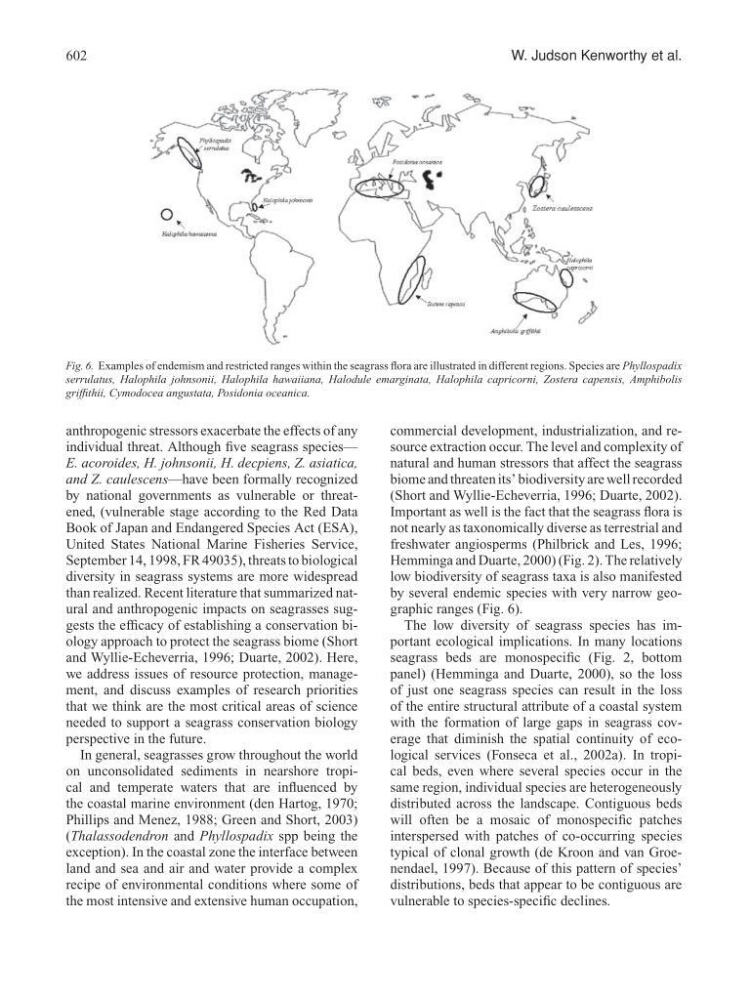
Fig. 6. Examples of endemism and restricted ranges within the seagrass flora are illustrated in different regions. Species are Phyllospadix
serrulatus, Halophila johnsonii, Halophila hawaiiana, Halodule emarginata, Halophila capricorni, Zostera capensis, Amphibolis
griffithii, Cymodocea angustata, Posidonia oceanica.
anthropogenic stressors exacerbate the effects of any
individual threat. Although five seagrass species—
E. acoroides, H. johnsonii, H. decpiens, Z. asiatica,
and Z. caulescens—have been formally recognized
by national governments as vulnerable or threatened, (vulnerable stage according to the Red Data
Book of Japan and Endangered Species Act (ESA),
United States National Marine Fisheries Service,
September 14, 1998, FR 49035), threats to biological
diversity in seagrass systems are more widespread
than realized. Recent literature that summarized natural and anthropogenic impacts on seagrasses suggests the efficacy of establishing a conservation biology approach to protect the seagrass biome (Short
and Wyllie-Echeverria, 1996; Duarte, 2002). Here,
we address issues of resource protection, management, and discuss examples of research priorities
that we think are the most critical areas of science
needed to support a seagrass conservation biology
perspective in the future.
In general, seagrasses grow throughout the world
on unconsolidated sediments in nearshore tropical and temperate waters that are influenced by
the coastal marine environment (den Hartog, 1970;
Phillips and Menez, 1988; Green and Short, 2003)
(Thalassodendron and Phyllospadix spp being the
exception). In the coastal zone the interface between
land and sea and air and water provide a complex
recipe of environmental conditions where some of
the most intensive and extensive human occupation,
commercial development, industrialization, and resource extraction occur. The level and complexity of
natural and human stressors that affect the seagrass
biome and threaten its’ biodiversity are well recorded
(Short and Wyllie-Echeverria, 1996; Duarte, 2002).
Important as well is the fact that the seagrass flora is
not nearly as taxonomically diverse as terrestrial and
freshwater angiosperms (Philbrick and Les, 1996;
Hemminga and Duarte, 2000) (Fig. 2). The relatively
low biodiversity of seagrass taxa is also manifested
by several endemic species with very narrow geographic ranges (Fig. 6).
The low diversity of seagrass species has important ecological implications. In many locations
seagrass beds are monospecific (Fig. 2, bottom
panel) (Hemminga and Duarte, 2000), so the loss
of just one seagrass species can result in the loss
of the entire structural attribute of a coastal system
with the formation of large gaps in seagrass coverage that diminish the spatial continuity of ecological services (Fonseca et al., 2002a). In tropical beds, even where several species occur in the
same region, individual species are heterogeneously
distributed across the landscape. Contiguous beds
will often be a mosaic of monospecific patches
interspersed with patches of co-occurring species
typical of clonal growth (de Kroon and van Groenendael, 1997). Because of this pattern of species’
distributions, beds that appear to be contiguous are
vulnerable to species-specific declines.