

Chapter 2 Seagrass Genetics and Evolution
43
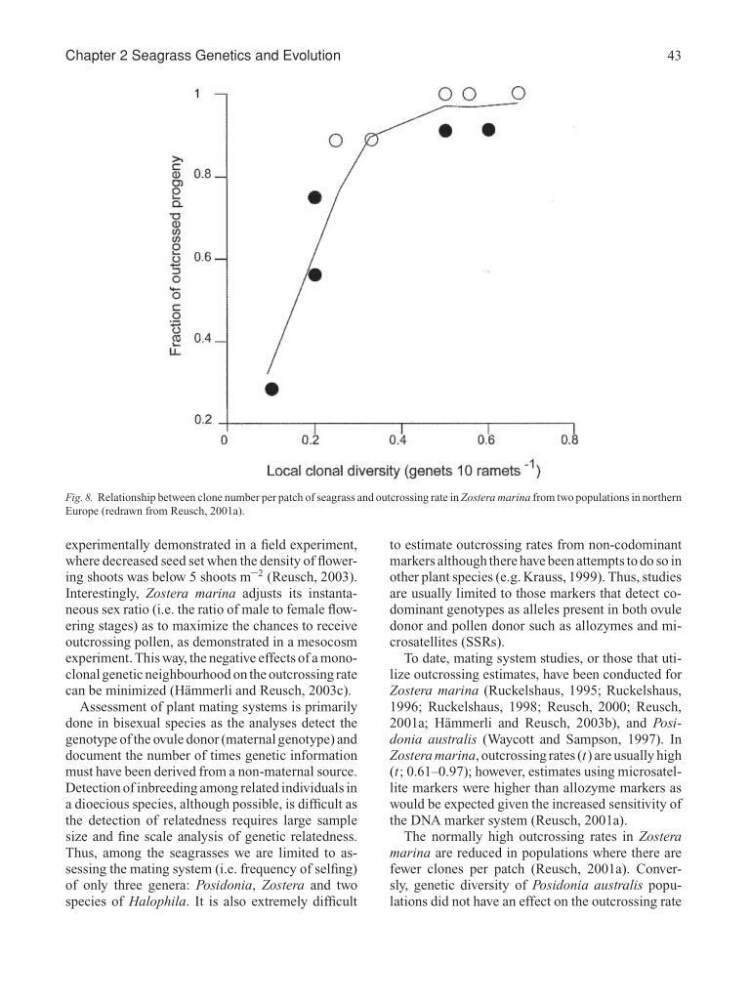
Fig. 8. Relationship between clone number per patch of seagrass and outcrossing rate in Zostera marina from two populations in northern
Europe (redrawn from Reusch, 2001a).
experimentally demonstrated in a field experiment,
where decreased seed set when the density of flowering shoots was below 5 shoots m –2 (Reusch, 2003).
Interestingly, Zostera marina adjusts its instantaneous sex ratio (i.e. the ratio of male to female flowering stages) as to maximize the chances to receive
outcrossing pollen, as demonstrated in a mesocosm
experiment. This way, the negative effects of a monoclonal genetic neighbourhood on the outcrossing rate
can be minimized (H¨ ammerli and Reusch, 2003c).
Assessment of plant mating systems is primarily
done in bisexual species as the analyses detect the
genotype of the ovule donor (maternal genotype) and
document the number of times genetic information
must have been derived from a non-maternal source.
Detection of inbreeding among related individuals in
a dioecious species, although possible, is difficult as
the detection of relatedness requires large sample
size and fine scale analysis of genetic relatedness.
Thus, among the seagrasses we are limited to assessing the mating system (i.e. frequency of selfing)
of only three genera: Posidonia, Zostera and two
species of Halophila. It is also extremely difficult
to estimate outcrossing rates from non-codominant
markers although there have been attempts to do so in
other plant species (e.g. Krauss, 1999). Thus, studies
are usually limited to those markers that detect codominant genotypes as alleles present in both ovule
donor and pollen donor such as allozymes and microsatellites (SSRs).
To date, mating system studies, or those that utilize outcrossing estimates, have been conducted for
Zostera marina (Ruckelshaus, 1995; Ruckelshaus,
1996; Ruckelshaus, 1998; Reusch, 2000; Reusch,
2001a; H¨ ammerli and Reusch, 2003b), and Posidonia australis (Waycott and Sampson, 1997). In
Zostera marina, outcrossing rates (t) are usually high
(t; 0.61–0.97); however, estimates using microsatellite markers were higher than allozyme markers as
would be expected given the increased sensitivity of
the DNA marker system (Reusch, 2001a).
The normally high outcrossing rates in Zostera
marina are reduced in populations where there are
fewer clones per patch (Reusch, 2001a). Conversly, genetic diversity of Posidonia australis populations did not have an effect on the outcrossing rate
43
Fig. 8. Relationship between clone number per patch of seagrass and outcrossing rate in Zostera marina from two populations in northern
Europe (redrawn from Reusch, 2001a).
experimentally demonstrated in a field experiment,
where decreased seed set when the density of flowering shoots was below 5 shoots m –2 (Reusch, 2003).
Interestingly, Zostera marina adjusts its instantaneous sex ratio (i.e. the ratio of male to female flowering stages) as to maximize the chances to receive
outcrossing pollen, as demonstrated in a mesocosm
experiment. This way, the negative effects of a monoclonal genetic neighbourhood on the outcrossing rate
can be minimized (H¨ ammerli and Reusch, 2003c).
Assessment of plant mating systems is primarily
done in bisexual species as the analyses detect the
genotype of the ovule donor (maternal genotype) and
document the number of times genetic information
must have been derived from a non-maternal source.
Detection of inbreeding among related individuals in
a dioecious species, although possible, is difficult as
the detection of relatedness requires large sample
size and fine scale analysis of genetic relatedness.
Thus, among the seagrasses we are limited to assessing the mating system (i.e. frequency of selfing)
of only three genera: Posidonia, Zostera and two
species of Halophila. It is also extremely difficult
to estimate outcrossing rates from non-codominant
markers although there have been attempts to do so in
other plant species (e.g. Krauss, 1999). Thus, studies
are usually limited to those markers that detect codominant genotypes as alleles present in both ovule
donor and pollen donor such as allozymes and microsatellites (SSRs).
To date, mating system studies, or those that utilize outcrossing estimates, have been conducted for
Zostera marina (Ruckelshaus, 1995; Ruckelshaus,
1996; Ruckelshaus, 1998; Reusch, 2000; Reusch,
2001a; H¨ ammerli and Reusch, 2003b), and Posidonia australis (Waycott and Sampson, 1997). In
Zostera marina, outcrossing rates (t) are usually high
(t; 0.61–0.97); however, estimates using microsatellite markers were higher than allozyme markers as
would be expected given the increased sensitivity of
the DNA marker system (Reusch, 2001a).
The normally high outcrossing rates in Zostera
marina are reduced in populations where there are
fewer clones per patch (Reusch, 2001a). Conversly, genetic diversity of Posidonia australis populations did not have an effect on the outcrossing rate