

558
D. I. Walker, G. A. Kendrick, and A. J. McComb
0
500
1000
1500
2000
2500
3000
3500
1965/67
1972
1982
1995
1999
Year
total area of seagrass (ha)
SUCCESS BANK
PARMELIA BANK
COCKBURN SOUND
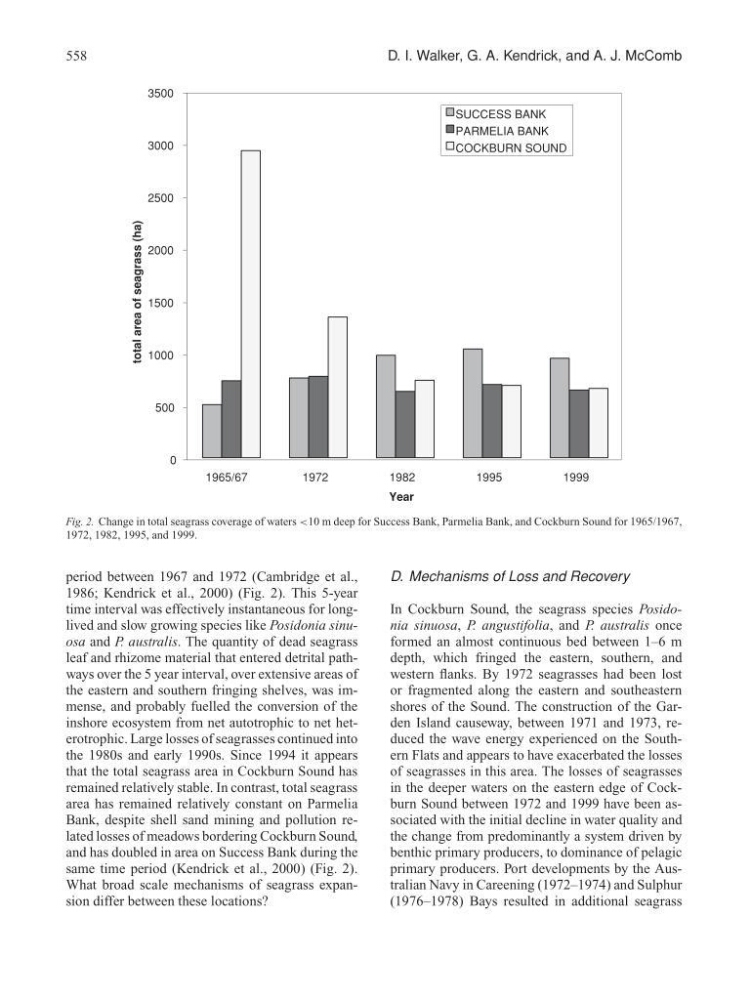
Fig. 2. Change in total seagrass coverage of waters <10 m deep for Success Bank, Parmelia Bank, and Cockburn Sound for 1965/1967,
1972, 1982, 1995, and 1999.
period between 1967 and 1972 (Cambridge et al.,
1986; Kendrick et al., 2000) (Fig. 2). This 5-year
time interval was effectively instantaneous for longlived and slow growing species like Posidonia sinuosa and P. australis. The quantity of dead seagrass
leaf and rhizome material that entered detrital pathways over the 5 year interval, over extensive areas of
the eastern and southern fringing shelves, was immense, and probably fuelled the conversion of the
inshore ecosystem from net autotrophic to net heterotrophic. Large losses of seagrasses continued into
the 1980s and early 1990s. Since 1994 it appears
that the total seagrass area in Cockburn Sound has
remained relatively stable. In contrast, total seagrass
area has remained relatively constant on Parmelia
Bank, despite shell sand mining and pollution related losses of meadows bordering Cockburn Sound,
and has doubled in area on Success Bank during the
same time period (Kendrick et al., 2000) (Fig. 2).
What broad scale mechanisms of seagrass expansion differ between these locations?
D. Mechanisms of Loss and Recovery
In Cockburn Sound, the seagrass species Posidonia sinuosa, P. angustifolia, and P. australis once
formed an almost continuous bed between 1–6 m
depth, which fringed the eastern, southern, and
western flanks. By 1972 seagrasses had been lost
or fragmented along the eastern and southeastern
shores of the Sound. The construction of the Garden Island causeway, between 1971 and 1973, reduced the wave energy experienced on the Southern Flats and appears to have exacerbated the losses
of seagrasses in this area. The losses of seagrasses
in the deeper waters on the eastern edge of Cockburn Sound between 1972 and 1999 have been associated with the initial decline in water quality and
the change from predominantly a system driven by
benthic primary producers, to dominance of pelagic
primary producers. Port developments by the Australian Navy in Careening (1972–1974) and Sulphur
(1976–1978) Bays resulted in additional seagrass
D. I. Walker, G. A. Kendrick, and A. J. McComb
0
500
1000
1500
2000
2500
3000
3500
1965/67
1972
1982
1995
1999
Year
total area of seagrass (ha)
SUCCESS BANK
PARMELIA BANK
COCKBURN SOUND
Fig. 2. Change in total seagrass coverage of waters <10 m deep for Success Bank, Parmelia Bank, and Cockburn Sound for 1965/1967,
1972, 1982, 1995, and 1999.
period between 1967 and 1972 (Cambridge et al.,
1986; Kendrick et al., 2000) (Fig. 2). This 5-year
time interval was effectively instantaneous for longlived and slow growing species like Posidonia sinuosa and P. australis. The quantity of dead seagrass
leaf and rhizome material that entered detrital pathways over the 5 year interval, over extensive areas of
the eastern and southern fringing shelves, was immense, and probably fuelled the conversion of the
inshore ecosystem from net autotrophic to net heterotrophic. Large losses of seagrasses continued into
the 1980s and early 1990s. Since 1994 it appears
that the total seagrass area in Cockburn Sound has
remained relatively stable. In contrast, total seagrass
area has remained relatively constant on Parmelia
Bank, despite shell sand mining and pollution related losses of meadows bordering Cockburn Sound,
and has doubled in area on Success Bank during the
same time period (Kendrick et al., 2000) (Fig. 2).
What broad scale mechanisms of seagrass expansion differ between these locations?
D. Mechanisms of Loss and Recovery
In Cockburn Sound, the seagrass species Posidonia sinuosa, P. angustifolia, and P. australis once
formed an almost continuous bed between 1–6 m
depth, which fringed the eastern, southern, and
western flanks. By 1972 seagrasses had been lost
or fragmented along the eastern and southeastern
shores of the Sound. The construction of the Garden Island causeway, between 1971 and 1973, reduced the wave energy experienced on the Southern Flats and appears to have exacerbated the losses
of seagrasses in this area. The losses of seagrasses
in the deeper waters on the eastern edge of Cockburn Sound between 1972 and 1999 have been associated with the initial decline in water quality and
the change from predominantly a system driven by
benthic primary producers, to dominance of pelagic
primary producers. Port developments by the Australian Navy in Careening (1972–1974) and Sulphur
(1976–1978) Bays resulted in additional seagrass