

Chapter 21 Seagrasses, Fish, and Fisheries
527
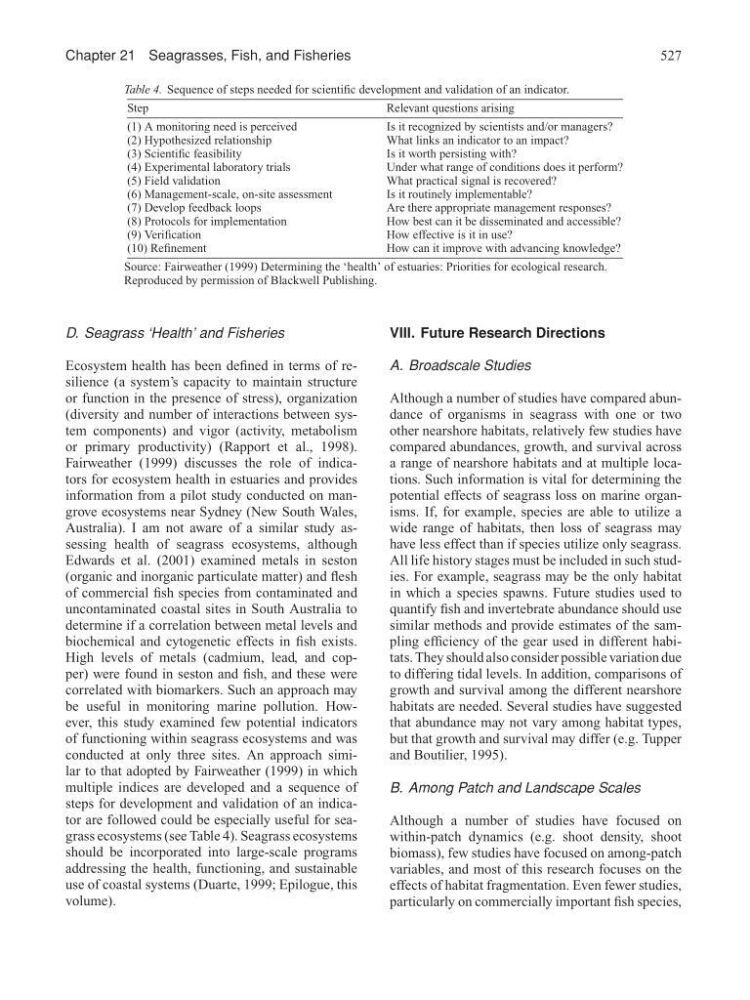
Table 4. Sequence of steps needed for scientific development and validation of an indicator.
Step
Relevant questions arising
(1) A monitoring need is perceived
Is it recognized by scientists and/or managers?
(2) Hypothesized relationship
What links an indicator to an impact?
(3) Scientific feasibility
Is it worth persisting with?
(4) Experimental laboratory trials
Under what range of conditions does it perform?
(5) Field validation
What practical signal is recovered?
(6) Management-scale, on-site assessment
Is it routinely implementable?
(7) Develop feedback loops
Are there appropriate management responses?
(8) Protocols for implementation
How best can it be disseminated and accessible?
(9) Verification
How effective is it in use?
(10) Refinement
How can it improve with advancing knowledge?
Source: Fairweather (1999) Determining the ‘health’ of estuaries: Priorities for ecological research.
Reproduced by permission of Blackwell Publishing.
D. Seagrass ‘Health’ and Fisheries
Ecosystem health has been defined in terms of resilience (a system’s capacity to maintain structure
or function in the presence of stress), organization
(diversity and number of interactions between system components) and vigor (activity, metabolism
or primary productivity) (Rapport et al., 1998).
Fairweather (1999) discusses the role of indicators for ecosystem health in estuaries and provides
information from a pilot study conducted on mangrove ecosystems near Sydney (New South Wales,
Australia). I am not aware of a similar study assessing health of seagrass ecosystems, although
Edwards et al. (2001) examined metals in seston
(organic and inorganic particulate matter) and flesh
of commercial fish species from contaminated and
uncontaminated coastal sites in South Australia to
determine if a correlation between metal levels and
biochemical and cytogenetic effects in fish exists.
High levels of metals (cadmium, lead, and copper) were found in seston and fish, and these were
correlated with biomarkers. Such an approach may
be useful in monitoring marine pollution. However, this study examined few potential indicators
of functioning within seagrass ecosystems and was
conducted at only three sites. An approach similar to that adopted by Fairweather (1999) in which
multiple indices are developed and a sequence of
steps for development and validation of an indicator are followed could be especially useful for seagrass ecosystems (see Table 4). Seagrass ecosystems
should be incorporated into large-scale programs
addressing the health, functioning, and sustainable
use of coastal systems (Duarte, 1999; Epilogue, this
volume).
VIII. Future Research Directions
A. Broadscale Studies
Although a number of studies have compared abundance of organisms in seagrass with one or two
other nearshore habitats, relatively few studies have
compared abundances, growth, and survival across
a range of nearshore habitats and at multiple locations. Such information is vital for determining the
potential effects of seagrass loss on marine organisms. If, for example, species are able to utilize a
wide range of habitats, then loss of seagrass may
have less effect than if species utilize only seagrass.
All life history stages must be included in such studies. For example, seagrass may be the only habitat
in which a species spawns. Future studies used to
quantify fish and invertebrate abundance should use
similar methods and provide estimates of the sampling efficiency of the gear used in different habitats. They should also consider possible variation due
to differing tidal levels. In addition, comparisons of
growth and survival among the different nearshore
habitats are needed. Several studies have suggested
that abundance may not vary among habitat types,
but that growth and survival may differ (e.g. Tupper
and Boutilier, 1995).
B. Among Patch and Landscape Scales
Although a number of studies have focused on
within-patch dynamics (e.g. shoot density, shoot
biomass), few studies have focused on among-patch
variables, and most of this research focuses on the
effects of habitat fragmentation. Even fewer studies,
particularly on commercially important fish species,
527
Table 4. Sequence of steps needed for scientific development and validation of an indicator.
Step
Relevant questions arising
(1) A monitoring need is perceived
Is it recognized by scientists and/or managers?
(2) Hypothesized relationship
What links an indicator to an impact?
(3) Scientific feasibility
Is it worth persisting with?
(4) Experimental laboratory trials
Under what range of conditions does it perform?
(5) Field validation
What practical signal is recovered?
(6) Management-scale, on-site assessment
Is it routinely implementable?
(7) Develop feedback loops
Are there appropriate management responses?
(8) Protocols for implementation
How best can it be disseminated and accessible?
(9) Verification
How effective is it in use?
(10) Refinement
How can it improve with advancing knowledge?
Source: Fairweather (1999) Determining the ‘health’ of estuaries: Priorities for ecological research.
Reproduced by permission of Blackwell Publishing.
D. Seagrass ‘Health’ and Fisheries
Ecosystem health has been defined in terms of resilience (a system’s capacity to maintain structure
or function in the presence of stress), organization
(diversity and number of interactions between system components) and vigor (activity, metabolism
or primary productivity) (Rapport et al., 1998).
Fairweather (1999) discusses the role of indicators for ecosystem health in estuaries and provides
information from a pilot study conducted on mangrove ecosystems near Sydney (New South Wales,
Australia). I am not aware of a similar study assessing health of seagrass ecosystems, although
Edwards et al. (2001) examined metals in seston
(organic and inorganic particulate matter) and flesh
of commercial fish species from contaminated and
uncontaminated coastal sites in South Australia to
determine if a correlation between metal levels and
biochemical and cytogenetic effects in fish exists.
High levels of metals (cadmium, lead, and copper) were found in seston and fish, and these were
correlated with biomarkers. Such an approach may
be useful in monitoring marine pollution. However, this study examined few potential indicators
of functioning within seagrass ecosystems and was
conducted at only three sites. An approach similar to that adopted by Fairweather (1999) in which
multiple indices are developed and a sequence of
steps for development and validation of an indicator are followed could be especially useful for seagrass ecosystems (see Table 4). Seagrass ecosystems
should be incorporated into large-scale programs
addressing the health, functioning, and sustainable
use of coastal systems (Duarte, 1999; Epilogue, this
volume).
VIII. Future Research Directions
A. Broadscale Studies
Although a number of studies have compared abundance of organisms in seagrass with one or two
other nearshore habitats, relatively few studies have
compared abundances, growth, and survival across
a range of nearshore habitats and at multiple locations. Such information is vital for determining the
potential effects of seagrass loss on marine organisms. If, for example, species are able to utilize a
wide range of habitats, then loss of seagrass may
have less effect than if species utilize only seagrass.
All life history stages must be included in such studies. For example, seagrass may be the only habitat
in which a species spawns. Future studies used to
quantify fish and invertebrate abundance should use
similar methods and provide estimates of the sampling efficiency of the gear used in different habitats. They should also consider possible variation due
to differing tidal levels. In addition, comparisons of
growth and survival among the different nearshore
habitats are needed. Several studies have suggested
that abundance may not vary among habitat types,
but that growth and survival may differ (e.g. Tupper
and Boutilier, 1995).
B. Among Patch and Landscape Scales
Although a number of studies have focused on
within-patch dynamics (e.g. shoot density, shoot
biomass), few studies have focused on among-patch
variables, and most of this research focuses on the
effects of habitat fragmentation. Even fewer studies,
particularly on commercially important fish species,