

Chapter 21 Seagrasses, Fish, and Fisheries
523
not suitable for tracing movements of most species
(Hobson, 1999).
More recently, researchers have used tissue assays and related these to geographic areas to investigate animal origins and movement (Hobson,
1999). One such method employs the use of stable isotope ratios (review: Peterson and Fry, 1987).
Animals acquire a natural isotopic tag (or label)
from their diet (e.g. carbon). Animals that move
between isotopically distinct feeding habitats can
retain isotopic information for varying periods of
time, depending on the turnover rate for the tissue
of interest (Hobson, 1999). Fry (1981) measured
the δ
13 C values of migrating brown shrimp (Farfantepenaeus aztecus, Penaeidae) to determine which
habitats shrimp originated from and to determine
which habitats contributed most to the commercial
shrimp fisheries. Such an analysis is dependent on
differences in isotopic signatures between feeding
grounds (e.g. seagrass meadows and phytoplanktondominated open bays). Seagrass beds had isotopic
signatures that were distinct from open bay areas.
As shrimp moved offshore from estuaries, they metabolized away the estuarine carbon in their tissues
as they foraged offshore (Fry, 1981). Non-migratory
offshore shrimp had constant values of δ
13 C that was
similar across the three areas sampled. Migrating
shrimp will rapidly become indistinguishable from
resident shrimp. The effective offshore life of the estuarine tag was predicted to be about 1.1–2.9 months
for female and male shrimp, respectively (Fry, 1981).
Shallow water habitats such as seagrass meadows
were important contributors of shrimp to commercial fisheries. As with food web studies, the utility
of this method is limited by the number of habitats
that are distinguishable, although additional isotopes
(e.g. hydrogen, nitrogen, sulfur) may allow more
habitats to be distinguished. The method also is limited by the growth rate and rate of tissue turnover of
target species (e.g. Fry, 1983).
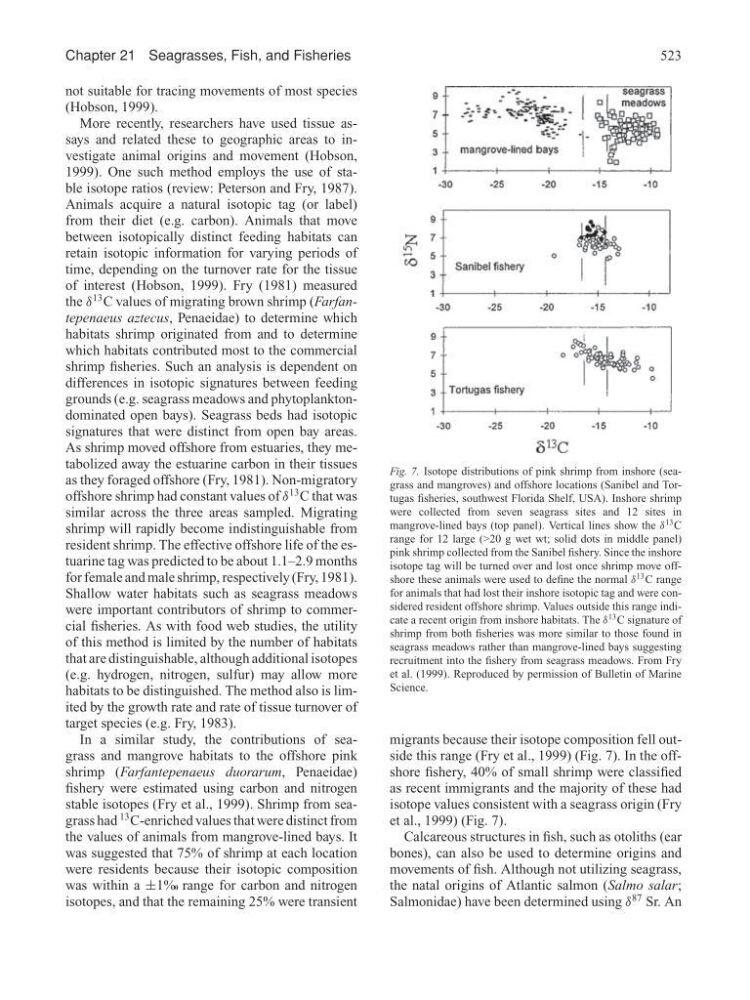
In a similar study, the contributions of seagrass and mangrove habitats to the offshore pink
shrimp (Farfantepenaeus duorarum, Penaeidae)
fishery were estimated using carbon and nitrogen
stable isotopes (Fry et al., 1999). Shrimp from seagrass had
13 C-enriched values that were distinct from
the values of animals from mangrove-lined bays. It
was suggested that 75% of shrimp at each location
were residents because their isotopic composition
was within a ±1%0 range for carbon and nitrogen
isotopes, and that the remaining 25% were transient
Fig. 7. Isotope distributions of pink shrimp from inshore (seagrass and mangroves) and offshore locations (Sanibel and Tortugas fisheries, southwest Florida Shelf, USA). Inshore shrimp
were collected from seven seagrass sites and 12 sites in
mangrove-lined bays (top panel). Vertical lines show the δ
13 C
range for 12 large (>20 g wet wt; solid dots in middle panel)
pink shrimp collected from the Sanibel fishery. Since the inshore
isotope tag will be turned over and lost once shrimp move offshore these animals were used to define the normal δ
13 C range
for animals that had lost their inshore isotopic tag and were considered resident offshore shrimp. Values outside this range indicate a recent origin from inshore habitats. The δ
13 C signature of
shrimp from both fisheries was more similar to those found in
seagrass meadows rather than mangrove-lined bays suggesting
recruitment into the fishery from seagrass meadows. From Fry
et al. (1999). Reproduced by permission of Bulletin of Marine
Science.
migrants because their isotope composition fell outside this range (Fry et al., 1999) (Fig. 7). In the offshore fishery, 40% of small shrimp were classified
as recent immigrants and the majority of these had
isotope values consistent with a seagrass origin (Fry
et al., 1999) (Fig. 7).
Calcareous structures in fish, such as otoliths (ear
bones), can also be used to determine origins and
movements of fish. Although not utilizing seagrass,
the natal origins of Atlantic salmon (Salmo salar;
Salmonidae) have been determined using δ
87 Sr. An
523
not suitable for tracing movements of most species
(Hobson, 1999).
More recently, researchers have used tissue assays and related these to geographic areas to investigate animal origins and movement (Hobson,
1999). One such method employs the use of stable isotope ratios (review: Peterson and Fry, 1987).
Animals acquire a natural isotopic tag (or label)
from their diet (e.g. carbon). Animals that move
between isotopically distinct feeding habitats can
retain isotopic information for varying periods of
time, depending on the turnover rate for the tissue
of interest (Hobson, 1999). Fry (1981) measured
the δ
13 C values of migrating brown shrimp (Farfantepenaeus aztecus, Penaeidae) to determine which
habitats shrimp originated from and to determine
which habitats contributed most to the commercial
shrimp fisheries. Such an analysis is dependent on
differences in isotopic signatures between feeding
grounds (e.g. seagrass meadows and phytoplanktondominated open bays). Seagrass beds had isotopic
signatures that were distinct from open bay areas.
As shrimp moved offshore from estuaries, they metabolized away the estuarine carbon in their tissues
as they foraged offshore (Fry, 1981). Non-migratory
offshore shrimp had constant values of δ
13 C that was
similar across the three areas sampled. Migrating
shrimp will rapidly become indistinguishable from
resident shrimp. The effective offshore life of the estuarine tag was predicted to be about 1.1–2.9 months
for female and male shrimp, respectively (Fry, 1981).
Shallow water habitats such as seagrass meadows
were important contributors of shrimp to commercial fisheries. As with food web studies, the utility
of this method is limited by the number of habitats
that are distinguishable, although additional isotopes
(e.g. hydrogen, nitrogen, sulfur) may allow more
habitats to be distinguished. The method also is limited by the growth rate and rate of tissue turnover of
target species (e.g. Fry, 1983).
In a similar study, the contributions of seagrass and mangrove habitats to the offshore pink
shrimp (Farfantepenaeus duorarum, Penaeidae)
fishery were estimated using carbon and nitrogen
stable isotopes (Fry et al., 1999). Shrimp from seagrass had
13 C-enriched values that were distinct from
the values of animals from mangrove-lined bays. It
was suggested that 75% of shrimp at each location
were residents because their isotopic composition
was within a ±1%0 range for carbon and nitrogen
isotopes, and that the remaining 25% were transient
Fig. 7. Isotope distributions of pink shrimp from inshore (seagrass and mangroves) and offshore locations (Sanibel and Tortugas fisheries, southwest Florida Shelf, USA). Inshore shrimp
were collected from seven seagrass sites and 12 sites in
mangrove-lined bays (top panel). Vertical lines show the δ
13 C
range for 12 large (>20 g wet wt; solid dots in middle panel)
pink shrimp collected from the Sanibel fishery. Since the inshore
isotope tag will be turned over and lost once shrimp move offshore these animals were used to define the normal δ
13 C range
for animals that had lost their inshore isotopic tag and were considered resident offshore shrimp. Values outside this range indicate a recent origin from inshore habitats. The δ
13 C signature of
shrimp from both fisheries was more similar to those found in
seagrass meadows rather than mangrove-lined bays suggesting
recruitment into the fishery from seagrass meadows. From Fry
et al. (1999). Reproduced by permission of Bulletin of Marine
Science.
migrants because their isotope composition fell outside this range (Fry et al., 1999) (Fig. 7). In the offshore fishery, 40% of small shrimp were classified
as recent immigrants and the majority of these had
isotope values consistent with a seagrass origin (Fry
et al., 1999) (Fig. 7).
Calcareous structures in fish, such as otoliths (ear
bones), can also be used to determine origins and
movements of fish. Although not utilizing seagrass,
the natal origins of Atlantic salmon (Salmo salar;
Salmonidae) have been determined using δ
87 Sr. An