

34
Michelle Waycott, Gabriele Procaccini, Donald H. Les and Thorsten B. H. Reusch
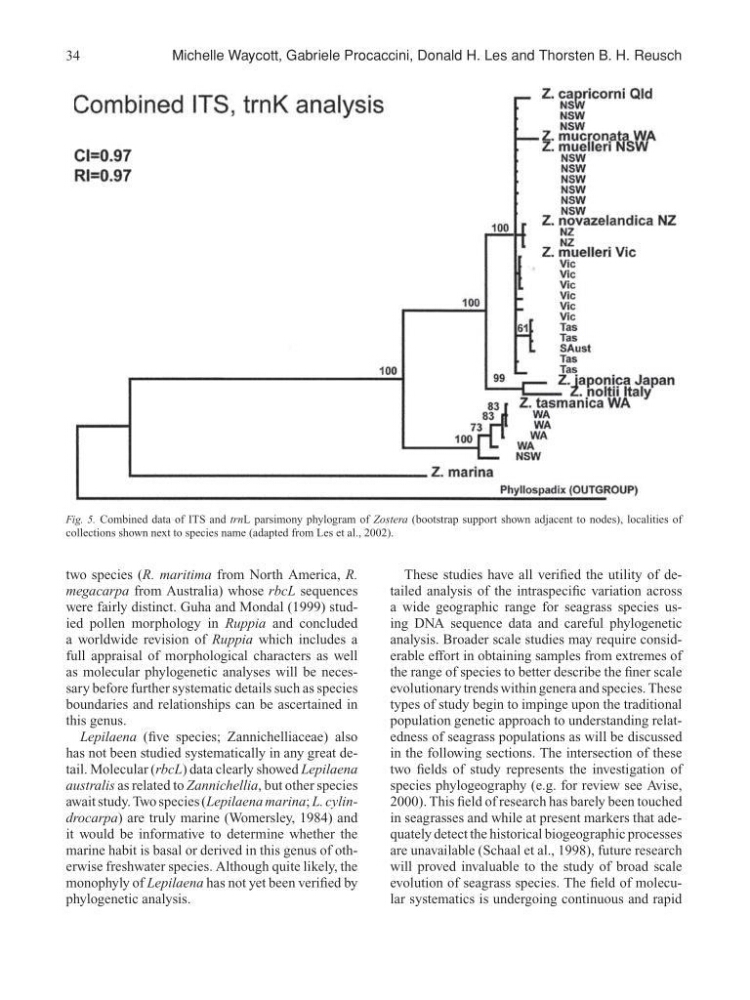
Fig. 5. Combined data of ITS and trnL parsimony phylogram of Zostera (bootstrap support shown adjacent to nodes), localities of
collections shown next to species name (adapted from Les et al., 2002).
two species (R. maritima from North America, R.
megacarpa from Australia) whose rbcL sequences
were fairly distinct. Guha and Mondal (1999) studied pollen morphology in Ruppia and concluded
a worldwide revision of Ruppia which includes a
full appraisal of morphological characters as well
as molecular phylogenetic analyses will be necessary before further systematic details such as species
boundaries and relationships can be ascertained in
this genus.
Lepilaena (five species; Zannichelliaceae) also
has not been studied systematically in any great detail. Molecular (rbcL) data clearly showed Lepilaena
australis as related to Zannichellia, but other species
await study. Two species (Lepilaena marina; L. cylindrocarpa) are truly marine (Womersley, 1984) and
it would be informative to determine whether the
marine habit is basal or derived in this genus of otherwise freshwater species. Although quite likely, the
monophyly of Lepilaena has not yet been verified by
phylogenetic analysis.
These studies have all verified the utility of detailed analysis of the intraspecific variation across
a wide geographic range for seagrass species using DNA sequence data and careful phylogenetic
analysis. Broader scale studies may require considerable effort in obtaining samples from extremes of
the range of species to better describe the finer scale
evolutionary trends within genera and species. These
types of study begin to impinge upon the traditional
population genetic approach to understanding relatedness of seagrass populations as will be discussed
in the following sections. The intersection of these
two fields of study represents the investigation of
species phylogeography (e.g. for review see Avise,
2000). This field of research has barely been touched
in seagrasses and while at present markers that adequately detect the historical biogeographic processes
are unavailable (Schaal et al., 1998), future research
will proved invaluable to the study of broad scale
evolution of seagrass species. The field of molecular systematics is undergoing continuous and rapid
Michelle Waycott, Gabriele Procaccini, Donald H. Les and Thorsten B. H. Reusch
Fig. 5. Combined data of ITS and trnL parsimony phylogram of Zostera (bootstrap support shown adjacent to nodes), localities of
collections shown next to species name (adapted from Les et al., 2002).
two species (R. maritima from North America, R.
megacarpa from Australia) whose rbcL sequences
were fairly distinct. Guha and Mondal (1999) studied pollen morphology in Ruppia and concluded
a worldwide revision of Ruppia which includes a
full appraisal of morphological characters as well
as molecular phylogenetic analyses will be necessary before further systematic details such as species
boundaries and relationships can be ascertained in
this genus.
Lepilaena (five species; Zannichelliaceae) also
has not been studied systematically in any great detail. Molecular (rbcL) data clearly showed Lepilaena
australis as related to Zannichellia, but other species
await study. Two species (Lepilaena marina; L. cylindrocarpa) are truly marine (Womersley, 1984) and
it would be informative to determine whether the
marine habit is basal or derived in this genus of otherwise freshwater species. Although quite likely, the
monophyly of Lepilaena has not yet been verified by
phylogenetic analysis.
These studies have all verified the utility of detailed analysis of the intraspecific variation across
a wide geographic range for seagrass species using DNA sequence data and careful phylogenetic
analysis. Broader scale studies may require considerable effort in obtaining samples from extremes of
the range of species to better describe the finer scale
evolutionary trends within genera and species. These
types of study begin to impinge upon the traditional
population genetic approach to understanding relatedness of seagrass populations as will be discussed
in the following sections. The intersection of these
two fields of study represents the investigation of
species phylogeography (e.g. for review see Avise,
2000). This field of research has barely been touched
in seagrasses and while at present markers that adequately detect the historical biogeographic processes
are unavailable (Schaal et al., 1998), future research
will proved invaluable to the study of broad scale
evolution of seagrass species. The field of molecular systematics is undergoing continuous and rapid