

478
John F. Valentine and J. Emmett Duffy
Ogden and Zieman 1977; Zieman et al. 1984;
McAfee and Morgan 1996; but see Nagelkerken
et al. 2000; Cocheret de la Morini` ere et al. 2003).
For example, the parrotfish Scarus guacamaia and
S. coelestinus have been reported to move up to 500m
inshore from coral reefs to feed (Winn and Bardach
1960; Winn et al. 1964). Away from reefs, juvenile
and smaller species parrotfishes also feed on seagrasses (Ogden and Zieman 1977; Handley 1984;
MacIntyre et al. 1987; McGlathery 1995; McAfee
and Morgan 1996; Kirsch et al. 2002). Once large
enough, many of these juvenile fish abandon structurally simpler seagrass habitats for more structurally complex coral reefs where they appear to find
protection from large piscivorous fishes (Springer
and McErlean 1962; Ogden and Zieman 1977; Dubin and Baker 1982; Handley 1984; Carpenter 1986;
Nagelkerken et al. 2001, 2002; Cocheret de la
Morini` ere et al. 2003). These observations suggest
that the flow of energy from seagrass habitats to coral
reefs can be substantial, but quantitative estimates
are constrained by the limited amount of information on food webs of coral reefs (cf. Polunin 1996).
Investigators have used tethering, stable isotope,
gut content, and reconstructive sampling techniques
to show that seagrasses are readily consumed by
fishes, at times in large quantities, in some areas of the Mediterranean Sea, the Indian and Pacific Oceans (Kirkman and Reid 1979, Klumpp
and Nichols 1983a, b; Hay 1981, 1984a,b; Lewis
1985; Nichols et al. 1985; Nojima and Mukai 1990;
Cebrian et al. 1996a,b; Pinto and Punchihewa 1996;
Marguiller et al. 1997). In virtually every study that
offered seagrass leaves to consumers, they were
readily consumed by herbivores, thereby demonstrating the susceptibility of seagrasses to herbivores
across broad geographic areas.
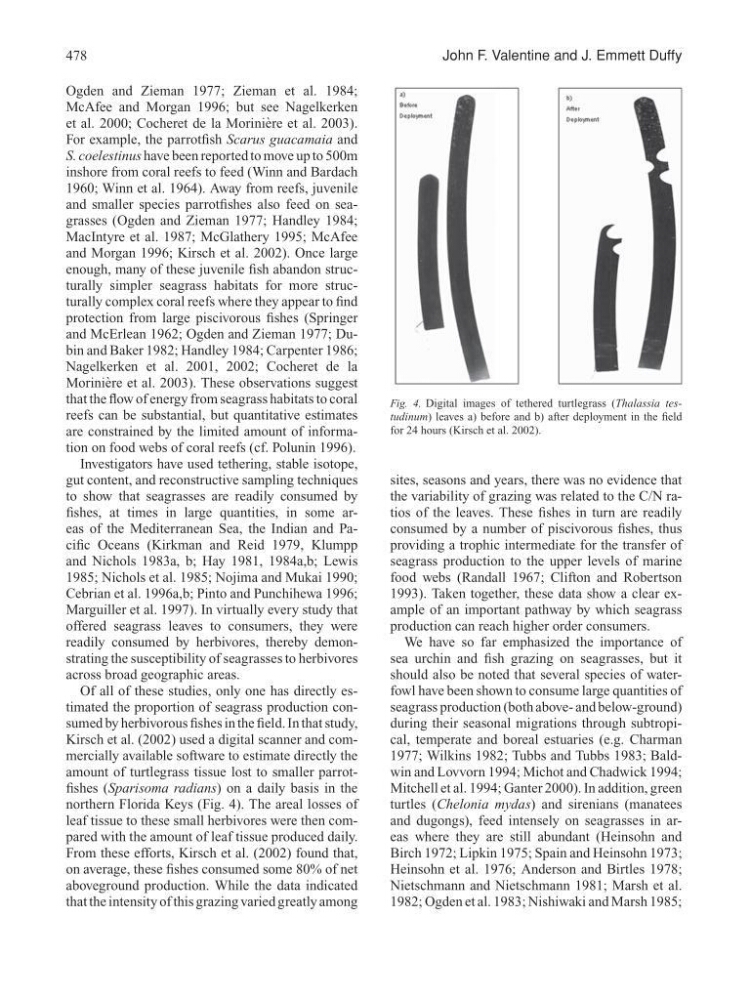
Of all of these studies, only one has directly estimated the proportion of seagrass production consumed by herbivorous fishes in the field. In that study,
Kirsch et al. (2002) used a digital scanner and commercially available software to estimate directly the
amount of turtlegrass tissue lost to smaller parrotfishes (Sparisoma radians) on a daily basis in the
northern Florida Keys (Fig. 4). The areal losses of
leaf tissue to these small herbivores were then compared with the amount of leaf tissue produced daily.
From these efforts, Kirsch et al. (2002) found that,
on average, these fishes consumed some 80% of net
aboveground production. While the data indicated
that the intensity of this grazing varied greatly among
Fig. 4. Digital images of tethered turtlegrass (Thalassia testudinum) leaves a) before and b) after deployment in the field
for 24 hours (Kirsch et al. 2002).
sites, seasons and years, there was no evidence that
the variability of grazing was related to the C/N ratios of the leaves. These fishes in turn are readily
consumed by a number of piscivorous fishes, thus
providing a trophic intermediate for the transfer of
seagrass production to the upper levels of marine
food webs (Randall 1967; Clifton and Robertson
1993). Taken together, these data show a clear example of an important pathway by which seagrass
production can reach higher order consumers.
We have so far emphasized the importance of
sea urchin and fish grazing on seagrasses, but it
should also be noted that several species of waterfowl have been shown to consume large quantities of
seagrass production (both above- and below-ground)
during their seasonal migrations through subtropical, temperate and boreal estuaries (e.g. Charman
1977; Wilkins 1982; Tubbs and Tubbs 1983; Baldwin and Lovvorn 1994; Michot and Chadwick 1994;
Mitchell et al. 1994; Ganter 2000). In addition, green
turtles (Chelonia mydas) and sirenians (manatees
and dugongs), feed intensely on seagrasses in areas where they are still abundant (Heinsohn and
Birch 1972; Lipkin 1975; Spain and Heinsohn 1973;
Heinsohn et al. 1976; Anderson and Birtles 1978;
Nietschmann and Nietschmann 1981; Marsh et al.
1982; Ogden et al. 1983; Nishiwaki and Marsh 1985;
John F. Valentine and J. Emmett Duffy
Ogden and Zieman 1977; Zieman et al. 1984;
McAfee and Morgan 1996; but see Nagelkerken
et al. 2000; Cocheret de la Morini` ere et al. 2003).
For example, the parrotfish Scarus guacamaia and
S. coelestinus have been reported to move up to 500m
inshore from coral reefs to feed (Winn and Bardach
1960; Winn et al. 1964). Away from reefs, juvenile
and smaller species parrotfishes also feed on seagrasses (Ogden and Zieman 1977; Handley 1984;
MacIntyre et al. 1987; McGlathery 1995; McAfee
and Morgan 1996; Kirsch et al. 2002). Once large
enough, many of these juvenile fish abandon structurally simpler seagrass habitats for more structurally complex coral reefs where they appear to find
protection from large piscivorous fishes (Springer
and McErlean 1962; Ogden and Zieman 1977; Dubin and Baker 1982; Handley 1984; Carpenter 1986;
Nagelkerken et al. 2001, 2002; Cocheret de la
Morini` ere et al. 2003). These observations suggest
that the flow of energy from seagrass habitats to coral
reefs can be substantial, but quantitative estimates
are constrained by the limited amount of information on food webs of coral reefs (cf. Polunin 1996).
Investigators have used tethering, stable isotope,
gut content, and reconstructive sampling techniques
to show that seagrasses are readily consumed by
fishes, at times in large quantities, in some areas of the Mediterranean Sea, the Indian and Pacific Oceans (Kirkman and Reid 1979, Klumpp
and Nichols 1983a, b; Hay 1981, 1984a,b; Lewis
1985; Nichols et al. 1985; Nojima and Mukai 1990;
Cebrian et al. 1996a,b; Pinto and Punchihewa 1996;
Marguiller et al. 1997). In virtually every study that
offered seagrass leaves to consumers, they were
readily consumed by herbivores, thereby demonstrating the susceptibility of seagrasses to herbivores
across broad geographic areas.
Of all of these studies, only one has directly estimated the proportion of seagrass production consumed by herbivorous fishes in the field. In that study,
Kirsch et al. (2002) used a digital scanner and commercially available software to estimate directly the
amount of turtlegrass tissue lost to smaller parrotfishes (Sparisoma radians) on a daily basis in the
northern Florida Keys (Fig. 4). The areal losses of
leaf tissue to these small herbivores were then compared with the amount of leaf tissue produced daily.
From these efforts, Kirsch et al. (2002) found that,
on average, these fishes consumed some 80% of net
aboveground production. While the data indicated
that the intensity of this grazing varied greatly among
Fig. 4. Digital images of tethered turtlegrass (Thalassia testudinum) leaves a) before and b) after deployment in the field
for 24 hours (Kirsch et al. 2002).
sites, seasons and years, there was no evidence that
the variability of grazing was related to the C/N ratios of the leaves. These fishes in turn are readily
consumed by a number of piscivorous fishes, thus
providing a trophic intermediate for the transfer of
seagrass production to the upper levels of marine
food webs (Randall 1967; Clifton and Robertson
1993). Taken together, these data show a clear example of an important pathway by which seagrass
production can reach higher order consumers.
We have so far emphasized the importance of
sea urchin and fish grazing on seagrasses, but it
should also be noted that several species of waterfowl have been shown to consume large quantities of
seagrass production (both above- and below-ground)
during their seasonal migrations through subtropical, temperate and boreal estuaries (e.g. Charman
1977; Wilkins 1982; Tubbs and Tubbs 1983; Baldwin and Lovvorn 1994; Michot and Chadwick 1994;
Mitchell et al. 1994; Ganter 2000). In addition, green
turtles (Chelonia mydas) and sirenians (manatees
and dugongs), feed intensely on seagrasses in areas where they are still abundant (Heinsohn and
Birch 1972; Lipkin 1975; Spain and Heinsohn 1973;
Heinsohn et al. 1976; Anderson and Birtles 1978;
Nietschmann and Nietschmann 1981; Marsh et al.
1982; Ogden et al. 1983; Nishiwaki and Marsh 1985;