

Chapter 20 Grazing in Seagrass Ecosystems
467
seagrasses throughout their 50 My history. Many
dugongine sirenians evolved large blade-like tusks
that were probably adaptations to uprooting and
feeding on the large, tough rhizomes of seagrass taxa
such as Thalassia and Zostera. Indeed, after reviewing the fossil history of both seagrasses and sirenians
in the Caribbean region, Domning (2001) concluded
that “for most of the past 50 Ma, Caribbean seagrass
communities have had to withstand sustained grazing pressure from several sympatric lineages of large
mammalian herbivores” (p. 45); “Under these conditions (which prevailed up to about 2-3 Ma), most
primary productivity was presumably consumed by
herbivores, in contrast to the detritus-based seagrass ecosystems of today, which include few if any
large herbivores” (p. 27). These conclusions may
even understate the historical dominance of seagrass grazing given the formerly great abundances of
seagrass-grazing green turtles and perhaps waterfowl (Jackson et al. 2001). Thus, in past times grazing vertebrates in seagrass beds may have been as
important in determining productivity as they were
in terrestrial grasslands (cf. McNaughton 1984).
IV. The Modern Seagrass Community
Interaction Web
Today the situation is quite different. For the most
part, large vertebrate grazers of seagrasses are functionally extinct, due to human exploitation, throughout most of the global ocean (Jackson et al. 2001).
Thus, many modern seagrass ecosystems are of
the detritus-based type, with little seagrass production grazed directly (Fig. 2, Cebri´ an and Duarte
2001; Cebri´ an 1999, 2002; Mateo et al., Chapter
7). Although waterfowl and sparid fishes have locally intense impacts on seagrass biomass in some
areas, the most abundant primary consumers in
most temperate seagrass ecosystems are smaller invertebrate mesograzers that feed mainly on algae
attached to seagrass leaves (Kikuchi 1974; Orth
and van Montfrans 1984; Klumpp et al. 1989; Jernakoff et al. 1996). In many warmer seas, seagrasses are intensely grazed by sea urchins and
some fishes (Thayer et al. 1984; Valentine and Heck
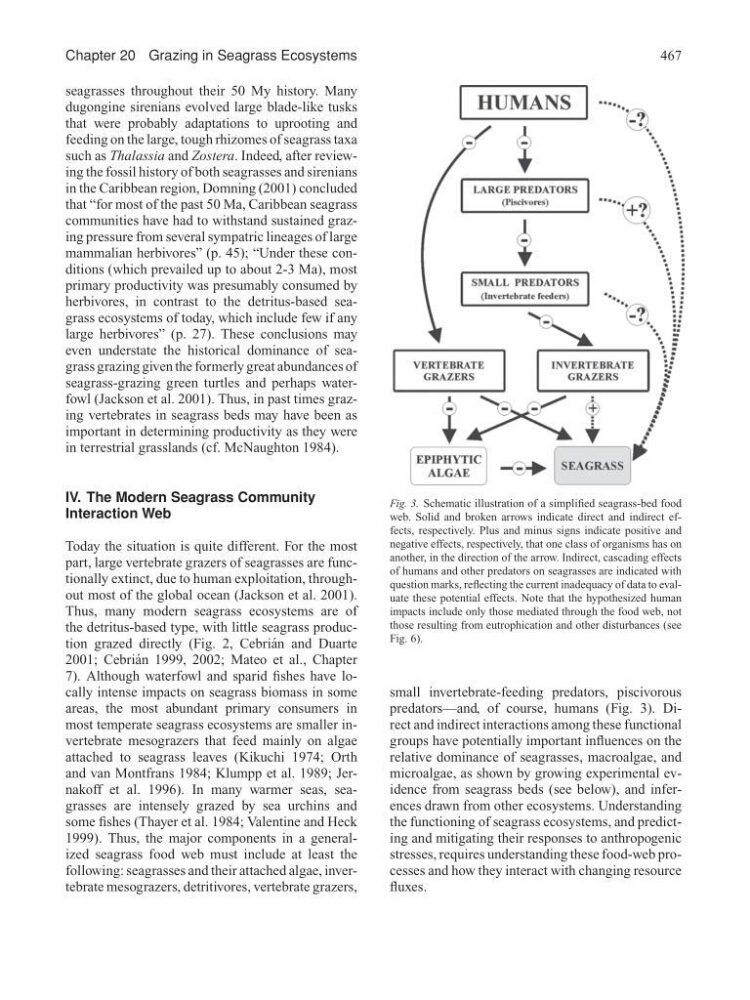
1999). Thus, the major components in a generalized seagrass food web must include at least the
following: seagrasses and their attached algae, invertebrate mesograzers, detritivores, vertebrate grazers,
Fig. 3. Schematic illustration of a simplified seagrass-bed food
web. Solid and broken arrows indicate direct and indirect effects, respectively. Plus and minus signs indicate positive and
negative effects, respectively, that one class of organisms has on
another, in the direction of the arrow. Indirect, cascading effects
of humans and other predators on seagrasses are indicated with
question marks, reflecting the current inadequacy of data to evaluate these potential effects. Note that the hypothesized human
impacts include only those mediated through the food web, not
those resulting from eutrophication and other disturbances (see
Fig. 6).
small invertebrate-feeding predators, piscivorous
predators—and, of course, humans (Fig. 3). Direct and indirect interactions among these functional
groups have potentially important influences on the
relative dominance of seagrasses, macroalgae, and
microalgae, as shown by growing experimental evidence from seagrass beds (see below), and inferences drawn from other ecosystems. Understanding
the functioning of seagrass ecosystems, and predicting and mitigating their responses to anthropogenic
stresses, requires understanding these food-web processes and how they interact with changing resource
fluxes.
467
seagrasses throughout their 50 My history. Many
dugongine sirenians evolved large blade-like tusks
that were probably adaptations to uprooting and
feeding on the large, tough rhizomes of seagrass taxa
such as Thalassia and Zostera. Indeed, after reviewing the fossil history of both seagrasses and sirenians
in the Caribbean region, Domning (2001) concluded
that “for most of the past 50 Ma, Caribbean seagrass
communities have had to withstand sustained grazing pressure from several sympatric lineages of large
mammalian herbivores” (p. 45); “Under these conditions (which prevailed up to about 2-3 Ma), most
primary productivity was presumably consumed by
herbivores, in contrast to the detritus-based seagrass ecosystems of today, which include few if any
large herbivores” (p. 27). These conclusions may
even understate the historical dominance of seagrass grazing given the formerly great abundances of
seagrass-grazing green turtles and perhaps waterfowl (Jackson et al. 2001). Thus, in past times grazing vertebrates in seagrass beds may have been as
important in determining productivity as they were
in terrestrial grasslands (cf. McNaughton 1984).
IV. The Modern Seagrass Community
Interaction Web
Today the situation is quite different. For the most
part, large vertebrate grazers of seagrasses are functionally extinct, due to human exploitation, throughout most of the global ocean (Jackson et al. 2001).
Thus, many modern seagrass ecosystems are of
the detritus-based type, with little seagrass production grazed directly (Fig. 2, Cebri´ an and Duarte
2001; Cebri´ an 1999, 2002; Mateo et al., Chapter
7). Although waterfowl and sparid fishes have locally intense impacts on seagrass biomass in some
areas, the most abundant primary consumers in
most temperate seagrass ecosystems are smaller invertebrate mesograzers that feed mainly on algae
attached to seagrass leaves (Kikuchi 1974; Orth
and van Montfrans 1984; Klumpp et al. 1989; Jernakoff et al. 1996). In many warmer seas, seagrasses are intensely grazed by sea urchins and
some fishes (Thayer et al. 1984; Valentine and Heck
1999). Thus, the major components in a generalized seagrass food web must include at least the
following: seagrasses and their attached algae, invertebrate mesograzers, detritivores, vertebrate grazers,
Fig. 3. Schematic illustration of a simplified seagrass-bed food
web. Solid and broken arrows indicate direct and indirect effects, respectively. Plus and minus signs indicate positive and
negative effects, respectively, that one class of organisms has on
another, in the direction of the arrow. Indirect, cascading effects
of humans and other predators on seagrasses are indicated with
question marks, reflecting the current inadequacy of data to evaluate these potential effects. Note that the hypothesized human
impacts include only those mediated through the food web, not
those resulting from eutrophication and other disturbances (see
Fig. 6).
small invertebrate-feeding predators, piscivorous
predators—and, of course, humans (Fig. 3). Direct and indirect interactions among these functional
groups have potentially important influences on the
relative dominance of seagrasses, macroalgae, and
microalgae, as shown by growing experimental evidence from seagrass beds (see below), and inferences drawn from other ecosystems. Understanding
the functioning of seagrass ecosystems, and predicting and mitigating their responses to anthropogenic
stresses, requires understanding these food-web processes and how they interact with changing resource
fluxes.