

Chapter 18 The Biology of Thalassia
427
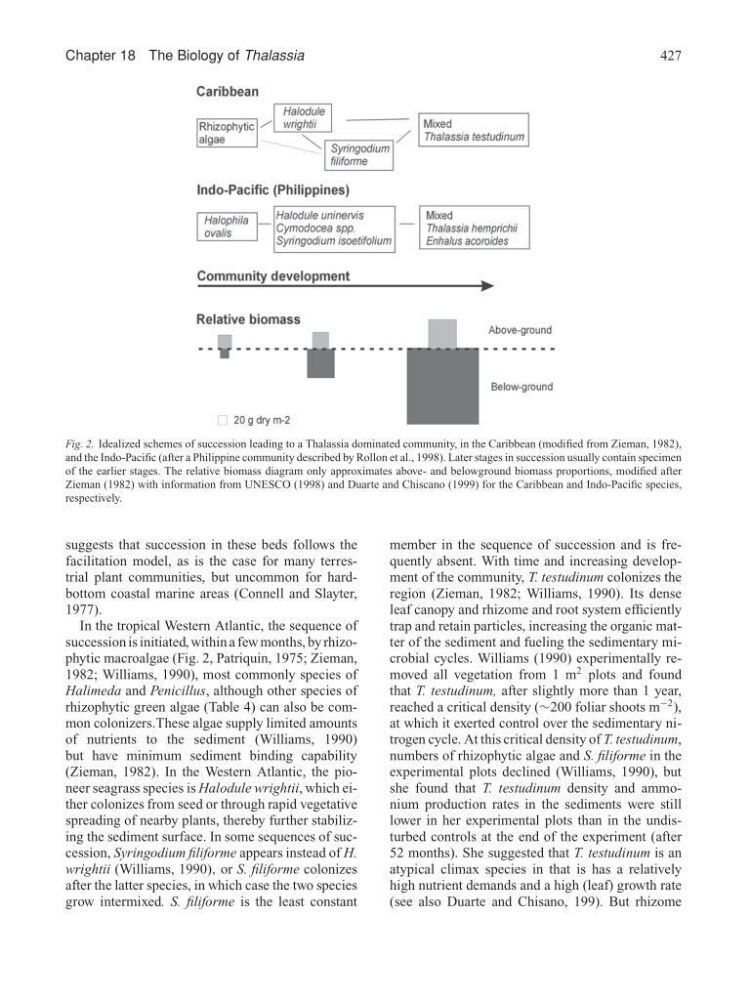
Fig. 2. Idealized schemes of succession leading to a Thalassia dominated community, in the Caribbean (modified from Zieman, 1982),
and the Indo-Pacific (after a Philippine community described by Rollon et al., 1998). Later stages in succession usually contain specimen
of the earlier stages. The relative biomass diagram only approximates above- and belowground biomass proportions, modified after
Zieman (1982) with information from UNESCO (1998) and Duarte and Chiscano (1999) for the Caribbean and Indo-Pacific species,
respectively.
suggests that succession in these beds follows the
facilitation model, as is the case for many terrestrial plant communities, but uncommon for hardbottom coastal marine areas (Connell and Slayter,
1977).
In the tropical Western Atlantic, the sequence of
succession is initiated, within a few months, by rhizophytic macroalgae (Fig. 2, Patriquin, 1975; Zieman,
1982; Williams, 1990), most commonly species of
Halimeda and Penicillus, although other species of
rhizophytic green algae (Table 4) can also be common colonizers.These algae supply limited amounts
of nutrients to the sediment (Williams, 1990)
but have minimum sediment binding capability
(Zieman, 1982). In the Western Atlantic, the pioneer seagrass species is Halodule wrightii, which either colonizes from seed or through rapid vegetative
spreading of nearby plants, thereby further stabilizing the sediment surface. In some sequences of succession, Syringodium filiforme appears instead of H.
wrightii (Williams, 1990), or S. filiforme colonizes
after the latter species, in which case the two species
grow intermixed. S. filiforme is the least constant
member in the sequence of succession and is frequently absent. With time and increasing development of the community, T. testudinum colonizes the
region (Zieman, 1982; Williams, 1990). Its dense
leaf canopy and rhizome and root system efficiently
trap and retain particles, increasing the organic matter of the sediment and fueling the sedimentary microbial cycles. Williams (1990) experimentally removed all vegetation from 1 m
2 plots and found
that T. testudinum, after slightly more than 1 year,
reached a critical density (∼200 foliar shoots m
−2 ),
at which it exerted control over the sedimentary nitrogen cycle. At this critical density of T. testudinum,
numbers of rhizophytic algae and S. filiforme in the
experimental plots declined (Williams, 1990), but
she found that T. testudinum density and ammonium production rates in the sediments were still
lower in her experimental plots than in the undisturbed controls at the end of the experiment (after
52 months). She suggested that T. testudinum is an
atypical climax species in that is has a relatively
high nutrient demands and a high (leaf) growth rate
(see also Duarte and Chisano, 199). But rhizome
427
Fig. 2. Idealized schemes of succession leading to a Thalassia dominated community, in the Caribbean (modified from Zieman, 1982),
and the Indo-Pacific (after a Philippine community described by Rollon et al., 1998). Later stages in succession usually contain specimen
of the earlier stages. The relative biomass diagram only approximates above- and belowground biomass proportions, modified after
Zieman (1982) with information from UNESCO (1998) and Duarte and Chiscano (1999) for the Caribbean and Indo-Pacific species,
respectively.
suggests that succession in these beds follows the
facilitation model, as is the case for many terrestrial plant communities, but uncommon for hardbottom coastal marine areas (Connell and Slayter,
1977).
In the tropical Western Atlantic, the sequence of
succession is initiated, within a few months, by rhizophytic macroalgae (Fig. 2, Patriquin, 1975; Zieman,
1982; Williams, 1990), most commonly species of
Halimeda and Penicillus, although other species of
rhizophytic green algae (Table 4) can also be common colonizers.These algae supply limited amounts
of nutrients to the sediment (Williams, 1990)
but have minimum sediment binding capability
(Zieman, 1982). In the Western Atlantic, the pioneer seagrass species is Halodule wrightii, which either colonizes from seed or through rapid vegetative
spreading of nearby plants, thereby further stabilizing the sediment surface. In some sequences of succession, Syringodium filiforme appears instead of H.
wrightii (Williams, 1990), or S. filiforme colonizes
after the latter species, in which case the two species
grow intermixed. S. filiforme is the least constant
member in the sequence of succession and is frequently absent. With time and increasing development of the community, T. testudinum colonizes the
region (Zieman, 1982; Williams, 1990). Its dense
leaf canopy and rhizome and root system efficiently
trap and retain particles, increasing the organic matter of the sediment and fueling the sedimentary microbial cycles. Williams (1990) experimentally removed all vegetation from 1 m
2 plots and found
that T. testudinum, after slightly more than 1 year,
reached a critical density (∼200 foliar shoots m
−2 ),
at which it exerted control over the sedimentary nitrogen cycle. At this critical density of T. testudinum,
numbers of rhizophytic algae and S. filiforme in the
experimental plots declined (Williams, 1990), but
she found that T. testudinum density and ammonium production rates in the sediments were still
lower in her experimental plots than in the undisturbed controls at the end of the experiment (after
52 months). She suggested that T. testudinum is an
atypical climax species in that is has a relatively
high nutrient demands and a high (leaf) growth rate
(see also Duarte and Chisano, 199). But rhizome