

Chapter 16 Biology of Zostera
375
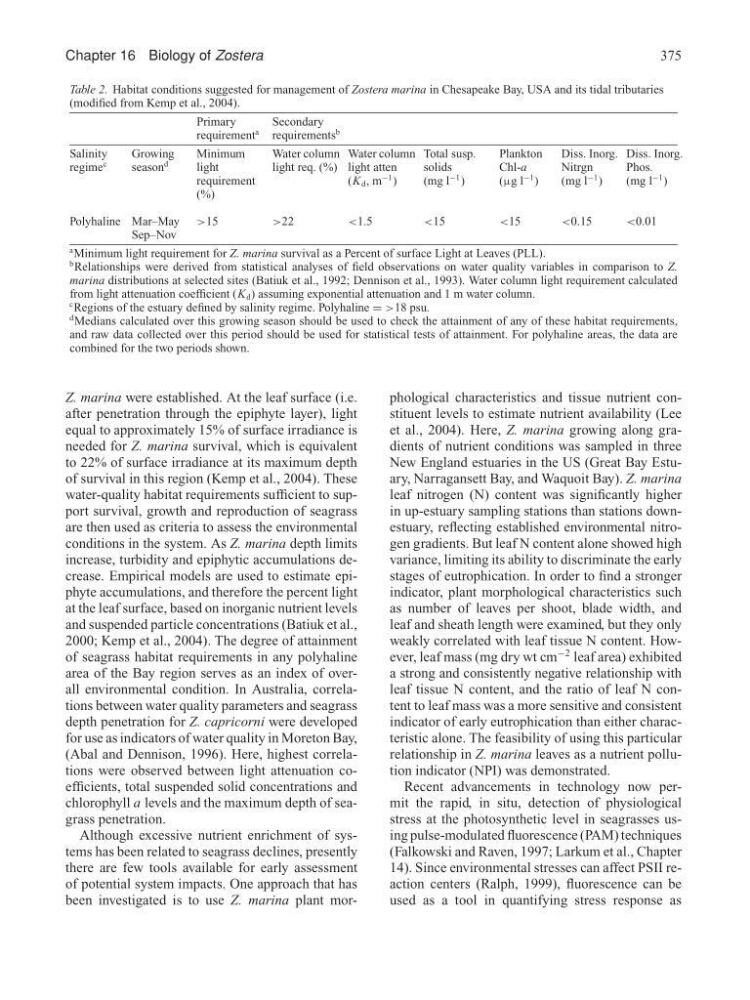
Table 2. Habitat conditions suggested for management of Zostera marina in Chesapeake Bay, USA and its tidal tributaries
(modified from Kemp et al., 2004).
Primary
requirement
a
Secondary
requirements
b
Salinity
regime
c
Growing
season
d
Minimum
light
requirement
(%)
Water column
light req. (%)
Water column
light atten
(K d , m
−1 )
Total susp.
solids
(mg l
−1 )
Plankton
Chl-a
(µg l
−1 )
Diss. Inorg.
Nitrgn
(mg l
−1 )
Diss. Inorg.
Phos.
(mg l
−1 )
Polyhaline Mar–May
Sep–Nov
>15
>22
<1.5
<15
<15
<0.15
<0.01
a Minimum light requirement for Z. marina survival as a Percent of surface Light at Leaves (PLL).
b Relationships were derived from statistical analyses of field observations on water quality variables in comparison to Z.
marina distributions at selected sites (Batiuk et al., 1992; Dennison et al., 1993). Water column light requirement calculated
from light attenuation coefficient (K d ) assuming exponential attenuation and 1 m water column.
c Regions of the estuary defined by salinity regime. Polyhaline = >18 psu.
d Medians calculated over this growing season should be used to check the attainment of any of these habitat requirements,
and raw data collected over this period should be used for statistical tests of attainment. For polyhaline areas, the data are
combined for the two periods shown.
Z. marina were established. At the leaf surface (i.e.
after penetration through the epiphyte layer), light
equal to approximately 15% of surface irradiance is
needed for Z. marina survival, which is equivalent
to 22% of surface irradiance at its maximum depth
of survival in this region (Kemp et al., 2004). These
water-quality habitat requirements sufficient to support survival, growth and reproduction of seagrass
are then used as criteria to assess the environmental
conditions in the system. As Z. marina depth limits
increase, turbidity and epiphytic accumulations decrease. Empirical models are used to estimate epiphyte accumulations, and therefore the percent light
at the leaf surface, based on inorganic nutrient levels
and suspended particle concentrations (Batiuk et al.,
2000; Kemp et al., 2004). The degree of attainment
of seagrass habitat requirements in any polyhaline
area of the Bay region serves as an index of overall environmental condition. In Australia, correlations between water quality parameters and seagrass
depth penetration for Z. capricorni were developed
for use as indicators of water quality in Moreton Bay,
(Abal and Dennison, 1996). Here, highest correlations were observed between light attenuation coefficients, total suspended solid concentrations and
chlorophyll a levels and the maximum depth of seagrass penetration.
Although excessive nutrient enrichment of systems has been related to seagrass declines, presently
there are few tools available for early assessment
of potential system impacts. One approach that has
been investigated is to use Z. marina plant morphological characteristics and tissue nutrient constituent levels to estimate nutrient availability (Lee
et al., 2004). Here, Z. marina growing along gradients of nutrient conditions was sampled in three
New England estuaries in the US (Great Bay Estuary, Narragansett Bay, and Waquoit Bay). Z. marina
leaf nitrogen (N) content was significantly higher
in up-estuary sampling stations than stations downestuary, reflecting established environmental nitrogen gradients. But leaf N content alone showed high
variance, limiting its ability to discriminate the early
stages of eutrophication. In order to find a stronger
indicator, plant morphological characteristics such
as number of leaves per shoot, blade width, and
leaf and sheath length were examined, but they only
weakly correlated with leaf tissue N content. However, leaf mass (mg dry wt cm
−2 leaf area) exhibited
a strong and consistently negative relationship with
leaf tissue N content, and the ratio of leaf N content to leaf mass was a more sensitive and consistent
indicator of early eutrophication than either characteristic alone. The feasibility of using this particular
relationship in Z. marina leaves as a nutrient pollution indicator (NPI) was demonstrated.
Recent advancements in technology now permit the rapid, in situ, detection of physiological
stress at the photosynthetic level in seagrasses using pulse-modulated fluorescence (PAM) techniques
(Falkowski and Raven, 1997; Larkum et al., Chapter
14). Since environmental stresses can affect PSII reaction centers (Ralph, 1999), fluorescence can be
used as a tool in quantifying stress response as
375
Table 2. Habitat conditions suggested for management of Zostera marina in Chesapeake Bay, USA and its tidal tributaries
(modified from Kemp et al., 2004).
Primary
requirement
a
Secondary
requirements
b
Salinity
regime
c
Growing
season
d
Minimum
light
requirement
(%)
Water column
light req. (%)
Water column
light atten
(K d , m
−1 )
Total susp.
solids
(mg l
−1 )
Plankton
Chl-a
(µg l
−1 )
Diss. Inorg.
Nitrgn
(mg l
−1 )
Diss. Inorg.
Phos.
(mg l
−1 )
Polyhaline Mar–May
Sep–Nov
>15
>22
<1.5
<15
<15
<0.15
<0.01
a Minimum light requirement for Z. marina survival as a Percent of surface Light at Leaves (PLL).
b Relationships were derived from statistical analyses of field observations on water quality variables in comparison to Z.
marina distributions at selected sites (Batiuk et al., 1992; Dennison et al., 1993). Water column light requirement calculated
from light attenuation coefficient (K d ) assuming exponential attenuation and 1 m water column.
c Regions of the estuary defined by salinity regime. Polyhaline = >18 psu.
d Medians calculated over this growing season should be used to check the attainment of any of these habitat requirements,
and raw data collected over this period should be used for statistical tests of attainment. For polyhaline areas, the data are
combined for the two periods shown.
Z. marina were established. At the leaf surface (i.e.
after penetration through the epiphyte layer), light
equal to approximately 15% of surface irradiance is
needed for Z. marina survival, which is equivalent
to 22% of surface irradiance at its maximum depth
of survival in this region (Kemp et al., 2004). These
water-quality habitat requirements sufficient to support survival, growth and reproduction of seagrass
are then used as criteria to assess the environmental
conditions in the system. As Z. marina depth limits
increase, turbidity and epiphytic accumulations decrease. Empirical models are used to estimate epiphyte accumulations, and therefore the percent light
at the leaf surface, based on inorganic nutrient levels
and suspended particle concentrations (Batiuk et al.,
2000; Kemp et al., 2004). The degree of attainment
of seagrass habitat requirements in any polyhaline
area of the Bay region serves as an index of overall environmental condition. In Australia, correlations between water quality parameters and seagrass
depth penetration for Z. capricorni were developed
for use as indicators of water quality in Moreton Bay,
(Abal and Dennison, 1996). Here, highest correlations were observed between light attenuation coefficients, total suspended solid concentrations and
chlorophyll a levels and the maximum depth of seagrass penetration.
Although excessive nutrient enrichment of systems has been related to seagrass declines, presently
there are few tools available for early assessment
of potential system impacts. One approach that has
been investigated is to use Z. marina plant morphological characteristics and tissue nutrient constituent levels to estimate nutrient availability (Lee
et al., 2004). Here, Z. marina growing along gradients of nutrient conditions was sampled in three
New England estuaries in the US (Great Bay Estuary, Narragansett Bay, and Waquoit Bay). Z. marina
leaf nitrogen (N) content was significantly higher
in up-estuary sampling stations than stations downestuary, reflecting established environmental nitrogen gradients. But leaf N content alone showed high
variance, limiting its ability to discriminate the early
stages of eutrophication. In order to find a stronger
indicator, plant morphological characteristics such
as number of leaves per shoot, blade width, and
leaf and sheath length were examined, but they only
weakly correlated with leaf tissue N content. However, leaf mass (mg dry wt cm
−2 leaf area) exhibited
a strong and consistently negative relationship with
leaf tissue N content, and the ratio of leaf N content to leaf mass was a more sensitive and consistent
indicator of early eutrophication than either characteristic alone. The feasibility of using this particular
relationship in Z. marina leaves as a nutrient pollution indicator (NPI) was demonstrated.
Recent advancements in technology now permit the rapid, in situ, detection of physiological
stress at the photosynthetic level in seagrasses using pulse-modulated fluorescence (PAM) techniques
(Falkowski and Raven, 1997; Larkum et al., Chapter
14). Since environmental stresses can affect PSII reaction centers (Ralph, 1999), fluorescence can be
used as a tool in quantifying stress response as