

354
A. Dekker, V. Brando, J. Anstee, S. Fyfe, T. Malthus and E. Karpouzli
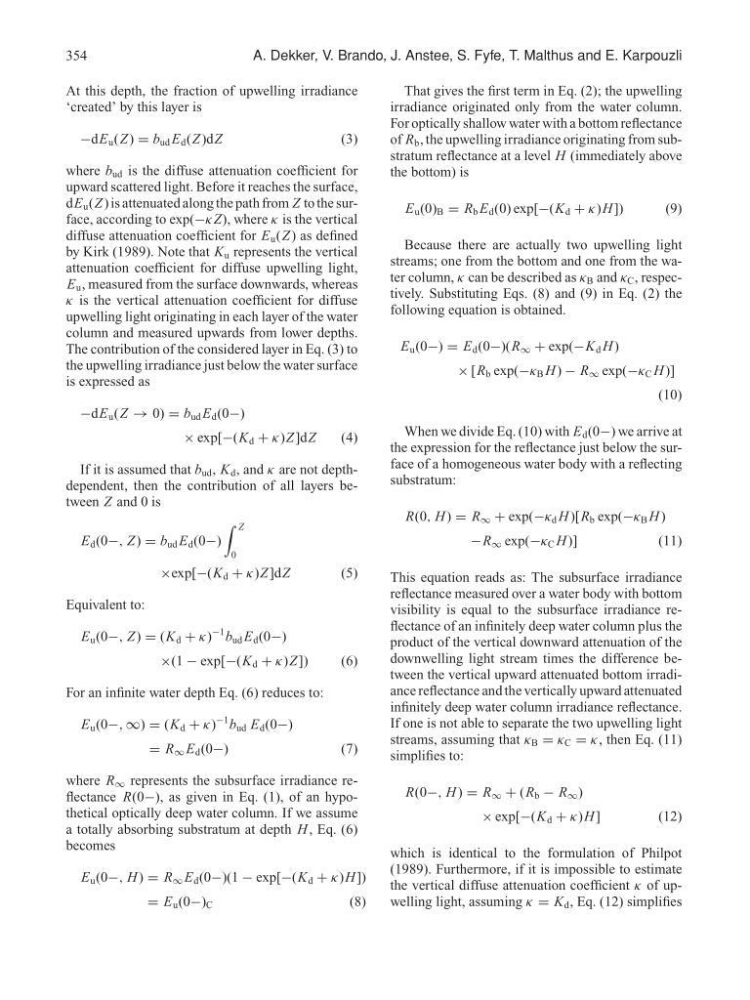
At this depth, the fraction of upwelling irradiance
‘created’ by this layer is
−dE u (Z ) = b ud E d (Z )dZ
(3)
where b ud is the diffuse attenuation coefficient for
upward scattered light. Before it reaches the surface,
dE u (Z ) is attenuated along the path from Z to the surface, according to exp(−κZ), where κ is the vertical
diffuse attenuation coefficient for E u (Z ) as defined
by Kirk (1989). Note that K u represents the vertical
attenuation coefficient for diffuse upwelling light,
E u , measured from the surface downwards, whereas
κ is the vertical attenuation coefficient for diffuse
upwelling light originating in each layer of the water
column and measured upwards from lower depths.
The contribution of the considered layer in Eq. (3) to
the upwelling irradiance just below the water surface
is expressed as
−dE u (Z → 0) = b ud E d (0−)
× exp[−(K d + κ)Z ]dZ
(4)
If it is assumed that b ud , K d , and κ are not depthdependent, then the contribution of all layers between Z and 0 is
E d (0−, Z ) = b ud E d (0−)
Z
0
×exp[−(K d + κ)Z ]dZ
(5)
Equivalent to:
E u (0−, Z ) = (K d + κ)
−1 b ud E d (0−)
×(1 − exp[−(K d + κ)Z ])
(6)
For an infinite water depth Eq. (6) reduces to:
E u (0−, ∞) = (K d + κ)
−1 b ud E d (0−)
= R ∞ E d (0−)
(7)
where R ∞ represents the subsurface irradiance reflectance R(0−), as given in Eq. (1), of an hypothetical optically deep water column. If we assume
a totally absorbing substratum at depth H , Eq. (6)
becomes
E u (0−, H ) = R ∞ E d (0−)(1 − exp[−(K d + κ)H ])
= E u (0−) C
(8)
That gives the first term in Eq. (2); the upwelling
irradiance originated only from the water column.
For optically shallow water with a bottom reflectance
of R b , the upwelling irradiance originating from substratum reflectance at a level H (immediately above
the bottom) is
E u (0) B = R b E d (0) exp[−(K d + κ)H ])
(9)
Because there are actually two upwelling light
streams; one from the bottom and one from the water column, κ can be described as κ B and κ C , respectively. Substituting Eqs. (8) and (9) in Eq. (2) the
following equation is obtained.
E u (0−) = E d (0−)(R ∞ + exp(−K d H )
× [R b exp(−κ B H ) − R ∞ exp(−κ C H )]
(10)
When we divide Eq. (10) with E d (0−) we arrive at
the expression for the reflectance just below the surface of a homogeneous water body with a reflecting
substratum:
R(0, H ) = R ∞ + exp(−κ d H )[R b exp(−κ B H )
−R ∞ exp(−κ C H )]
(11)
This equation reads as: The subsurface irradiance
reflectance measured over a water body with bottom
visibility is equal to the subsurface irradiance reflectance of an infinitely deep water column plus the
product of the vertical downward attenuation of the
downwelling light stream times the difference between the vertical upward attenuated bottom irradiance reflectance and the vertically upward attenuated
infinitely deep water column irradiance reflectance.
If one is not able to separate the two upwelling light
streams, assuming that κ B = κ C = κ, then Eq. (11)
simplifies to:
R(0−, H ) = R ∞ + (R b − R ∞ )
× exp[−(K d + κ)H ]
(12)
which is identical to the formulation of Philpot
(1989). Furthermore, if it is impossible to estimate
the vertical diffuse attenuation coefficient κ of upwelling light, assuming κ = K d , Eq. (12) simplifies
A. Dekker, V. Brando, J. Anstee, S. Fyfe, T. Malthus and E. Karpouzli
At this depth, the fraction of upwelling irradiance
‘created’ by this layer is
−dE u (Z ) = b ud E d (Z )dZ
(3)
where b ud is the diffuse attenuation coefficient for
upward scattered light. Before it reaches the surface,
dE u (Z ) is attenuated along the path from Z to the surface, according to exp(−κZ), where κ is the vertical
diffuse attenuation coefficient for E u (Z ) as defined
by Kirk (1989). Note that K u represents the vertical
attenuation coefficient for diffuse upwelling light,
E u , measured from the surface downwards, whereas
κ is the vertical attenuation coefficient for diffuse
upwelling light originating in each layer of the water
column and measured upwards from lower depths.
The contribution of the considered layer in Eq. (3) to
the upwelling irradiance just below the water surface
is expressed as
−dE u (Z → 0) = b ud E d (0−)
× exp[−(K d + κ)Z ]dZ
(4)
If it is assumed that b ud , K d , and κ are not depthdependent, then the contribution of all layers between Z and 0 is
E d (0−, Z ) = b ud E d (0−)
Z
0
×exp[−(K d + κ)Z ]dZ
(5)
Equivalent to:
E u (0−, Z ) = (K d + κ)
−1 b ud E d (0−)
×(1 − exp[−(K d + κ)Z ])
(6)
For an infinite water depth Eq. (6) reduces to:
E u (0−, ∞) = (K d + κ)
−1 b ud E d (0−)
= R ∞ E d (0−)
(7)
where R ∞ represents the subsurface irradiance reflectance R(0−), as given in Eq. (1), of an hypothetical optically deep water column. If we assume
a totally absorbing substratum at depth H , Eq. (6)
becomes
E u (0−, H ) = R ∞ E d (0−)(1 − exp[−(K d + κ)H ])
= E u (0−) C
(8)
That gives the first term in Eq. (2); the upwelling
irradiance originated only from the water column.
For optically shallow water with a bottom reflectance
of R b , the upwelling irradiance originating from substratum reflectance at a level H (immediately above
the bottom) is
E u (0) B = R b E d (0) exp[−(K d + κ)H ])
(9)
Because there are actually two upwelling light
streams; one from the bottom and one from the water column, κ can be described as κ B and κ C , respectively. Substituting Eqs. (8) and (9) in Eq. (2) the
following equation is obtained.
E u (0−) = E d (0−)(R ∞ + exp(−K d H )
× [R b exp(−κ B H ) − R ∞ exp(−κ C H )]
(10)
When we divide Eq. (10) with E d (0−) we arrive at
the expression for the reflectance just below the surface of a homogeneous water body with a reflecting
substratum:
R(0, H ) = R ∞ + exp(−κ d H )[R b exp(−κ B H )
−R ∞ exp(−κ C H )]
(11)
This equation reads as: The subsurface irradiance
reflectance measured over a water body with bottom
visibility is equal to the subsurface irradiance reflectance of an infinitely deep water column plus the
product of the vertical downward attenuation of the
downwelling light stream times the difference between the vertical upward attenuated bottom irradiance reflectance and the vertically upward attenuated
infinitely deep water column irradiance reflectance.
If one is not able to separate the two upwelling light
streams, assuming that κ B = κ C = κ, then Eq. (11)
simplifies to:
R(0−, H ) = R ∞ + (R b − R ∞ )
× exp[−(K d + κ)H ]
(12)
which is identical to the formulation of Philpot
(1989). Furthermore, if it is impossible to estimate
the vertical diffuse attenuation coefficient κ of upwelling light, assuming κ = K d , Eq. (12) simplifies