

352
A. Dekker, V. Brando, J. Anstee, S. Fyfe, T. Malthus and E. Karpouzli
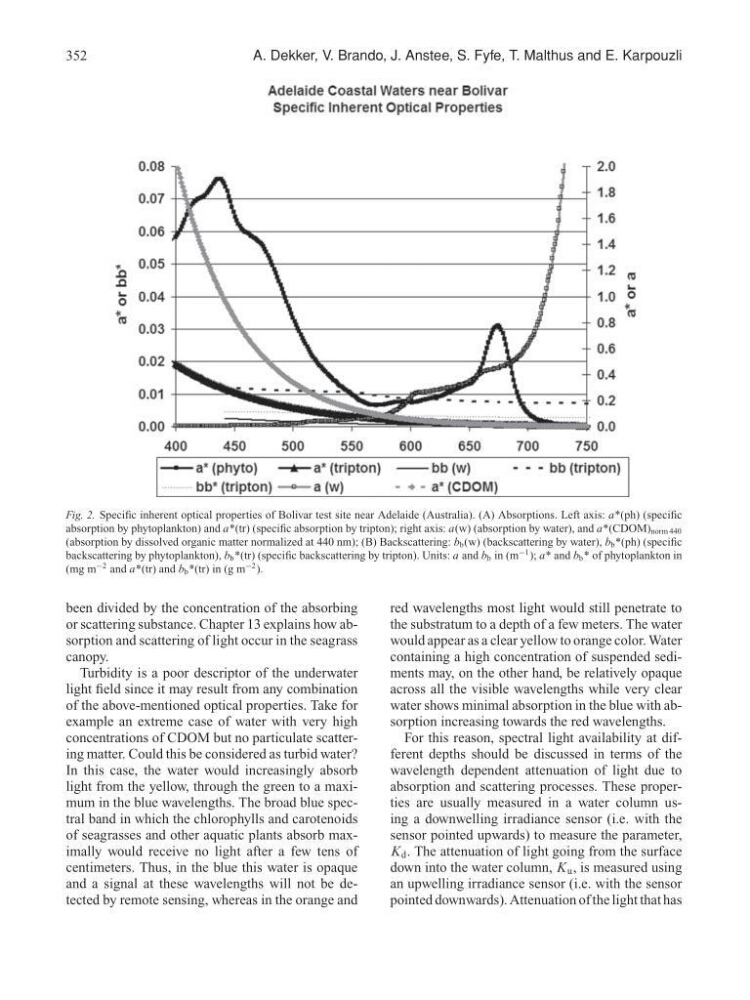
Fig. 2. Specific inherent optical properties of Bolivar test site near Adelaide (Australia). (A) Absorptions. Left axis: a*(ph) (specific
absorption by phytoplankton) and a*(tr) (specific absorption by tripton); right axis: a(w) (absorption by water), and a*(CDOM) norm 440
(absorption by dissolved organic matter normalized at 440 nm); (B) Backscattering: b b (w) (backscattering by water), b b *(ph) (specific
backscattering by phytoplankton), b b *(tr) (specific backscattering by tripton). Units: a and b b in (m
−1 ); a* and b b * of phytoplankton in
(mg m
−2 and a*(tr) and b b *(tr) in (g m
−2 ).
been divided by the concentration of the absorbing
or scattering substance. Chapter 13 explains how absorption and scattering of light occur in the seagrass
canopy.
Turbidity is a poor descriptor of the underwater
light field since it may result from any combination
of the above-mentioned optical properties. Take for
example an extreme case of water with very high
concentrations of CDOM but no particulate scattering matter. Could this be considered as turbid water?
In this case, the water would increasingly absorb
light from the yellow, through the green to a maximum in the blue wavelengths. The broad blue spectral band in which the chlorophylls and carotenoids
of seagrasses and other aquatic plants absorb maximally would receive no light after a few tens of
centimeters. Thus, in the blue this water is opaque
and a signal at these wavelengths will not be detected by remote sensing, whereas in the orange and
red wavelengths most light would still penetrate to
the substratum to a depth of a few meters. The water
would appear as a clear yellow to orange color. Water
containing a high concentration of suspended sediments may, on the other hand, be relatively opaque
across all the visible wavelengths while very clear
water shows minimal absorption in the blue with absorption increasing towards the red wavelengths.
For this reason, spectral light availability at different depths should be discussed in terms of the
wavelength dependent attenuation of light due to
absorption and scattering processes. These properties are usually measured in a water column using a downwelling irradiance sensor (i.e. with the
sensor pointed upwards) to measure the parameter,
K d . The attenuation of light going from the surface
down into the water column, K u , is measured using
an upwelling irradiance sensor (i.e. with the sensor
pointed downwards). Attenuation of the light that has
A. Dekker, V. Brando, J. Anstee, S. Fyfe, T. Malthus and E. Karpouzli
Fig. 2. Specific inherent optical properties of Bolivar test site near Adelaide (Australia). (A) Absorptions. Left axis: a*(ph) (specific
absorption by phytoplankton) and a*(tr) (specific absorption by tripton); right axis: a(w) (absorption by water), and a*(CDOM) norm 440
(absorption by dissolved organic matter normalized at 440 nm); (B) Backscattering: b b (w) (backscattering by water), b b *(ph) (specific
backscattering by phytoplankton), b b *(tr) (specific backscattering by tripton). Units: a and b b in (m
−1 ); a* and b b * of phytoplankton in
(mg m
−2 and a*(tr) and b b *(tr) in (g m
−2 ).
been divided by the concentration of the absorbing
or scattering substance. Chapter 13 explains how absorption and scattering of light occur in the seagrass
canopy.
Turbidity is a poor descriptor of the underwater
light field since it may result from any combination
of the above-mentioned optical properties. Take for
example an extreme case of water with very high
concentrations of CDOM but no particulate scattering matter. Could this be considered as turbid water?
In this case, the water would increasingly absorb
light from the yellow, through the green to a maximum in the blue wavelengths. The broad blue spectral band in which the chlorophylls and carotenoids
of seagrasses and other aquatic plants absorb maximally would receive no light after a few tens of
centimeters. Thus, in the blue this water is opaque
and a signal at these wavelengths will not be detected by remote sensing, whereas in the orange and
red wavelengths most light would still penetrate to
the substratum to a depth of a few meters. The water
would appear as a clear yellow to orange color. Water
containing a high concentration of suspended sediments may, on the other hand, be relatively opaque
across all the visible wavelengths while very clear
water shows minimal absorption in the blue with absorption increasing towards the red wavelengths.
For this reason, spectral light availability at different depths should be discussed in terms of the
wavelength dependent attenuation of light due to
absorption and scattering processes. These properties are usually measured in a water column using a downwelling irradiance sensor (i.e. with the
sensor pointed upwards) to measure the parameter,
K d . The attenuation of light going from the surface
down into the water column, K u , is measured using
an upwelling irradiance sensor (i.e. with the sensor
pointed downwards). Attenuation of the light that has