

Chapter 14 Photosynthesis in Seagrasses
339
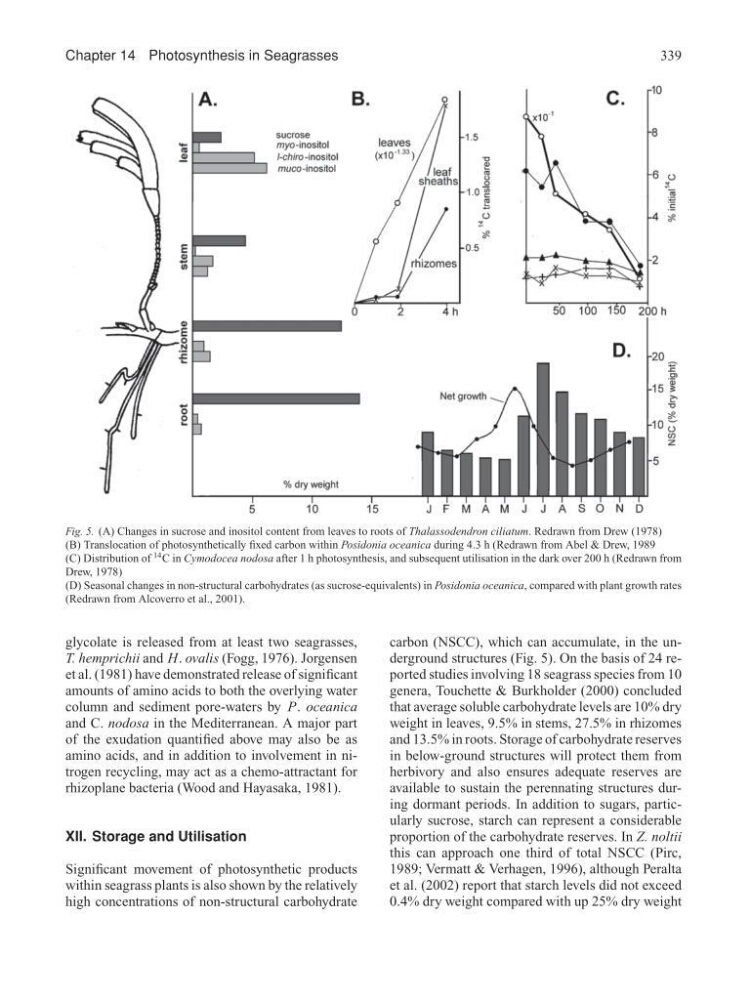
Fig. 5. (A) Changes in sucrose and inositol content from leaves to roots of Thalassodendron ciliatum. Redrawn from Drew (1978)
(B) Translocation of photosynthetically fixed carbon within Posidonia oceanica during 4.3 h (Redrawn from Abel & Drew, 1989
(C) Distribution of
14 C in Cymodocea nodosa after 1 h photosynthesis, and subsequent utilisation in the dark over 200 h (Redrawn from
Drew, 1978)
(D) Seasonal changes in non-structural carbohydrates (as sucrose-equivalents) in Posidonia oceanica, compared with plant growth rates
(Redrawn from Alcoverro et al., 2001).
glycolate is released from at least two seagrasses,
T. hemprichii and H. ovalis (Fogg, 1976). Jorgensen
et al. (1981) have demonstrated release of significant
amounts of amino acids to both the overlying water
column and sediment pore-waters by P. oceanica
and C. nodosa in the Mediterranean. A major part
of the exudation quantified above may also be as
amino acids, and in addition to involvement in nitrogen recycling, may act as a chemo-attractant for
rhizoplane bacteria (Wood and Hayasaka, 1981).
XII. Storage and Utilisation
Significant movement of photosynthetic products
within seagrass plants is also shown by the relatively
high concentrations of non-structural carbohydrate
carbon (NSCC), which can accumulate, in the underground structures (Fig. 5). On the basis of 24 reported studies involving 18 seagrass species from 10
genera, Touchette & Burkholder (2000) concluded
that average soluble carbohydrate levels are 10% dry
weight in leaves, 9.5% in stems, 27.5% in rhizomes
and 13.5% in roots. Storage of carbohydrate reserves
in below-ground structures will protect them from
herbivory and also ensures adequate reserves are
available to sustain the perennating structures during dormant periods. In addition to sugars, particularly sucrose, starch can represent a considerable
proportion of the carbohydrate reserves. In Z. noltii
this can approach one third of total NSCC (Pirc,
1989; Vermatt & Verhagen, 1996), although Peralta
et al. (2002) report that starch levels did not exceed
0.4% dry weight compared with up 25% dry weight
339
Fig. 5. (A) Changes in sucrose and inositol content from leaves to roots of Thalassodendron ciliatum. Redrawn from Drew (1978)
(B) Translocation of photosynthetically fixed carbon within Posidonia oceanica during 4.3 h (Redrawn from Abel & Drew, 1989
(C) Distribution of
14 C in Cymodocea nodosa after 1 h photosynthesis, and subsequent utilisation in the dark over 200 h (Redrawn from
Drew, 1978)
(D) Seasonal changes in non-structural carbohydrates (as sucrose-equivalents) in Posidonia oceanica, compared with plant growth rates
(Redrawn from Alcoverro et al., 2001).
glycolate is released from at least two seagrasses,
T. hemprichii and H. ovalis (Fogg, 1976). Jorgensen
et al. (1981) have demonstrated release of significant
amounts of amino acids to both the overlying water
column and sediment pore-waters by P. oceanica
and C. nodosa in the Mediterranean. A major part
of the exudation quantified above may also be as
amino acids, and in addition to involvement in nitrogen recycling, may act as a chemo-attractant for
rhizoplane bacteria (Wood and Hayasaka, 1981).
XII. Storage and Utilisation
Significant movement of photosynthetic products
within seagrass plants is also shown by the relatively
high concentrations of non-structural carbohydrate
carbon (NSCC), which can accumulate, in the underground structures (Fig. 5). On the basis of 24 reported studies involving 18 seagrass species from 10
genera, Touchette & Burkholder (2000) concluded
that average soluble carbohydrate levels are 10% dry
weight in leaves, 9.5% in stems, 27.5% in rhizomes
and 13.5% in roots. Storage of carbohydrate reserves
in below-ground structures will protect them from
herbivory and also ensures adequate reserves are
available to sustain the perennating structures during dormant periods. In addition to sugars, particularly sucrose, starch can represent a considerable
proportion of the carbohydrate reserves. In Z. noltii
this can approach one third of total NSCC (Pirc,
1989; Vermatt & Verhagen, 1996), although Peralta
et al. (2002) report that starch levels did not exceed
0.4% dry weight compared with up 25% dry weight