

Chapter 14 Photosynthesis in Seagrasses
337
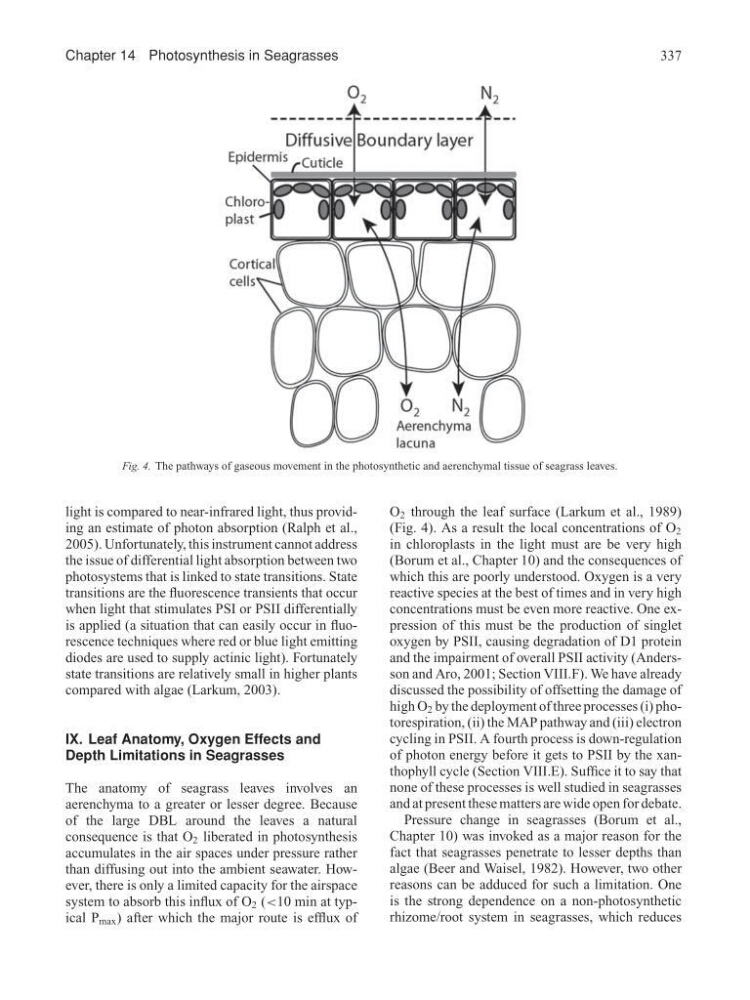
Fig. 4. The pathways of gaseous movement in the photosynthetic and aerenchymal tissue of seagrass leaves.
light is compared to near-infrared light, thus providing an estimate of photon absorption (Ralph et al.,
2005). Unfortunately, this instrument cannot address
the issue of differential light absorption between two
photosystems that is linked to state transitions. State
transitions are the fluorescence transients that occur
when light that stimulates PSI or PSII differentially
is applied (a situation that can easily occur in fluorescence techniques where red or blue light emitting
diodes are used to supply actinic light). Fortunately
state transitions are relatively small in higher plants
compared with algae (Larkum, 2003).
IX. Leaf Anatomy, Oxygen Effects and
The anatomy of seagrass leaves involves an
aerenchyma to a greater or lesser degree. Because
of the large DBL around the leaves a natural
consequence is that O 2 liberated in photosynthesis
accumulates in the air spaces under pressure rather
than diffusing out into the ambient seawater. However, there is only a limited capacity for the airspace
system to absorb this influx of O 2 (<10 min at typical P max ) after which the major route is efflux of
O 2 through the leaf surface (Larkum et al., 1989)
(Fig. 4). As a result the local concentrations of O 2
in chloroplasts in the light must are be very high
(Borum et al., Chapter 10) and the consequences of
which this are poorly understood. Oxygen is a very
reactive species at the best of times and in very high
concentrations must be even more reactive. One expression of this must be the production of singlet
oxygen by PSII, causing degradation of D1 protein
and the impairment of overall PSII activity (Andersson and Aro, 2001; Section VIII.F). We have already
discussed the possibility of offsetting the damage of
high O 2 by the deployment of three processes (i) photorespiration, (ii) the MAP pathway and (iii) electron
cycling in PSII. A fourth process is down-regulation
of photon energy before it gets to PSII by the xanthophyll cycle (Section VIII.E). Suffice it to say that
none of these processes is well studied in seagrasses
and at present these matters are wide open for debate.
Pressure change in seagrasses (Borum et al.,
Chapter 10) was invoked as a major reason for the
fact that seagrasses penetrate to lesser depths than
algae (Beer and Waisel, 1982). However, two other
reasons can be adduced for such a limitation. One
is the strong dependence on a non-photosynthetic
rhizome/root system in seagrasses, which reduces
Depth Limitations in Seagrasses
337
Fig. 4. The pathways of gaseous movement in the photosynthetic and aerenchymal tissue of seagrass leaves.
light is compared to near-infrared light, thus providing an estimate of photon absorption (Ralph et al.,
2005). Unfortunately, this instrument cannot address
the issue of differential light absorption between two
photosystems that is linked to state transitions. State
transitions are the fluorescence transients that occur
when light that stimulates PSI or PSII differentially
is applied (a situation that can easily occur in fluorescence techniques where red or blue light emitting
diodes are used to supply actinic light). Fortunately
state transitions are relatively small in higher plants
compared with algae (Larkum, 2003).
IX. Leaf Anatomy, Oxygen Effects and
The anatomy of seagrass leaves involves an
aerenchyma to a greater or lesser degree. Because
of the large DBL around the leaves a natural
consequence is that O 2 liberated in photosynthesis
accumulates in the air spaces under pressure rather
than diffusing out into the ambient seawater. However, there is only a limited capacity for the airspace
system to absorb this influx of O 2 (<10 min at typical P max ) after which the major route is efflux of
O 2 through the leaf surface (Larkum et al., 1989)
(Fig. 4). As a result the local concentrations of O 2
in chloroplasts in the light must are be very high
(Borum et al., Chapter 10) and the consequences of
which this are poorly understood. Oxygen is a very
reactive species at the best of times and in very high
concentrations must be even more reactive. One expression of this must be the production of singlet
oxygen by PSII, causing degradation of D1 protein
and the impairment of overall PSII activity (Andersson and Aro, 2001; Section VIII.F). We have already
discussed the possibility of offsetting the damage of
high O 2 by the deployment of three processes (i) photorespiration, (ii) the MAP pathway and (iii) electron
cycling in PSII. A fourth process is down-regulation
of photon energy before it gets to PSII by the xanthophyll cycle (Section VIII.E). Suffice it to say that
none of these processes is well studied in seagrasses
and at present these matters are wide open for debate.
Pressure change in seagrasses (Borum et al.,
Chapter 10) was invoked as a major reason for the
fact that seagrasses penetrate to lesser depths than
algae (Beer and Waisel, 1982). However, two other
reasons can be adduced for such a limitation. One
is the strong dependence on a non-photosynthetic
rhizome/root system in seagrasses, which reduces
Depth Limitations in Seagrasses