

Chapter 14 Photosynthesis in Seagrasses
325
a few studies (Fonseca and Kenworthy, 1987; Koch,
1994, Koch and Gust, 1999; see also Koch et al.,
Chapter 8). However, no studies to date have effectively shown how the hydrodynamic properties of
various seagrass leaves are related to photosynthetic
rates under different degrees and types of water motion. Presumably it is an important factor in the depth
and spatial distribution of many seagrasses, as it is
in freshwater hydrophytes (Maberly and Madsen,
2002) and in algae and many other plants (Raven,
1970, 1997). Hydrodynamic properties must also be
an important factor in the regulation of seagrass primary production, particularly in tropical seagrasses
exposed to supersaturating irradiances for more than
half of the solar day.
IV. Inorganic Carbon Uptake Mechanisms
Seagrasses generally live in full seawater (33%0) at a
pH of ca 8.2 and a bicarbonate (HCO
−
3 ) concentration of ca 2 mol m
−3 (Larkum et al., 1989). Under
these conditions there is very little CO 2 available
(ca 10 mmol m
−3 , at 25
◦ C). Thus while CO 2 is the
substrate for Rubisco, the primary enzyme for C i fixation in photosynthesis, the most available source of
inorganic carbon (C i ) is HCO
−
3 . Therefore it is not
surprising that many seagrasses have mechanisms
for the uptake of HCO
−
3 or its conversion to CO 2 near
the leaf surface; whether all seagrasses have these
mechanisms is not fully documented but it seems
likely. It has been claimed that seagrasses do not
have the efficiency of marine algae to concentrate
C i (Bj¨ ork et al., 1997), but this needs further justification. However, on theoretical grounds it can be
shown that many seagrasses must be limited by the
supply of C i under P max conditions (Larkum et al.,
1989).
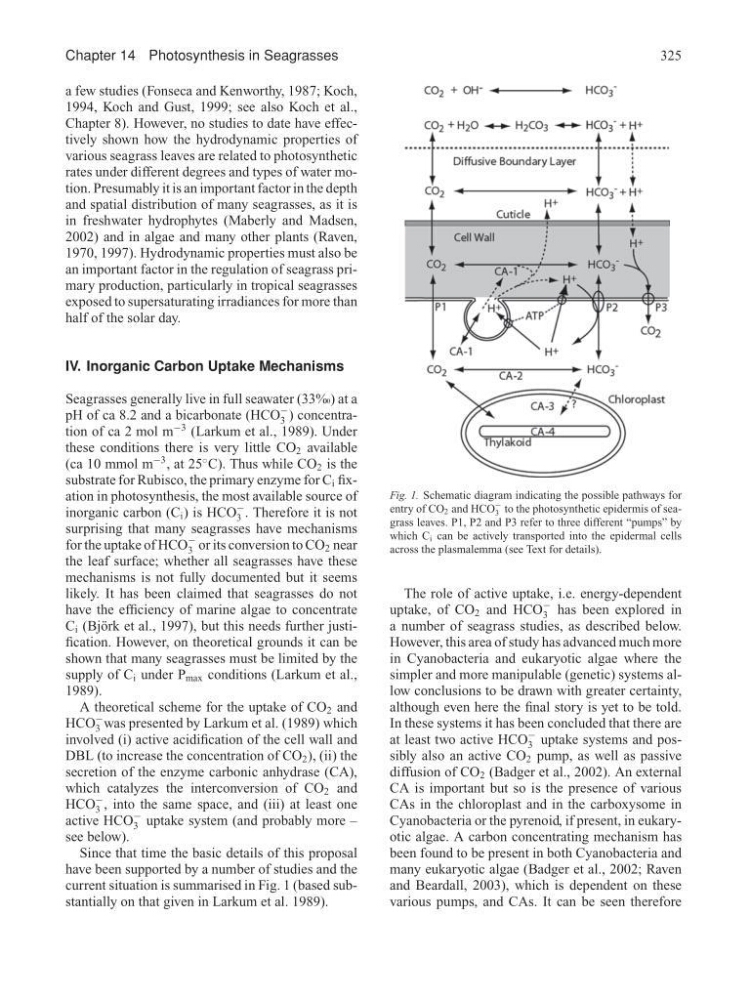
A theoretical scheme for the uptake of CO 2 and
HCO
−
3 was presented by Larkum et al. (1989) which
involved (i) active acidification of the cell wall and
DBL (to increase the concentration of CO 2 ), (ii) the
secretion of the enzyme carbonic anhydrase (CA),
which catalyzes the interconversion of CO 2 and
HCO
−
3 , into the same space, and (iii) at least one
active HCO
−
3 uptake system (and probably more –
see below).
Since that time the basic details of this proposal
have been supported by a number of studies and the
current situation is summarised in Fig. 1 (based substantially on that given in Larkum et al. 1989).
Fig. 1. Schematic diagram indicating the possible pathways for
entry of CO 2 and HCO
−
3 to the photosynthetic epidermis of seagrass leaves. P1, P2 and P3 refer to three different “pumps” by
which C i can be actively transported into the epidermal cells
across the plasmalemma (see Text for details).
The role of active uptake, i.e. energy-dependent
uptake, of CO 2 and HCO
−
3 has been explored in
a number of seagrass studies, as described below.
However, this area of study has advanced much more
in Cyanobacteria and eukaryotic algae where the
simpler and more manipulable (genetic) systems allow conclusions to be drawn with greater certainty,
although even here the final story is yet to be told.
In these systems it has been concluded that there are
at least two active HCO
−
3 uptake systems and possibly also an active CO 2 pump, as well as passive
diffusion of CO 2 (Badger et al., 2002). An external
CA is important but so is the presence of various
CAs in the chloroplast and in the carboxysome in
Cyanobacteria or the pyrenoid, if present, in eukaryotic algae. A carbon concentrating mechanism has
been found to be present in both Cyanobacteria and
many eukaryotic algae (Badger et al., 2002; Raven
and Beardall, 2003), which is dependent on these
various pumps, and CAs. It can be seen therefore
325
a few studies (Fonseca and Kenworthy, 1987; Koch,
1994, Koch and Gust, 1999; see also Koch et al.,
Chapter 8). However, no studies to date have effectively shown how the hydrodynamic properties of
various seagrass leaves are related to photosynthetic
rates under different degrees and types of water motion. Presumably it is an important factor in the depth
and spatial distribution of many seagrasses, as it is
in freshwater hydrophytes (Maberly and Madsen,
2002) and in algae and many other plants (Raven,
1970, 1997). Hydrodynamic properties must also be
an important factor in the regulation of seagrass primary production, particularly in tropical seagrasses
exposed to supersaturating irradiances for more than
half of the solar day.
IV. Inorganic Carbon Uptake Mechanisms
Seagrasses generally live in full seawater (33%0) at a
pH of ca 8.2 and a bicarbonate (HCO
−
3 ) concentration of ca 2 mol m
−3 (Larkum et al., 1989). Under
these conditions there is very little CO 2 available
(ca 10 mmol m
−3 , at 25
◦ C). Thus while CO 2 is the
substrate for Rubisco, the primary enzyme for C i fixation in photosynthesis, the most available source of
inorganic carbon (C i ) is HCO
−
3 . Therefore it is not
surprising that many seagrasses have mechanisms
for the uptake of HCO
−
3 or its conversion to CO 2 near
the leaf surface; whether all seagrasses have these
mechanisms is not fully documented but it seems
likely. It has been claimed that seagrasses do not
have the efficiency of marine algae to concentrate
C i (Bj¨ ork et al., 1997), but this needs further justification. However, on theoretical grounds it can be
shown that many seagrasses must be limited by the
supply of C i under P max conditions (Larkum et al.,
1989).
A theoretical scheme for the uptake of CO 2 and
HCO
−
3 was presented by Larkum et al. (1989) which
involved (i) active acidification of the cell wall and
DBL (to increase the concentration of CO 2 ), (ii) the
secretion of the enzyme carbonic anhydrase (CA),
which catalyzes the interconversion of CO 2 and
HCO
−
3 , into the same space, and (iii) at least one
active HCO
−
3 uptake system (and probably more –
see below).
Since that time the basic details of this proposal
have been supported by a number of studies and the
current situation is summarised in Fig. 1 (based substantially on that given in Larkum et al. 1989).
Fig. 1. Schematic diagram indicating the possible pathways for
entry of CO 2 and HCO
−
3 to the photosynthetic epidermis of seagrass leaves. P1, P2 and P3 refer to three different “pumps” by
which C i can be actively transported into the epidermal cells
across the plasmalemma (see Text for details).
The role of active uptake, i.e. energy-dependent
uptake, of CO 2 and HCO
−
3 has been explored in
a number of seagrass studies, as described below.
However, this area of study has advanced much more
in Cyanobacteria and eukaryotic algae where the
simpler and more manipulable (genetic) systems allow conclusions to be drawn with greater certainty,
although even here the final story is yet to be told.
In these systems it has been concluded that there are
at least two active HCO
−
3 uptake systems and possibly also an active CO 2 pump, as well as passive
diffusion of CO 2 (Badger et al., 2002). An external
CA is important but so is the presence of various
CAs in the chloroplast and in the carboxysome in
Cyanobacteria or the pyrenoid, if present, in eukaryotic algae. A carbon concentrating mechanism has
been found to be present in both Cyanobacteria and
many eukaryotic algae (Badger et al., 2002; Raven
and Beardall, 2003), which is dependent on these
various pumps, and CAs. It can be seen therefore