

304
R. C. Zimmerman
plant canopy relative to the incident light field, or to
the spectral quality of the incident light. Further, it
is difficult to evaluate potentially important density
dependent effects (e.g. self-shading) with these “big
leaf ” models. Finally, the data required to develop
and validate the empirical models are time consuming to collect and not easily automated, which limits
their utility for resource management objectives.
We can develop a more mechanistic understanding of seagrass bed productivity by employing
some biophysical principles and geometric reasoning to characterize the general interaction of seagrass
canopies with the submarine light field and water
column in which they are embedded. This chapter
focuses on the vertical distribution and orientation
of leaf biomass (Fig. 3), and the optical properties of
leaves that determine spectral light absorption by the
plant canopy (Fig. 4) within an optically active water
column. An overview of general terms and principles
of radiative transfer theory relevant to this discussion
is presented in Zimmerman and Dekker, Chapter 12.
More detailed treatments of radiative transfer theory
applied to natural waters can be found in Kirk (1994)
and Mobley (1994).
II. Radiation Transfer and Light Interception
If we ignore scattering and assume leaves to be optically black, then the probability that a photon will
be transmitted through a horizontally homogeneous
canopy composed of randomly distributed horizontal leaves of unit thickness can be approximated by
application of the Lambert-Beer Law of radiative
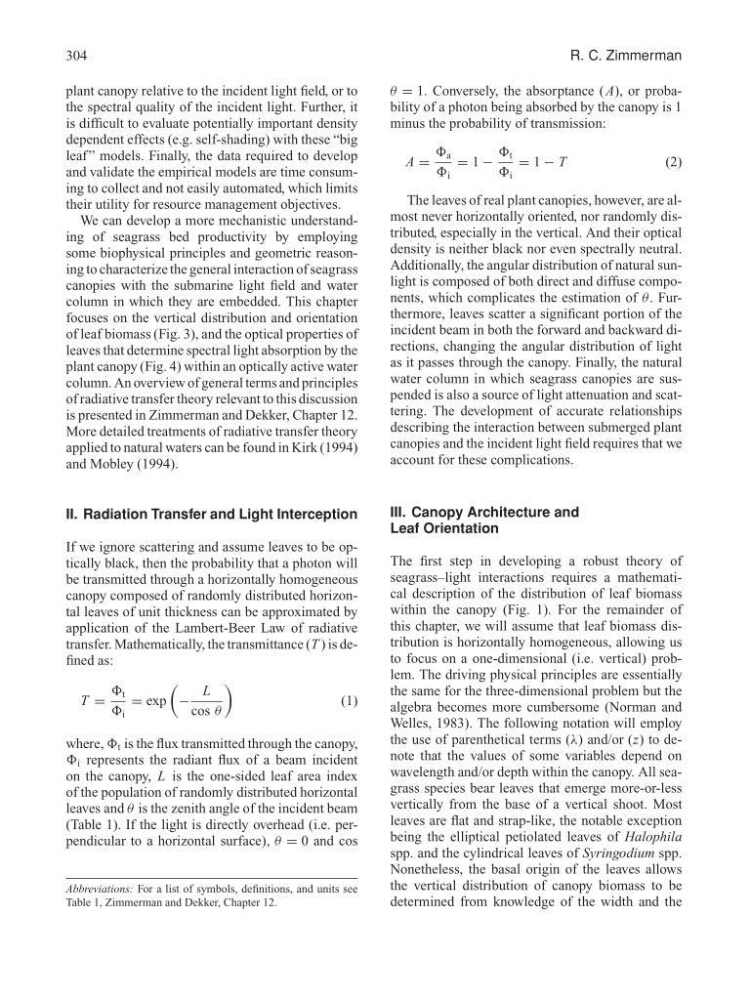
transfer. Mathematically, the transmittance (T ) is defined as:
T =
t
i
= exp
−
L
cos θ
(1)
where, t is the flux transmitted through the canopy,
i represents the radiant flux of a beam incident
on the canopy, L is the one-sided leaf area index
of the population of randomly distributed horizontal
leaves and θ is the zenith angle of the incident beam
(Table 1). If the light is directly overhead (i.e. perpendicular to a horizontal surface), θ = 0 and cos
Abbreviations: For a list of symbols, definitions, and units see
Table 1, Zimmerman and Dekker, Chapter 12.
θ = 1. Conversely, the absorptance (A), or probability of a photon being absorbed by the canopy is 1
minus the probability of transmission:
A =
a
i
= 1 −
t
i
= 1 − T
(2)
The leaves of real plant canopies, however, are almost never horizontally oriented, nor randomly distributed, especially in the vertical. And their optical
density is neither black nor even spectrally neutral.
Additionally, the angular distribution of natural sunlight is composed of both direct and diffuse components, which complicates the estimation of θ . Furthermore, leaves scatter a significant portion of the
incident beam in both the forward and backward directions, changing the angular distribution of light
as it passes through the canopy. Finally, the natural
water column in which seagrass canopies are suspended is also a source of light attenuation and scattering. The development of accurate relationships
describing the interaction between submerged plant
canopies and the incident light field requires that we
account for these complications.
III. Canopy Architecture and
Leaf Orientation
The first step in developing a robust theory of
seagrass–light interactions requires a mathematical description of the distribution of leaf biomass
within the canopy (Fig. 1). For the remainder of
this chapter, we will assume that leaf biomass distribution is horizontally homogeneous, allowing us
to focus on a one-dimensional (i.e. vertical) problem. The driving physical principles are essentially
the same for the three-dimensional problem but the
algebra becomes more cumbersome (Norman and
Welles, 1983). The following notation will employ
the use of parenthetical terms (λ) and/or (z) to denote that the values of some variables depend on
wavelength and/or depth within the canopy. All seagrass species bear leaves that emerge more-or-less
vertically from the base of a vertical shoot. Most
leaves are flat and strap-like, the notable exception
being the elliptical petiolated leaves of Halophila
spp. and the cylindrical leaves of Syringodium spp.
Nonetheless, the basal origin of the leaves allows
the vertical distribution of canopy biomass to be
determined from knowledge of the width and the
R. C. Zimmerman
plant canopy relative to the incident light field, or to
the spectral quality of the incident light. Further, it
is difficult to evaluate potentially important density
dependent effects (e.g. self-shading) with these “big
leaf ” models. Finally, the data required to develop
and validate the empirical models are time consuming to collect and not easily automated, which limits
their utility for resource management objectives.
We can develop a more mechanistic understanding of seagrass bed productivity by employing
some biophysical principles and geometric reasoning to characterize the general interaction of seagrass
canopies with the submarine light field and water
column in which they are embedded. This chapter
focuses on the vertical distribution and orientation
of leaf biomass (Fig. 3), and the optical properties of
leaves that determine spectral light absorption by the
plant canopy (Fig. 4) within an optically active water
column. An overview of general terms and principles
of radiative transfer theory relevant to this discussion
is presented in Zimmerman and Dekker, Chapter 12.
More detailed treatments of radiative transfer theory
applied to natural waters can be found in Kirk (1994)
and Mobley (1994).
II. Radiation Transfer and Light Interception
If we ignore scattering and assume leaves to be optically black, then the probability that a photon will
be transmitted through a horizontally homogeneous
canopy composed of randomly distributed horizontal leaves of unit thickness can be approximated by
application of the Lambert-Beer Law of radiative
transfer. Mathematically, the transmittance (T ) is defined as:
T =
t
i
= exp
−
L
cos θ
(1)
where, t is the flux transmitted through the canopy,
i represents the radiant flux of a beam incident
on the canopy, L is the one-sided leaf area index
of the population of randomly distributed horizontal
leaves and θ is the zenith angle of the incident beam
(Table 1). If the light is directly overhead (i.e. perpendicular to a horizontal surface), θ = 0 and cos
Abbreviations: For a list of symbols, definitions, and units see
Table 1, Zimmerman and Dekker, Chapter 12.
θ = 1. Conversely, the absorptance (A), or probability of a photon being absorbed by the canopy is 1
minus the probability of transmission:
A =
a
i
= 1 −
t
i
= 1 − T
(2)
The leaves of real plant canopies, however, are almost never horizontally oriented, nor randomly distributed, especially in the vertical. And their optical
density is neither black nor even spectrally neutral.
Additionally, the angular distribution of natural sunlight is composed of both direct and diffuse components, which complicates the estimation of θ . Furthermore, leaves scatter a significant portion of the
incident beam in both the forward and backward directions, changing the angular distribution of light
as it passes through the canopy. Finally, the natural
water column in which seagrass canopies are suspended is also a source of light attenuation and scattering. The development of accurate relationships
describing the interaction between submerged plant
canopies and the incident light field requires that we
account for these complications.
III. Canopy Architecture and
Leaf Orientation
The first step in developing a robust theory of
seagrass–light interactions requires a mathematical description of the distribution of leaf biomass
within the canopy (Fig. 1). For the remainder of
this chapter, we will assume that leaf biomass distribution is horizontally homogeneous, allowing us
to focus on a one-dimensional (i.e. vertical) problem. The driving physical principles are essentially
the same for the three-dimensional problem but the
algebra becomes more cumbersome (Norman and
Welles, 1983). The following notation will employ
the use of parenthetical terms (λ) and/or (z) to denote that the values of some variables depend on
wavelength and/or depth within the canopy. All seagrass species bear leaves that emerge more-or-less
vertically from the base of a vertical shoot. Most
leaves are flat and strap-like, the notable exception
being the elliptical petiolated leaves of Halophila
spp. and the cylindrical leaves of Syringodium spp.
Nonetheless, the basal origin of the leaves allows
the vertical distribution of canopy biomass to be
determined from knowledge of the width and the