

Chapter 12 Aquatic Optics
299
analysis, the transmittance represents the fraction of
incident light that was not absorbed. In that case, the
absorbance, or optical density, is defined as:
D ≡ log 10
i
t
(10)
It follows that:
A = 1 − 10
−D
(11)
Unlike the transparent solution mentioned above,
however, scattering has a major impact on the
fate and distribution of light in natural waters.
Scattering impedes vertical light penetration by
prolonging the path length, which increases the
probability of absorption. Scattering also propagates photons back into the direction of the downwelling light. Earth observation sensors measure the
backscattered photons that survive the water column, the air–water interface and the atmosphere.
In most cases, the aim of applying earth observation is to reconstruct the constituents causing that
backscattering.
The way in which scattering affects the penetration of light into the medium depends on the angular distribution of the scattered flux. This angular distribution has a characteristic shape for any
given medium and is specified in terms of the normalised volume scattering function (β). The scattering coefficient b can be obtained by integration of
β over all directions (solid angles). The measurement of β, however, is not trivial and b is routinely
calculated (not measured) from easier-to-obtain
measurements of beam absorption and attenuation
(b = c − a).
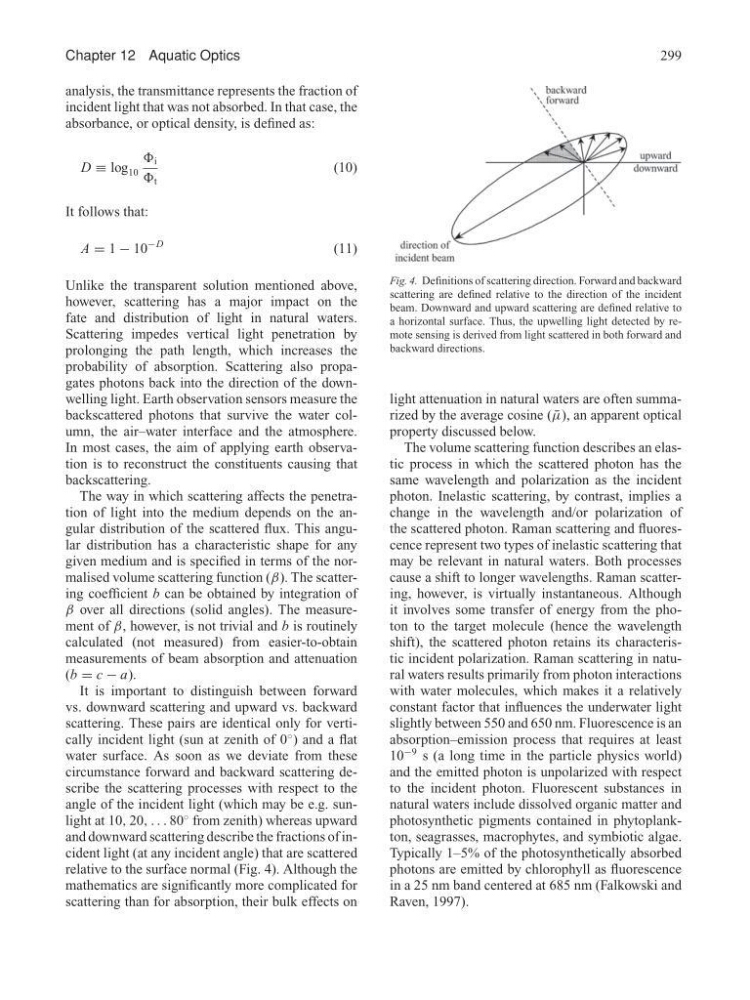
It is important to distinguish between forward
vs. downward scattering and upward vs. backward
scattering. These pairs are identical only for vertically incident light (sun at zenith of 0
◦ ) and a flat
water surface. As soon as we deviate from these
circumstance forward and backward scattering describe the scattering processes with respect to the
angle of the incident light (which may be e.g. sunlight at 10, 20, . . . 80
◦ from zenith) whereas upward
and downward scattering describe the fractions of incident light (at any incident angle) that are scattered
relative to the surface normal (Fig. 4). Although the
mathematics are significantly more complicated for
scattering than for absorption, their bulk effects on
Fig. 4. Definitions of scattering direction. Forward and backward
scattering are defined relative to the direction of the incident
beam. Downward and upward scattering are defined relative to
a horizontal surface. Thus, the upwelling light detected by remote sensing is derived from light scattered in both forward and
backward directions.
light attenuation in natural waters are often summarized by the average cosine ( ¯
µ), an apparent optical
property discussed below.
The volume scattering function describes an elastic process in which the scattered photon has the
same wavelength and polarization as the incident
photon. Inelastic scattering, by contrast, implies a
change in the wavelength and/or polarization of
the scattered photon. Raman scattering and fluorescence represent two types of inelastic scattering that
may be relevant in natural waters. Both processes
cause a shift to longer wavelengths. Raman scattering, however, is virtually instantaneous. Although
it involves some transfer of energy from the photon to the target molecule (hence the wavelength
shift), the scattered photon retains its characteristic incident polarization. Raman scattering in natural waters results primarily from photon interactions
with water molecules, which makes it a relatively
constant factor that influences the underwater light
slightly between 550 and 650 nm. Fluorescence is an
absorption–emission process that requires at least
10
−9 s (a long time in the particle physics world)
and the emitted photon is unpolarized with respect
to the incident photon. Fluorescent substances in
natural waters include dissolved organic matter and
photosynthetic pigments contained in phytoplankton, seagrasses, macrophytes, and symbiotic algae.
Typically 1–5% of the photosynthetically absorbed
photons are emitted by chlorophyll as fluorescence
in a 25 nm band centered at 685 nm (Falkowski and
Raven, 1997).
299
analysis, the transmittance represents the fraction of
incident light that was not absorbed. In that case, the
absorbance, or optical density, is defined as:
D ≡ log 10
i
t
(10)
It follows that:
A = 1 − 10
−D
(11)
Unlike the transparent solution mentioned above,
however, scattering has a major impact on the
fate and distribution of light in natural waters.
Scattering impedes vertical light penetration by
prolonging the path length, which increases the
probability of absorption. Scattering also propagates photons back into the direction of the downwelling light. Earth observation sensors measure the
backscattered photons that survive the water column, the air–water interface and the atmosphere.
In most cases, the aim of applying earth observation is to reconstruct the constituents causing that
backscattering.
The way in which scattering affects the penetration of light into the medium depends on the angular distribution of the scattered flux. This angular distribution has a characteristic shape for any
given medium and is specified in terms of the normalised volume scattering function (β). The scattering coefficient b can be obtained by integration of
β over all directions (solid angles). The measurement of β, however, is not trivial and b is routinely
calculated (not measured) from easier-to-obtain
measurements of beam absorption and attenuation
(b = c − a).
It is important to distinguish between forward
vs. downward scattering and upward vs. backward
scattering. These pairs are identical only for vertically incident light (sun at zenith of 0
◦ ) and a flat
water surface. As soon as we deviate from these
circumstance forward and backward scattering describe the scattering processes with respect to the
angle of the incident light (which may be e.g. sunlight at 10, 20, . . . 80
◦ from zenith) whereas upward
and downward scattering describe the fractions of incident light (at any incident angle) that are scattered
relative to the surface normal (Fig. 4). Although the
mathematics are significantly more complicated for
scattering than for absorption, their bulk effects on
Fig. 4. Definitions of scattering direction. Forward and backward
scattering are defined relative to the direction of the incident
beam. Downward and upward scattering are defined relative to
a horizontal surface. Thus, the upwelling light detected by remote sensing is derived from light scattered in both forward and
backward directions.
light attenuation in natural waters are often summarized by the average cosine ( ¯
µ), an apparent optical
property discussed below.
The volume scattering function describes an elastic process in which the scattered photon has the
same wavelength and polarization as the incident
photon. Inelastic scattering, by contrast, implies a
change in the wavelength and/or polarization of
the scattered photon. Raman scattering and fluorescence represent two types of inelastic scattering that
may be relevant in natural waters. Both processes
cause a shift to longer wavelengths. Raman scattering, however, is virtually instantaneous. Although
it involves some transfer of energy from the photon to the target molecule (hence the wavelength
shift), the scattered photon retains its characteristic incident polarization. Raman scattering in natural waters results primarily from photon interactions
with water molecules, which makes it a relatively
constant factor that influences the underwater light
slightly between 550 and 650 nm. Fluorescence is an
absorption–emission process that requires at least
10
−9 s (a long time in the particle physics world)
and the emitted photon is unpolarized with respect
to the incident photon. Fluorescent substances in
natural waters include dissolved organic matter and
photosynthetic pigments contained in phytoplankton, seagrasses, macrophytes, and symbiotic algae.
Typically 1–5% of the photosynthetically absorbed
photons are emitted by chlorophyll as fluorescence
in a 25 nm band centered at 685 nm (Falkowski and
Raven, 1997).