

240
J. Romero, K.-S. Lee, M. P ´
erez, M. A. Mateo, and T. Alcoverro
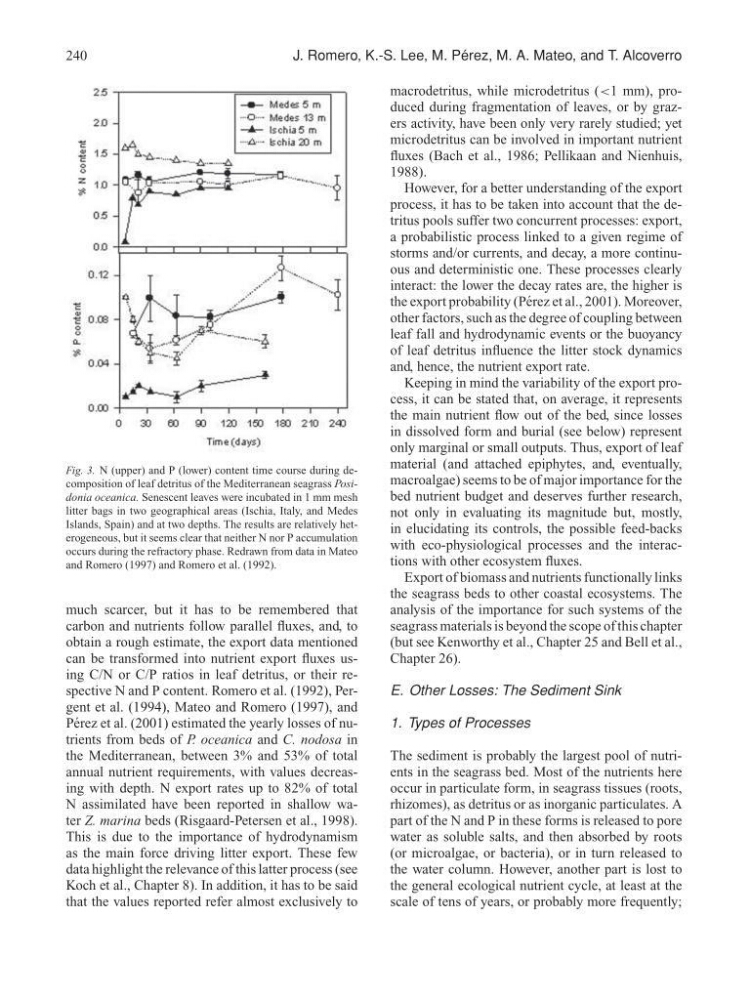
Fig. 3. N (upper) and P (lower) content time course during decomposition of leaf detritus of the Mediterranean seagrass Posidonia oceanica. Senescent leaves were incubated in 1 mm mesh
litter bags in two geographical areas (Ischia, Italy, and Medes
Islands, Spain) and at two depths. The results are relatively heterogeneous, but it seems clear that neither N nor P accumulation
occurs during the refractory phase. Redrawn from data in Mateo
and Romero (1997) and Romero et al. (1992).
much scarcer, but it has to be remembered that
carbon and nutrients follow parallel fluxes, and, to
obtain a rough estimate, the export data mentioned
can be transformed into nutrient export fluxes using C/N or C/P ratios in leaf detritus, or their respective N and P content. Romero et al. (1992), Pergent et al. (1994), Mateo and Romero (1997), and
P´ erez et al. (2001) estimated the yearly losses of nutrients from beds of P. oceanica and C. nodosa in
the Mediterranean, between 3% and 53% of total
annual nutrient requirements, with values decreasing with depth. N export rates up to 82% of total
N assimilated have been reported in shallow water Z. marina beds (Risgaard-Petersen et al., 1998).
This is due to the importance of hydrodynamism
as the main force driving litter export. These few
data highlight the relevance of this latter process (see
Koch et al., Chapter 8). In addition, it has to be said
that the values reported refer almost exclusively to
macrodetritus, while microdetritus (<1 mm), produced during fragmentation of leaves, or by grazers activity, have been only very rarely studied; yet
microdetritus can be involved in important nutrient
fluxes (Bach et al., 1986; Pellikaan and Nienhuis,
1988).
However, for a better understanding of the export
process, it has to be taken into account that the detritus pools suffer two concurrent processes: export,
a probabilistic process linked to a given regime of
storms and/or currents, and decay, a more continuous and deterministic one. These processes clearly
interact: the lower the decay rates are, the higher is
the export probability (P´ erez et al., 2001). Moreover,
other factors, such as the degree of coupling between
leaf fall and hydrodynamic events or the buoyancy
of leaf detritus influence the litter stock dynamics
and, hence, the nutrient export rate.
Keeping in mind the variability of the export process, it can be stated that, on average, it represents
the main nutrient flow out of the bed, since losses
in dissolved form and burial (see below) represent
only marginal or small outputs. Thus, export of leaf
material (and attached epiphytes, and, eventually,
macroalgae) seems to be of major importance for the
bed nutrient budget and deserves further research,
not only in evaluating its magnitude but, mostly,
in elucidating its controls, the possible feed-backs
with eco-physiological processes and the interactions with other ecosystem fluxes.
Export of biomass and nutrients functionally links
the seagrass beds to other coastal ecosystems. The
analysis of the importance for such systems of the
seagrass materials is beyond the scope of this chapter
(but see Kenworthy et al., Chapter 25 and Bell et al.,
Chapter 26).
E. Other Losses: The Sediment Sink
1. Types of Processes
The sediment is probably the largest pool of nutrients in the seagrass bed. Most of the nutrients here
occur in particulate form, in seagrass tissues (roots,
rhizomes), as detritus or as inorganic particulates. A
part of the N and P in these forms is released to pore
water as soluble salts, and then absorbed by roots
(or microalgae, or bacteria), or in turn released to
the water column. However, another part is lost to
the general ecological nutrient cycle, at least at the
scale of tens of years, or probably more frequently;
J. Romero, K.-S. Lee, M. P ´
erez, M. A. Mateo, and T. Alcoverro
Fig. 3. N (upper) and P (lower) content time course during decomposition of leaf detritus of the Mediterranean seagrass Posidonia oceanica. Senescent leaves were incubated in 1 mm mesh
litter bags in two geographical areas (Ischia, Italy, and Medes
Islands, Spain) and at two depths. The results are relatively heterogeneous, but it seems clear that neither N nor P accumulation
occurs during the refractory phase. Redrawn from data in Mateo
and Romero (1997) and Romero et al. (1992).
much scarcer, but it has to be remembered that
carbon and nutrients follow parallel fluxes, and, to
obtain a rough estimate, the export data mentioned
can be transformed into nutrient export fluxes using C/N or C/P ratios in leaf detritus, or their respective N and P content. Romero et al. (1992), Pergent et al. (1994), Mateo and Romero (1997), and
P´ erez et al. (2001) estimated the yearly losses of nutrients from beds of P. oceanica and C. nodosa in
the Mediterranean, between 3% and 53% of total
annual nutrient requirements, with values decreasing with depth. N export rates up to 82% of total
N assimilated have been reported in shallow water Z. marina beds (Risgaard-Petersen et al., 1998).
This is due to the importance of hydrodynamism
as the main force driving litter export. These few
data highlight the relevance of this latter process (see
Koch et al., Chapter 8). In addition, it has to be said
that the values reported refer almost exclusively to
macrodetritus, while microdetritus (<1 mm), produced during fragmentation of leaves, or by grazers activity, have been only very rarely studied; yet
microdetritus can be involved in important nutrient
fluxes (Bach et al., 1986; Pellikaan and Nienhuis,
1988).
However, for a better understanding of the export
process, it has to be taken into account that the detritus pools suffer two concurrent processes: export,
a probabilistic process linked to a given regime of
storms and/or currents, and decay, a more continuous and deterministic one. These processes clearly
interact: the lower the decay rates are, the higher is
the export probability (P´ erez et al., 2001). Moreover,
other factors, such as the degree of coupling between
leaf fall and hydrodynamic events or the buoyancy
of leaf detritus influence the litter stock dynamics
and, hence, the nutrient export rate.
Keeping in mind the variability of the export process, it can be stated that, on average, it represents
the main nutrient flow out of the bed, since losses
in dissolved form and burial (see below) represent
only marginal or small outputs. Thus, export of leaf
material (and attached epiphytes, and, eventually,
macroalgae) seems to be of major importance for the
bed nutrient budget and deserves further research,
not only in evaluating its magnitude but, mostly,
in elucidating its controls, the possible feed-backs
with eco-physiological processes and the interactions with other ecosystem fluxes.
Export of biomass and nutrients functionally links
the seagrass beds to other coastal ecosystems. The
analysis of the importance for such systems of the
seagrass materials is beyond the scope of this chapter
(but see Kenworthy et al., Chapter 25 and Bell et al.,
Chapter 26).
E. Other Losses: The Sediment Sink
1. Types of Processes
The sediment is probably the largest pool of nutrients in the seagrass bed. Most of the nutrients here
occur in particulate form, in seagrass tissues (roots,
rhizomes), as detritus or as inorganic particulates. A
part of the N and P in these forms is released to pore
water as soluble salts, and then absorbed by roots
(or microalgae, or bacteria), or in turn released to
the water column. However, another part is lost to
the general ecological nutrient cycle, at least at the
scale of tens of years, or probably more frequently;