

236
J. Romero, K.-S. Lee, M. P ´
erez, M. A. Mateo, and T. Alcoverro
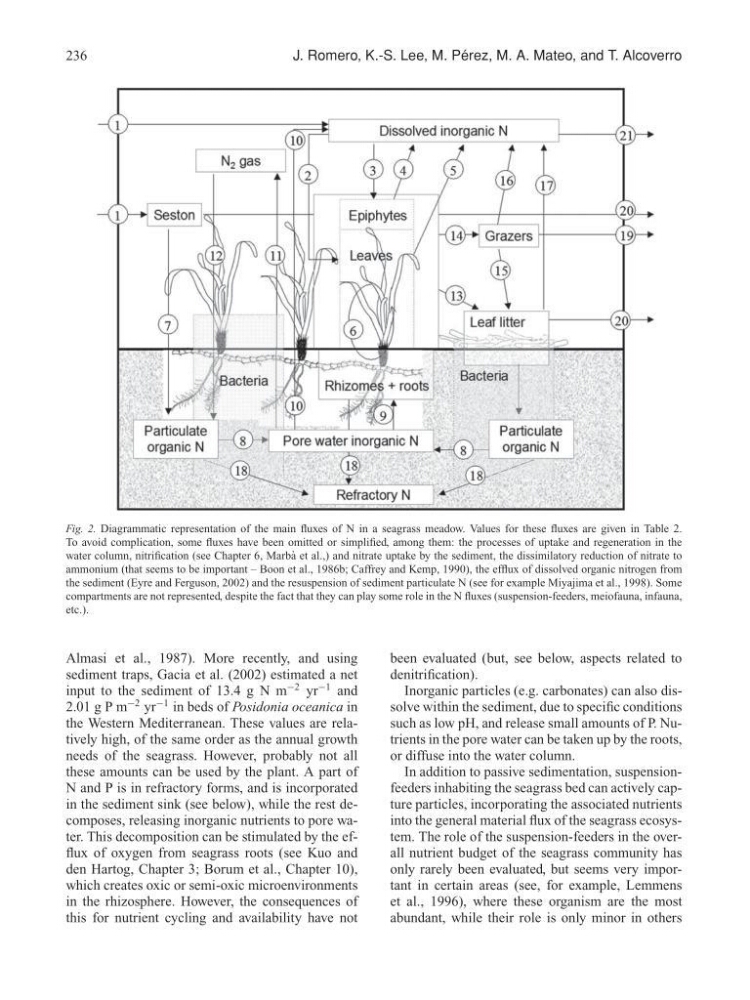
Fig. 2. Diagrammatic representation of the main fluxes of N in a seagrass meadow. Values for these fluxes are given in Table 2.
To avoid complication, some fluxes have been omitted or simplified, among them: the processes of uptake and regeneration in the
water column, nitrification (see Chapter 6, Marb` a et al.,) and nitrate uptake by the sediment, the dissimilatory reduction of nitrate to
ammonium (that seems to be important – Boon et al., 1986b; Caffrey and Kemp, 1990), the efflux of dissolved organic nitrogen from
the sediment (Eyre and Ferguson, 2002) and the resuspension of sediment particulate N (see for example Miyajima et al., 1998). Some
compartments are not represented, despite the fact that they can play some role in the N fluxes (suspension-feeders, meiofauna, infauna,
etc.).
Almasi et al., 1987). More recently, and using
sediment traps, Gacia et al. (2002) estimated a net
input to the sediment of 13.4 g N m
−2 yr
−1 and
2.01 g P m
−2 yr
−1 in beds of Posidonia oceanica in
the Western Mediterranean. These values are relatively high, of the same order as the annual growth
needs of the seagrass. However, probably not all
these amounts can be used by the plant. A part of
N and P is in refractory forms, and is incorporated
in the sediment sink (see below), while the rest decomposes, releasing inorganic nutrients to pore water. This decomposition can be stimulated by the efflux of oxygen from seagrass roots (see Kuo and
den Hartog, Chapter 3; Borum et al., Chapter 10),
which creates oxic or semi-oxic microenvironments
in the rhizosphere. However, the consequences of
this for nutrient cycling and availability have not
been evaluated (but, see below, aspects related to
denitrification).
Inorganic particles (e.g. carbonates) can also dissolve within the sediment, due to specific conditions
such as low pH, and release small amounts of P. Nutrients in the pore water can be taken up by the roots,
or diffuse into the water column.
In addition to passive sedimentation, suspensionfeeders inhabiting the seagrass bed can actively capture particles, incorporating the associated nutrients
into the general material flux of the seagrass ecosystem. The role of the suspension-feeders in the overall nutrient budget of the seagrass community has
only rarely been evaluated, but seems very important in certain areas (see, for example, Lemmens
et al., 1996), where these organism are the most
abundant, while their role is only minor in others
J. Romero, K.-S. Lee, M. P ´
erez, M. A. Mateo, and T. Alcoverro
Fig. 2. Diagrammatic representation of the main fluxes of N in a seagrass meadow. Values for these fluxes are given in Table 2.
To avoid complication, some fluxes have been omitted or simplified, among them: the processes of uptake and regeneration in the
water column, nitrification (see Chapter 6, Marb` a et al.,) and nitrate uptake by the sediment, the dissimilatory reduction of nitrate to
ammonium (that seems to be important – Boon et al., 1986b; Caffrey and Kemp, 1990), the efflux of dissolved organic nitrogen from
the sediment (Eyre and Ferguson, 2002) and the resuspension of sediment particulate N (see for example Miyajima et al., 1998). Some
compartments are not represented, despite the fact that they can play some role in the N fluxes (suspension-feeders, meiofauna, infauna,
etc.).
Almasi et al., 1987). More recently, and using
sediment traps, Gacia et al. (2002) estimated a net
input to the sediment of 13.4 g N m
−2 yr
−1 and
2.01 g P m
−2 yr
−1 in beds of Posidonia oceanica in
the Western Mediterranean. These values are relatively high, of the same order as the annual growth
needs of the seagrass. However, probably not all
these amounts can be used by the plant. A part of
N and P is in refractory forms, and is incorporated
in the sediment sink (see below), while the rest decomposes, releasing inorganic nutrients to pore water. This decomposition can be stimulated by the efflux of oxygen from seagrass roots (see Kuo and
den Hartog, Chapter 3; Borum et al., Chapter 10),
which creates oxic or semi-oxic microenvironments
in the rhizosphere. However, the consequences of
this for nutrient cycling and availability have not
been evaluated (but, see below, aspects related to
denitrification).
Inorganic particles (e.g. carbonates) can also dissolve within the sediment, due to specific conditions
such as low pH, and release small amounts of P. Nutrients in the pore water can be taken up by the roots,
or diffuse into the water column.
In addition to passive sedimentation, suspensionfeeders inhabiting the seagrass bed can actively capture particles, incorporating the associated nutrients
into the general material flux of the seagrass ecosystem. The role of the suspension-feeders in the overall nutrient budget of the seagrass community has
only rarely been evaluated, but seems very important in certain areas (see, for example, Lemmens
et al., 1996), where these organism are the most
abundant, while their role is only minor in others