

232
J. Romero, K.-S. Lee, M. P ´
erez, M. A. Mateo, and T. Alcoverro
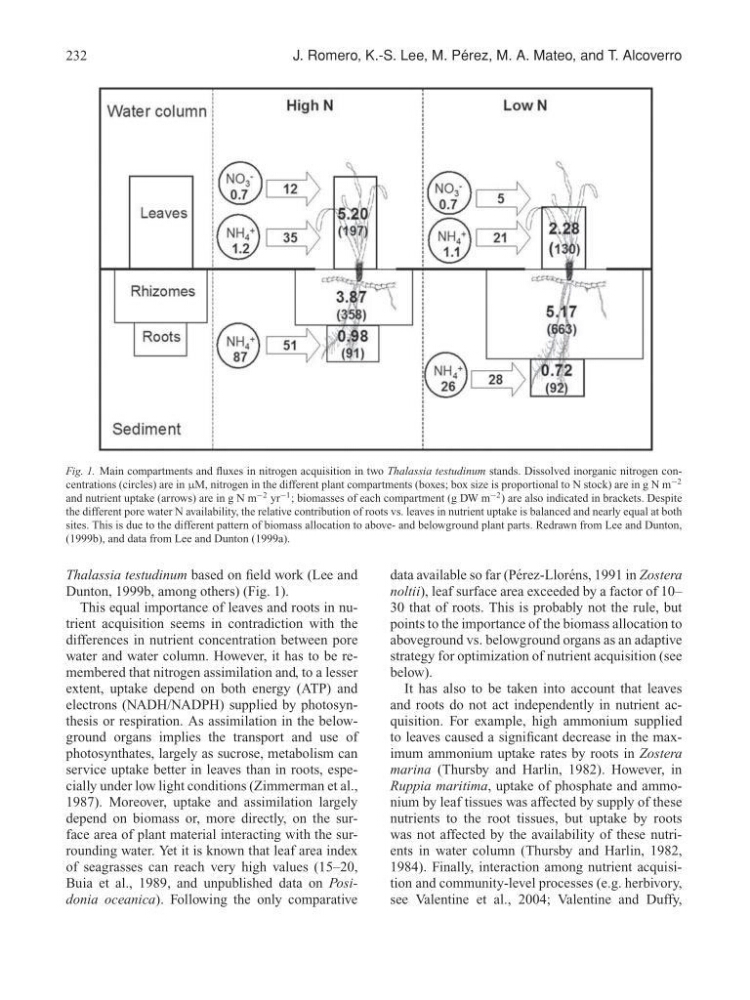
Fig. 1. Main compartments and fluxes in nitrogen acquisition in two Thalassia testudinum stands. Dissolved inorganic nitrogen concentrations (circles) are in µM, nitrogen in the different plant compartments (boxes; box size is proportional to N stock) are in g N m
−2
and nutrient uptake (arrows) are in g N m
−2 yr
−1 ; biomasses of each compartment (g DW m
−2 ) are also indicated in brackets. Despite
the different pore water N availability, the relative contribution of roots vs. leaves in nutrient uptake is balanced and nearly equal at both
sites. This is due to the different pattern of biomass allocation to above- and belowground plant parts. Redrawn from Lee and Dunton,
(1999b), and data from Lee and Dunton (1999a).
Thalassia testudinum based on field work (Lee and
Dunton, 1999b, among others) (Fig. 1).
This equal importance of leaves and roots in nutrient acquisition seems in contradiction with the
differences in nutrient concentration between pore
water and water column. However, it has to be remembered that nitrogen assimilation and, to a lesser
extent, uptake depend on both energy (ATP) and
electrons (NADH/NADPH) supplied by photosynthesis or respiration. As assimilation in the belowground organs implies the transport and use of
photosynthates, largely as sucrose, metabolism can
service uptake better in leaves than in roots, especially under low light conditions (Zimmerman et al.,
1987). Moreover, uptake and assimilation largely
depend on biomass or, more directly, on the surface area of plant material interacting with the surrounding water. Yet it is known that leaf area index
of seagrasses can reach very high values (15–20,
Buia et al., 1989, and unpublished data on Posidonia oceanica). Following the only comparative
data available so far (P´ erez-Llor´ ens, 1991 in Zostera
noltii), leaf surface area exceeded by a factor of 10–
30 that of roots. This is probably not the rule, but
points to the importance of the biomass allocation to
aboveground vs. belowground organs as an adaptive
strategy for optimization of nutrient acquisition (see
below).
It has also to be taken into account that leaves
and roots do not act independently in nutrient acquisition. For example, high ammonium supplied
to leaves caused a significant decrease in the maximum ammonium uptake rates by roots in Zostera
marina (Thursby and Harlin, 1982). However, in
Ruppia maritima, uptake of phosphate and ammonium by leaf tissues was affected by supply of these
nutrients to the root tissues, but uptake by roots
was not affected by the availability of these nutrients in water column (Thursby and Harlin, 1982,
1984). Finally, interaction among nutrient acquisition and community-level processes (e.g. herbivory,
see Valentine et al., 2004; Valentine and Duffy,
J. Romero, K.-S. Lee, M. P ´
erez, M. A. Mateo, and T. Alcoverro
Fig. 1. Main compartments and fluxes in nitrogen acquisition in two Thalassia testudinum stands. Dissolved inorganic nitrogen concentrations (circles) are in µM, nitrogen in the different plant compartments (boxes; box size is proportional to N stock) are in g N m
−2
and nutrient uptake (arrows) are in g N m
−2 yr
−1 ; biomasses of each compartment (g DW m
−2 ) are also indicated in brackets. Despite
the different pore water N availability, the relative contribution of roots vs. leaves in nutrient uptake is balanced and nearly equal at both
sites. This is due to the different pattern of biomass allocation to above- and belowground plant parts. Redrawn from Lee and Dunton,
(1999b), and data from Lee and Dunton (1999a).
Thalassia testudinum based on field work (Lee and
Dunton, 1999b, among others) (Fig. 1).
This equal importance of leaves and roots in nutrient acquisition seems in contradiction with the
differences in nutrient concentration between pore
water and water column. However, it has to be remembered that nitrogen assimilation and, to a lesser
extent, uptake depend on both energy (ATP) and
electrons (NADH/NADPH) supplied by photosynthesis or respiration. As assimilation in the belowground organs implies the transport and use of
photosynthates, largely as sucrose, metabolism can
service uptake better in leaves than in roots, especially under low light conditions (Zimmerman et al.,
1987). Moreover, uptake and assimilation largely
depend on biomass or, more directly, on the surface area of plant material interacting with the surrounding water. Yet it is known that leaf area index
of seagrasses can reach very high values (15–20,
Buia et al., 1989, and unpublished data on Posidonia oceanica). Following the only comparative
data available so far (P´ erez-Llor´ ens, 1991 in Zostera
noltii), leaf surface area exceeded by a factor of 10–
30 that of roots. This is probably not the rule, but
points to the importance of the biomass allocation to
aboveground vs. belowground organs as an adaptive
strategy for optimization of nutrient acquisition (see
below).
It has also to be taken into account that leaves
and roots do not act independently in nutrient acquisition. For example, high ammonium supplied
to leaves caused a significant decrease in the maximum ammonium uptake rates by roots in Zostera
marina (Thursby and Harlin, 1982). However, in
Ruppia maritima, uptake of phosphate and ammonium by leaf tissues was affected by supply of these
nutrients to the root tissues, but uptake by roots
was not affected by the availability of these nutrients in water column (Thursby and Harlin, 1982,
1984). Finally, interaction among nutrient acquisition and community-level processes (e.g. herbivory,
see Valentine et al., 2004; Valentine and Duffy,