

Chapter 9
Nutrient Dynamics in Seagrass Ecosystems
Javier Romero*
Departament d’Ecologia, Universitat de Barcelona, Avda. Diagonal 645, 08028
Barcelona, Spain
Kun-Seop Lee
Department of Biology, Pusan National University, Pusan 609-735, Korea
Marta P ´
erez and Miguel A. Mateo
Departament d’Ecologia, Universitat de Barcelona, Avda. Diagonal 645, 08028
Barcelona, Spain
Teresa Alcoverro
Centre d’Estudis Avan¸ cats de Blanes, CSIC, Cam´ ı de Sta. B `
arbara s/n, 17300
Blanes, Spain
I. Introduction
A. Nutrients: Concept
The term ‘nutrient’ applies to any material that, taken
into a living organism, serves to sustain it in its existence, promoting growth, replacing losses, or providing energy. In the framework of primary production
ecology, the term ‘nutrients’ is usually understood as
‘inorganic nutrients’, that is, inorganic salts or ions
that provide the elements necessary for plant survival, growth, and reproduction. Almost all the natural occurring elements are found in plant tissues;
however, only a reduced number (17) are necessary
for plant growth: these are called essential elements.
They range from elements constituting the bulk of
plant tissues (i.e. C, H, and O) to trace elements
that are only required for a very specific biochemical function (e.g. Fe, Co). Except for, maybe, oxygen
and hydrogen, all of them can be considered nutrients. However, the interest of plant physiologists and
ecologists is usually in those anions or cations, which
∗ Author for correspondence, email: jromero@ub.edu
are likely to limit plant growth and production, i.e.
those elements in which the supply is limited as compared with plant requirements.
B. Major Nutrients in the Sea:
Nitrogen and Phosphorous
The synthesis of organic matter by primary producers can be viewed as a kind of stoichiometric reaction
(in the sense that the reactants should be present at
some definite proportions to give the final product).
The following equation is often used as a reference
for plankton production:
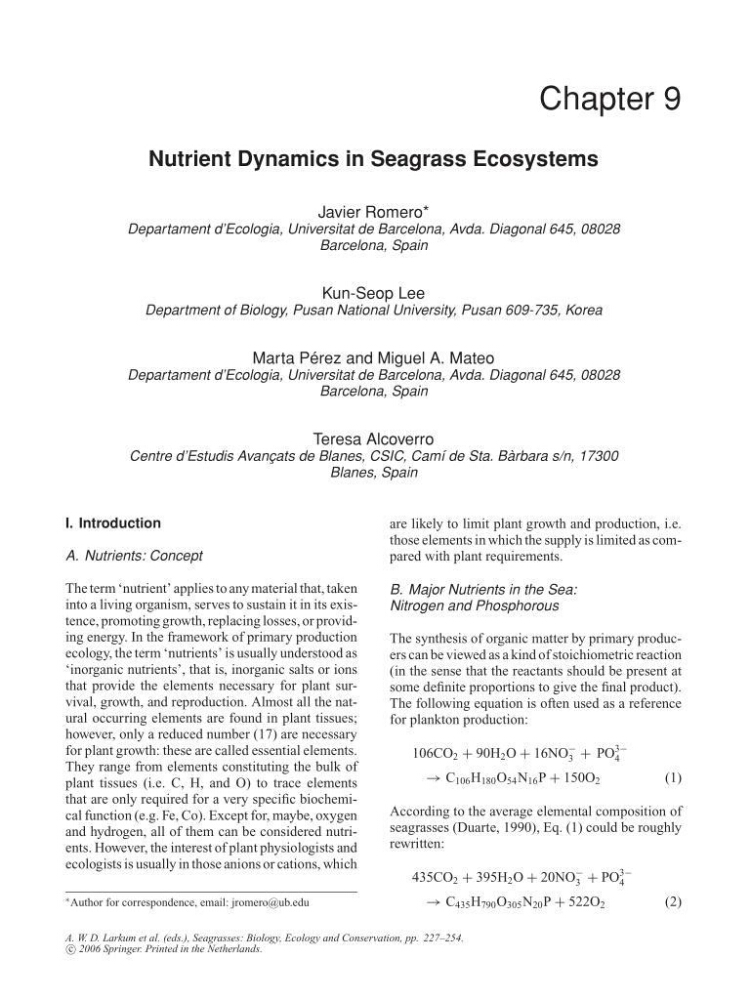
106CO 2 + 90H 2 O + 16NO
−
3 + PO
3−
4
→ C 106 H 180 O 54 N 16 P + 150O 2
(1)
According to the average elemental composition of
seagrasses (Duarte, 1990), Eq. (1) could be roughly
rewritten:
435CO 2 + 395H 2 O + 20NO
−
3 + PO
3−
4
→ C 435 H 790 O 305 N 20 P + 522O 2
(2)
227–254.
A. W. D. Larkum et al. (eds.), Seagrasses: Biology, Ecology and Conservation, pp.
c
2006 Springer. Printed in the Netherlands.
Nutrient Dynamics in Seagrass Ecosystems
Javier Romero*
Departament d’Ecologia, Universitat de Barcelona, Avda. Diagonal 645, 08028
Barcelona, Spain
Kun-Seop Lee
Department of Biology, Pusan National University, Pusan 609-735, Korea
Marta P ´
erez and Miguel A. Mateo
Departament d’Ecologia, Universitat de Barcelona, Avda. Diagonal 645, 08028
Barcelona, Spain
Teresa Alcoverro
Centre d’Estudis Avan¸ cats de Blanes, CSIC, Cam´ ı de Sta. B `
arbara s/n, 17300
Blanes, Spain
I. Introduction
A. Nutrients: Concept
The term ‘nutrient’ applies to any material that, taken
into a living organism, serves to sustain it in its existence, promoting growth, replacing losses, or providing energy. In the framework of primary production
ecology, the term ‘nutrients’ is usually understood as
‘inorganic nutrients’, that is, inorganic salts or ions
that provide the elements necessary for plant survival, growth, and reproduction. Almost all the natural occurring elements are found in plant tissues;
however, only a reduced number (17) are necessary
for plant growth: these are called essential elements.
They range from elements constituting the bulk of
plant tissues (i.e. C, H, and O) to trace elements
that are only required for a very specific biochemical function (e.g. Fe, Co). Except for, maybe, oxygen
and hydrogen, all of them can be considered nutrients. However, the interest of plant physiologists and
ecologists is usually in those anions or cations, which
∗ Author for correspondence, email: jromero@ub.edu
are likely to limit plant growth and production, i.e.
those elements in which the supply is limited as compared with plant requirements.
B. Major Nutrients in the Sea:
Nitrogen and Phosphorous
The synthesis of organic matter by primary producers can be viewed as a kind of stoichiometric reaction
(in the sense that the reactants should be present at
some definite proportions to give the final product).
The following equation is often used as a reference
for plankton production:
106CO 2 + 90H 2 O + 16NO
−
3 + PO
3−
4
→ C 106 H 180 O 54 N 16 P + 150O 2
(1)
According to the average elemental composition of
seagrasses (Duarte, 1990), Eq. (1) could be roughly
rewritten:
435CO 2 + 395H 2 O + 20NO
−
3 + PO
3−
4
→ C 435 H 790 O 305 N 20 P + 522O 2
(2)
227–254.
A. W. D. Larkum et al. (eds.), Seagrasses: Biology, Ecology and Conservation, pp.
c
2006 Springer. Printed in the Netherlands.