

Chapter 8 Fluid Dynamics in Seagrass Ecology
209
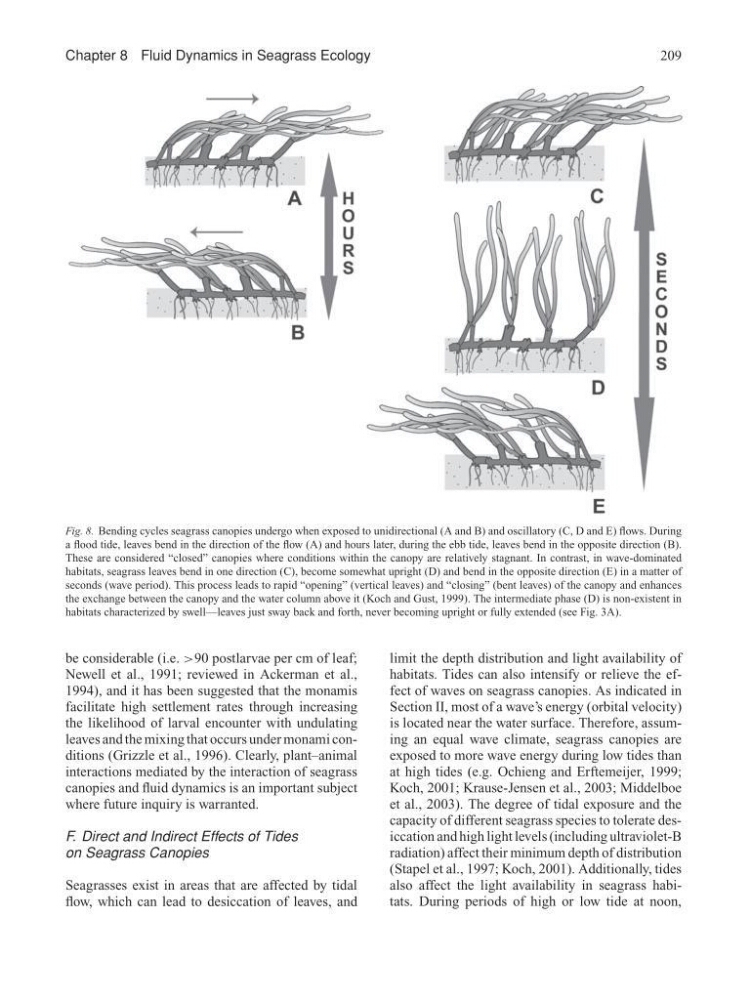
Fig. 8. Bending cycles seagrass canopies undergo when exposed to unidirectional (A and B) and oscillatory (C, D and E) flows. During
a flood tide, leaves bend in the direction of the flow (A) and hours later, during the ebb tide, leaves bend in the opposite direction (B).
These are considered “closed” canopies where conditions within the canopy are relatively stagnant. In contrast, in wave-dominated
habitats, seagrass leaves bend in one direction (C), become somewhat upright (D) and bend in the opposite direction (E) in a matter of
seconds (wave period). This process leads to rapid “opening” (vertical leaves) and “closing” (bent leaves) of the canopy and enhances
the exchange between the canopy and the water column above it (Koch and Gust, 1999). The intermediate phase (D) is non-existent in
habitats characterized by swell—leaves just sway back and forth, never becoming upright or fully extended (see Fig. 3A).
be considerable (i.e. >90 postlarvae per cm of leaf;
Newell et al., 1991; reviewed in Ackerman et al.,
1994), and it has been suggested that the monamis
facilitate high settlement rates through increasing
the likelihood of larval encounter with undulating
leaves and the mixing that occurs under monami conditions (Grizzle et al., 1996). Clearly, plant–animal
interactions mediated by the interaction of seagrass
canopies and fluid dynamics is an important subject
where future inquiry is warranted.
F. Direct and Indirect Effects of Tides
on Seagrass Canopies
Seagrasses exist in areas that are affected by tidal
flow, which can lead to desiccation of leaves, and
limit the depth distribution and light availability of
habitats. Tides can also intensify or relieve the effect of waves on seagrass canopies. As indicated in
Section II, most of a wave’s energy (orbital velocity)
is located near the water surface. Therefore, assuming an equal wave climate, seagrass canopies are
exposed to more wave energy during low tides than
at high tides (e.g. Ochieng and Erftemeijer, 1999;
Koch, 2001; Krause-Jensen et al., 2003; Middelboe
et al., 2003). The degree of tidal exposure and the
capacity of different seagrass species to tolerate desiccation and high light levels (including ultraviolet-B
radiation) affect their minimum depth of distribution
(Stapel et al., 1997; Koch, 2001). Additionally, tides
also affect the light availability in seagrass habitats. During periods of high or low tide at noon,
209
Fig. 8. Bending cycles seagrass canopies undergo when exposed to unidirectional (A and B) and oscillatory (C, D and E) flows. During
a flood tide, leaves bend in the direction of the flow (A) and hours later, during the ebb tide, leaves bend in the opposite direction (B).
These are considered “closed” canopies where conditions within the canopy are relatively stagnant. In contrast, in wave-dominated
habitats, seagrass leaves bend in one direction (C), become somewhat upright (D) and bend in the opposite direction (E) in a matter of
seconds (wave period). This process leads to rapid “opening” (vertical leaves) and “closing” (bent leaves) of the canopy and enhances
the exchange between the canopy and the water column above it (Koch and Gust, 1999). The intermediate phase (D) is non-existent in
habitats characterized by swell—leaves just sway back and forth, never becoming upright or fully extended (see Fig. 3A).
be considerable (i.e. >90 postlarvae per cm of leaf;
Newell et al., 1991; reviewed in Ackerman et al.,
1994), and it has been suggested that the monamis
facilitate high settlement rates through increasing
the likelihood of larval encounter with undulating
leaves and the mixing that occurs under monami conditions (Grizzle et al., 1996). Clearly, plant–animal
interactions mediated by the interaction of seagrass
canopies and fluid dynamics is an important subject
where future inquiry is warranted.
F. Direct and Indirect Effects of Tides
on Seagrass Canopies
Seagrasses exist in areas that are affected by tidal
flow, which can lead to desiccation of leaves, and
limit the depth distribution and light availability of
habitats. Tides can also intensify or relieve the effect of waves on seagrass canopies. As indicated in
Section II, most of a wave’s energy (orbital velocity)
is located near the water surface. Therefore, assuming an equal wave climate, seagrass canopies are
exposed to more wave energy during low tides than
at high tides (e.g. Ochieng and Erftemeijer, 1999;
Koch, 2001; Krause-Jensen et al., 2003; Middelboe
et al., 2003). The degree of tidal exposure and the
capacity of different seagrass species to tolerate desiccation and high light levels (including ultraviolet-B
radiation) affect their minimum depth of distribution
(Stapel et al., 1997; Koch, 2001). Additionally, tides
also affect the light availability in seagrass habitats. During periods of high or low tide at noon,