

198
E. W. Koch, J. D. Ackerman, J. Verduin and M. van Keulen
celerities are equal. It is important to note that waves
and wave trains are not isolated from one another;
circumstances can lead to destructive interference
with calm periods between wave trains and constructive interference with the generation of large waves
including rogue wavees due to the convergence of
many waves.
As indicated above, a number of changes occur as
waves enter the nearshore and ultimately reach the
shore. The waves become shallow water waves as
the wave train encounters the friction (shear stress)
of the bottom or seagrass canopy, the wave orbits become more elliptical in shape near the bottom, and
the wave crests become more pronounced. This can
lead to wave-induced transport in a process referred
to as Stokes drift, which may be of considerable importance in many coastal environments (Monismith
and Fong, 2004). The steepness of the wave becomes
unstable if it is greater than 1:7 (H :λ) and the water at the crest begins to travel faster than the water
near the bottom and it will break into a plunging
wave, spilling wave, or surging wave depending on
the steepness and topography of the bottom. Since
waves approach the shore at different angles, they
are unlikely to break simultaneously and may refract
from the original direction leading to the complexity
of waves experienced in coastal seagrass beds (Koch
and Gust, 1999). Realistically, the fluid dynamic conditions within these nearshore regions are affected by
a number of factors including tides and wind waves,
all of which lead to significant changes in the surface
elevation and water flow within seagrass beds. The
general predictions are that seagrasses, like other
benthic vegetation, increase the bottom shear stress
and hence have a wave dampening affect (see Section
V.B., below). This process has been relatively well
characterized for coastal kelp forests (see review in
Okubo et al., 2002), but has yet to be examined in a
thorough manner for seagrasses. Clearly, additional
efforts are needed in this area.
Whereas, the ultimate goal of studying fluid dynamic concepts is to better understand ecological
processes in seagrasses, it is important to note that
vegetative flows remain the most complex and difficult flows to describe and understand (Raupach
et al., 1991; Finnigan, 2000). Therefore, applications
in vegetated flows have typically involved steady
state condition (i.e. non turbulent), although some
progress in unsteady flows has been made with respect to seaweeds (Gaylord and Denny, 1997). Fortunately, this realization provides a challenge to those
interested in the biological, chemical, geological,
and physical processes that occur in seagrass systems.
III. Micro-Scale Processes at the Molecular
Level (µm)
As water flows through seagrass beds, a boundary
layer develops on the sediment surface as well as on
each seagrass component exposed to the moving water (leaf, short-shoot, flower) (Ackerman, 1986; Fonseca and Kenworthy, 1987; Koch, 1994; Cornelisen
and Thomas, 2002). The faster the water moves,
the thinner the diffusive boundary layer (DBL, or
δ D ) becomes (Massel, 1999; Fig. 1) and, consequently, the faster the transfer of molecules from
the water column to the sediment and/or seagrass.
It follows that when currents are weak, the flux of
molecules to the seagrass surface may be limited by
diffusion through the δ D (i.e. physical limitation).
Under those conditions, many biological sites or
enzymes in the seagrass tissue are available to assimilate molecules when/if they reach the plant’s surface
(Koch, 1994; Cornelisen and Thomas, 2002). After a
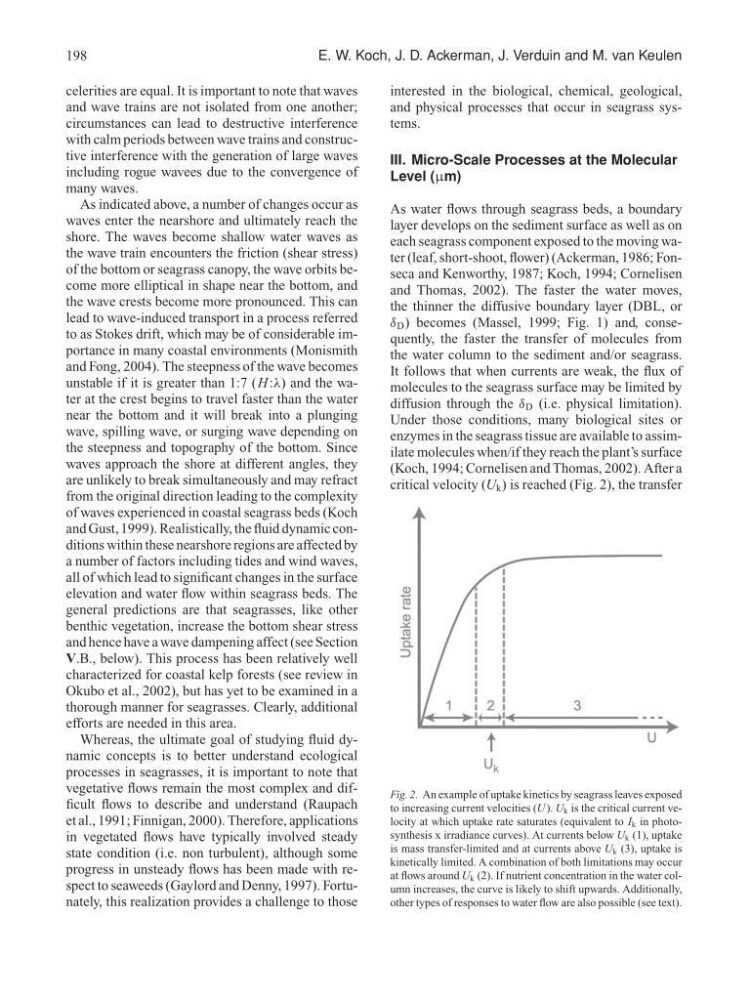
critical velocity (U k ) is reached (Fig. 2), the transfer
Fig. 2. An example of uptake kinetics by seagrass leaves exposed
to increasing current velocities (U ). U k is the critical current velocity at which uptake rate saturates (equivalent to I k in photosynthesis x irradiance curves). At currents below U k (1), uptake
is mass transfer-limited and at currents above U k (3), uptake is
kinetically limited. A combination of both limitations may occur
at flows around U k (2). If nutrient concentration in the water column increases, the curve is likely to shift upwards. Additionally,
other types of responses to water flow are also possible (see text).
E. W. Koch, J. D. Ackerman, J. Verduin and M. van Keulen
celerities are equal. It is important to note that waves
and wave trains are not isolated from one another;
circumstances can lead to destructive interference
with calm periods between wave trains and constructive interference with the generation of large waves
including rogue wavees due to the convergence of
many waves.
As indicated above, a number of changes occur as
waves enter the nearshore and ultimately reach the
shore. The waves become shallow water waves as
the wave train encounters the friction (shear stress)
of the bottom or seagrass canopy, the wave orbits become more elliptical in shape near the bottom, and
the wave crests become more pronounced. This can
lead to wave-induced transport in a process referred
to as Stokes drift, which may be of considerable importance in many coastal environments (Monismith
and Fong, 2004). The steepness of the wave becomes
unstable if it is greater than 1:7 (H :λ) and the water at the crest begins to travel faster than the water
near the bottom and it will break into a plunging
wave, spilling wave, or surging wave depending on
the steepness and topography of the bottom. Since
waves approach the shore at different angles, they
are unlikely to break simultaneously and may refract
from the original direction leading to the complexity
of waves experienced in coastal seagrass beds (Koch
and Gust, 1999). Realistically, the fluid dynamic conditions within these nearshore regions are affected by
a number of factors including tides and wind waves,
all of which lead to significant changes in the surface
elevation and water flow within seagrass beds. The
general predictions are that seagrasses, like other
benthic vegetation, increase the bottom shear stress
and hence have a wave dampening affect (see Section
V.B., below). This process has been relatively well
characterized for coastal kelp forests (see review in
Okubo et al., 2002), but has yet to be examined in a
thorough manner for seagrasses. Clearly, additional
efforts are needed in this area.
Whereas, the ultimate goal of studying fluid dynamic concepts is to better understand ecological
processes in seagrasses, it is important to note that
vegetative flows remain the most complex and difficult flows to describe and understand (Raupach
et al., 1991; Finnigan, 2000). Therefore, applications
in vegetated flows have typically involved steady
state condition (i.e. non turbulent), although some
progress in unsteady flows has been made with respect to seaweeds (Gaylord and Denny, 1997). Fortunately, this realization provides a challenge to those
interested in the biological, chemical, geological,
and physical processes that occur in seagrass systems.
III. Micro-Scale Processes at the Molecular
Level (µm)
As water flows through seagrass beds, a boundary
layer develops on the sediment surface as well as on
each seagrass component exposed to the moving water (leaf, short-shoot, flower) (Ackerman, 1986; Fonseca and Kenworthy, 1987; Koch, 1994; Cornelisen
and Thomas, 2002). The faster the water moves,
the thinner the diffusive boundary layer (DBL, or
δ D ) becomes (Massel, 1999; Fig. 1) and, consequently, the faster the transfer of molecules from
the water column to the sediment and/or seagrass.
It follows that when currents are weak, the flux of
molecules to the seagrass surface may be limited by
diffusion through the δ D (i.e. physical limitation).
Under those conditions, many biological sites or
enzymes in the seagrass tissue are available to assimilate molecules when/if they reach the plant’s surface
(Koch, 1994; Cornelisen and Thomas, 2002). After a
critical velocity (U k ) is reached (Fig. 2), the transfer
Fig. 2. An example of uptake kinetics by seagrass leaves exposed
to increasing current velocities (U ). U k is the critical current velocity at which uptake rate saturates (equivalent to I k in photosynthesis x irradiance curves). At currents below U k (1), uptake
is mass transfer-limited and at currents above U k (3), uptake is
kinetically limited. A combination of both limitations may occur
at flows around U k (2). If nutrient concentration in the water column increases, the curve is likely to shift upwards. Additionally,
other types of responses to water flow are also possible (see text).