

164
M. A. Mateo, J. Cebri ´
an, K. Dunton, and T. Mutchler
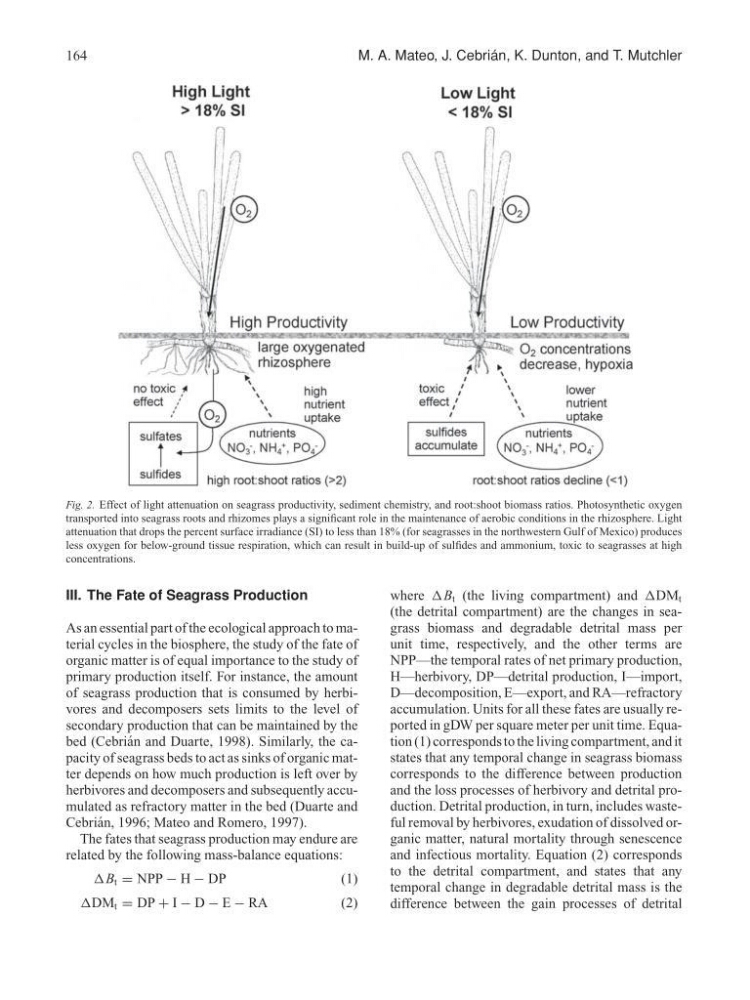
Fig. 2. Effect of light attenuation on seagrass productivity, sediment chemistry, and root:shoot biomass ratios. Photosynthetic oxygen
transported into seagrass roots and rhizomes plays a significant role in the maintenance of aerobic conditions in the rhizosphere. Light
attenuation that drops the percent surface irradiance (SI) to less than 18% (for seagrasses in the northwestern Gulf of Mexico) produces
less oxygen for below-ground tissue respiration, which can result in build-up of sulfides and ammonium, toxic to seagrasses at high
concentrations.
III. The Fate of Seagrass Production
As an essential part of the ecological approach to material cycles in the biosphere, the study of the fate of
organic matter is of equal importance to the study of
primary production itself. For instance, the amount
of seagrass production that is consumed by herbivores and decomposers sets limits to the level of
secondary production that can be maintained by the
bed (Cebri´ an and Duarte, 1998). Similarly, the capacity of seagrass beds to act as sinks of organic matter depends on how much production is left over by
herbivores and decomposers and subsequently accumulated as refractory matter in the bed (Duarte and
Cebri´ an, 1996; Mateo and Romero, 1997).
The fates that seagrass production may endure are
related by the following mass-balance equations:
B t = NPP − H − DP
(1)
DM t = DP + I − D − E − RA
(2)
where B t (the living compartment) and DM t
(the detrital compartment) are the changes in seagrass biomass and degradable detrital mass per
unit time, respectively, and the other terms are
NPP—the temporal rates of net primary production,
H—herbivory, DP—detrital production, I—import,
D—decomposition, E—export, and RA—refractory
accumulation. Units for all these fates are usually reported in gDW per square meter per unit time. Equation (1) corresponds to the living compartment, and it
states that any temporal change in seagrass biomass
corresponds to the difference between production
and the loss processes of herbivory and detrital production. Detrital production, in turn, includes wasteful removal by herbivores, exudation of dissolved organic matter, natural mortality through senescence
and infectious mortality. Equation (2) corresponds
to the detrital compartment, and states that any
temporal change in degradable detrital mass is the
difference between the gain processes of detrital
M. A. Mateo, J. Cebri ´
an, K. Dunton, and T. Mutchler
Fig. 2. Effect of light attenuation on seagrass productivity, sediment chemistry, and root:shoot biomass ratios. Photosynthetic oxygen
transported into seagrass roots and rhizomes plays a significant role in the maintenance of aerobic conditions in the rhizosphere. Light
attenuation that drops the percent surface irradiance (SI) to less than 18% (for seagrasses in the northwestern Gulf of Mexico) produces
less oxygen for below-ground tissue respiration, which can result in build-up of sulfides and ammonium, toxic to seagrasses at high
concentrations.
III. The Fate of Seagrass Production
As an essential part of the ecological approach to material cycles in the biosphere, the study of the fate of
organic matter is of equal importance to the study of
primary production itself. For instance, the amount
of seagrass production that is consumed by herbivores and decomposers sets limits to the level of
secondary production that can be maintained by the
bed (Cebri´ an and Duarte, 1998). Similarly, the capacity of seagrass beds to act as sinks of organic matter depends on how much production is left over by
herbivores and decomposers and subsequently accumulated as refractory matter in the bed (Duarte and
Cebri´ an, 1996; Mateo and Romero, 1997).
The fates that seagrass production may endure are
related by the following mass-balance equations:
B t = NPP − H − DP
(1)
DM t = DP + I − D − E − RA
(2)
where B t (the living compartment) and DM t
(the detrital compartment) are the changes in seagrass biomass and degradable detrital mass per
unit time, respectively, and the other terms are
NPP—the temporal rates of net primary production,
H—herbivory, DP—detrital production, I—import,
D—decomposition, E—export, and RA—refractory
accumulation. Units for all these fates are usually reported in gDW per square meter per unit time. Equation (1) corresponds to the living compartment, and it
states that any temporal change in seagrass biomass
corresponds to the difference between production
and the loss processes of herbivory and detrital production. Detrital production, in turn, includes wasteful removal by herbivores, exudation of dissolved organic matter, natural mortality through senescence
and infectious mortality. Equation (2) corresponds
to the detrital compartment, and states that any
temporal change in degradable detrital mass is the
difference between the gain processes of detrital