

144
N. Marb `
a, M. Holmer, and E. Gacia
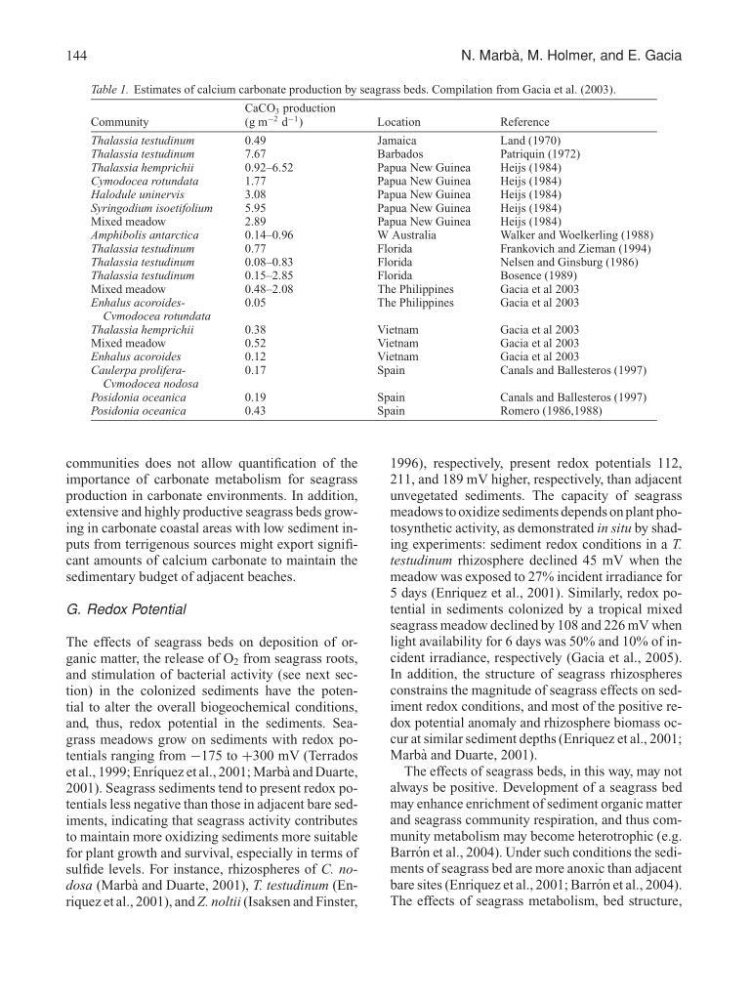
Table 1. Estimates of calcium carbonate production by seagrass beds. Compilation from Gacia et al. (2003).
CaCO 3 production
Community
(g m
−2 d
−1 )
Location
Reference
Thalassia testudinum
0.49
Jamaica
Land (1970)
Thalassia testudinum
7.67
Barbados
Patriquin (1972)
Thalassia hemprichii
0.92–6.52
Papua New Guinea
Heijs (1984)
Cymodocea rotundata
1.77
Papua New Guinea
Heijs (1984)
Halodule uninervis
3.08
Papua New Guinea
Heijs (1984)
Syringodium isoetifolium
5.95
Papua New Guinea
Heijs (1984)
Mixed meadow
2.89
Papua New Guinea
Heijs (1984)
Amphibolis antarctica
0.14–0.96
W Australia
Walker and Woelkerling (1988)
Thalassia testudinum
0.77
Florida
Frankovich and Zieman (1994)
Thalassia testudinum
0.08–0.83
Florida
Nelsen and Ginsburg (1986)
Thalassia testudinum
0.15–2.85
Florida
Bosence (1989)
Mixed meadow
0.48–2.08
The Philippines
Gacia et al 2003
Enhalus acoroides0.05
The Philippines
Gacia et al 2003
Cvmodocea rotundata
Thalassia hemprichii
0.38
Vietnam
Gacia et al 2003
Mixed meadow
0.52
Vietnam
Gacia et al 2003
Enhalus acoroides
0.12
Vietnam
Gacia et al 2003
Caulerpa prolifera0.17
Spain
Canals and Ballesteros (1997)
Cvmodocea nodosa
Posidonia oceanica
0.19
Spain
Canals and Ballesteros (1997)
Posidonia oceanica
0.43
Spain
Romero (1986,1988)
communities does not allow quantification of the
importance of carbonate metabolism for seagrass
production in carbonate environments. In addition,
extensive and highly productive seagrass beds growing in carbonate coastal areas with low sediment inputs from terrigenous sources might export significant amounts of calcium carbonate to maintain the
sedimentary budget of adjacent beaches.
G. Redox Potential
The effects of seagrass beds on deposition of organic matter, the release of O 2 from seagrass roots,
and stimulation of bacterial activity (see next section) in the colonized sediments have the potential to alter the overall biogeochemical conditions,
and, thus, redox potential in the sediments. Seagrass meadows grow on sediments with redox potentials ranging from −175 to +300 mV (Terrados
et al., 1999; Enr´ ıquez et al., 2001; Marb` a and Duarte,
2001). Seagrass sediments tend to present redox potentials less negative than those in adjacent bare sediments, indicating that seagrass activity contributes
to maintain more oxidizing sediments more suitable
for plant growth and survival, especially in terms of
sulfide levels. For instance, rhizospheres of C. nodosa (Marb` a and Duarte, 2001), T. testudinum (Enriquez et al., 2001), and Z. noltii (Isaksen and Finster,
1996), respectively, present redox potentials 112,
211, and 189 mV higher, respectively, than adjacent
unvegetated sediments. The capacity of seagrass
meadows to oxidize sediments depends on plant photosynthetic activity, as demonstrated in situ by shading experiments: sediment redox conditions in a T.
testudinum rhizosphere declined 45 mV when the
meadow was exposed to 27% incident irradiance for
5 days (Enriquez et al., 2001). Similarly, redox potential in sediments colonized by a tropical mixed
seagrass meadow declined by 108 and 226 mV when
light availability for 6 days was 50% and 10% of incident irradiance, respectively (Gacia et al., 2005).
In addition, the structure of seagrass rhizospheres
constrains the magnitude of seagrass effects on sediment redox conditions, and most of the positive redox potential anomaly and rhizosphere biomass occur at similar sediment depths (Enriquez et al., 2001;
Marb` a and Duarte, 2001).
The effects of seagrass beds, in this way, may not
always be positive. Development of a seagrass bed
may enhance enrichment of sediment organic matter
and seagrass community respiration, and thus community metabolism may become heterotrophic (e.g.
Barr´ on et al., 2004). Under such conditions the sediments of seagrass bed are more anoxic than adjacent
bare sites (Enriquez et al., 2001; Barr´ on et al., 2004).
The effects of seagrass metabolism, bed structure,
N. Marb `
a, M. Holmer, and E. Gacia
Table 1. Estimates of calcium carbonate production by seagrass beds. Compilation from Gacia et al. (2003).
CaCO 3 production
Community
(g m
−2 d
−1 )
Location
Reference
Thalassia testudinum
0.49
Jamaica
Land (1970)
Thalassia testudinum
7.67
Barbados
Patriquin (1972)
Thalassia hemprichii
0.92–6.52
Papua New Guinea
Heijs (1984)
Cymodocea rotundata
1.77
Papua New Guinea
Heijs (1984)
Halodule uninervis
3.08
Papua New Guinea
Heijs (1984)
Syringodium isoetifolium
5.95
Papua New Guinea
Heijs (1984)
Mixed meadow
2.89
Papua New Guinea
Heijs (1984)
Amphibolis antarctica
0.14–0.96
W Australia
Walker and Woelkerling (1988)
Thalassia testudinum
0.77
Florida
Frankovich and Zieman (1994)
Thalassia testudinum
0.08–0.83
Florida
Nelsen and Ginsburg (1986)
Thalassia testudinum
0.15–2.85
Florida
Bosence (1989)
Mixed meadow
0.48–2.08
The Philippines
Gacia et al 2003
Enhalus acoroides0.05
The Philippines
Gacia et al 2003
Cvmodocea rotundata
Thalassia hemprichii
0.38
Vietnam
Gacia et al 2003
Mixed meadow
0.52
Vietnam
Gacia et al 2003
Enhalus acoroides
0.12
Vietnam
Gacia et al 2003
Caulerpa prolifera0.17
Spain
Canals and Ballesteros (1997)
Cvmodocea nodosa
Posidonia oceanica
0.19
Spain
Canals and Ballesteros (1997)
Posidonia oceanica
0.43
Spain
Romero (1986,1988)
communities does not allow quantification of the
importance of carbonate metabolism for seagrass
production in carbonate environments. In addition,
extensive and highly productive seagrass beds growing in carbonate coastal areas with low sediment inputs from terrigenous sources might export significant amounts of calcium carbonate to maintain the
sedimentary budget of adjacent beaches.
G. Redox Potential
The effects of seagrass beds on deposition of organic matter, the release of O 2 from seagrass roots,
and stimulation of bacterial activity (see next section) in the colonized sediments have the potential to alter the overall biogeochemical conditions,
and, thus, redox potential in the sediments. Seagrass meadows grow on sediments with redox potentials ranging from −175 to +300 mV (Terrados
et al., 1999; Enr´ ıquez et al., 2001; Marb` a and Duarte,
2001). Seagrass sediments tend to present redox potentials less negative than those in adjacent bare sediments, indicating that seagrass activity contributes
to maintain more oxidizing sediments more suitable
for plant growth and survival, especially in terms of
sulfide levels. For instance, rhizospheres of C. nodosa (Marb` a and Duarte, 2001), T. testudinum (Enriquez et al., 2001), and Z. noltii (Isaksen and Finster,
1996), respectively, present redox potentials 112,
211, and 189 mV higher, respectively, than adjacent
unvegetated sediments. The capacity of seagrass
meadows to oxidize sediments depends on plant photosynthetic activity, as demonstrated in situ by shading experiments: sediment redox conditions in a T.
testudinum rhizosphere declined 45 mV when the
meadow was exposed to 27% incident irradiance for
5 days (Enriquez et al., 2001). Similarly, redox potential in sediments colonized by a tropical mixed
seagrass meadow declined by 108 and 226 mV when
light availability for 6 days was 50% and 10% of incident irradiance, respectively (Gacia et al., 2005).
In addition, the structure of seagrass rhizospheres
constrains the magnitude of seagrass effects on sediment redox conditions, and most of the positive redox potential anomaly and rhizosphere biomass occur at similar sediment depths (Enriquez et al., 2001;
Marb` a and Duarte, 2001).
The effects of seagrass beds, in this way, may not
always be positive. Development of a seagrass bed
may enhance enrichment of sediment organic matter
and seagrass community respiration, and thus community metabolism may become heterotrophic (e.g.
Barr´ on et al., 2004). Under such conditions the sediments of seagrass bed are more anoxic than adjacent
bare sites (Enriquez et al., 2001; Barr´ on et al., 2004).
The effects of seagrass metabolism, bed structure,