

140
N. Marb `
a, M. Holmer, and E. Gacia
shifting seagrass bed metabolism from autotrophic
to heterotrophic (Ziegler and Benner, 1999a). In
sediments, DOC is also rapidly accessible to bacteria and becomes available to higher consumers
(Robertson et al., 1982). An experiment with T.
hemprichii and C. rotundata showed that both seagrass species excreted DOC by below-ground tissues
more than sufficient to fuel the anaerobic microbial
activity (Holmer et al., 2001). Also, the activity of
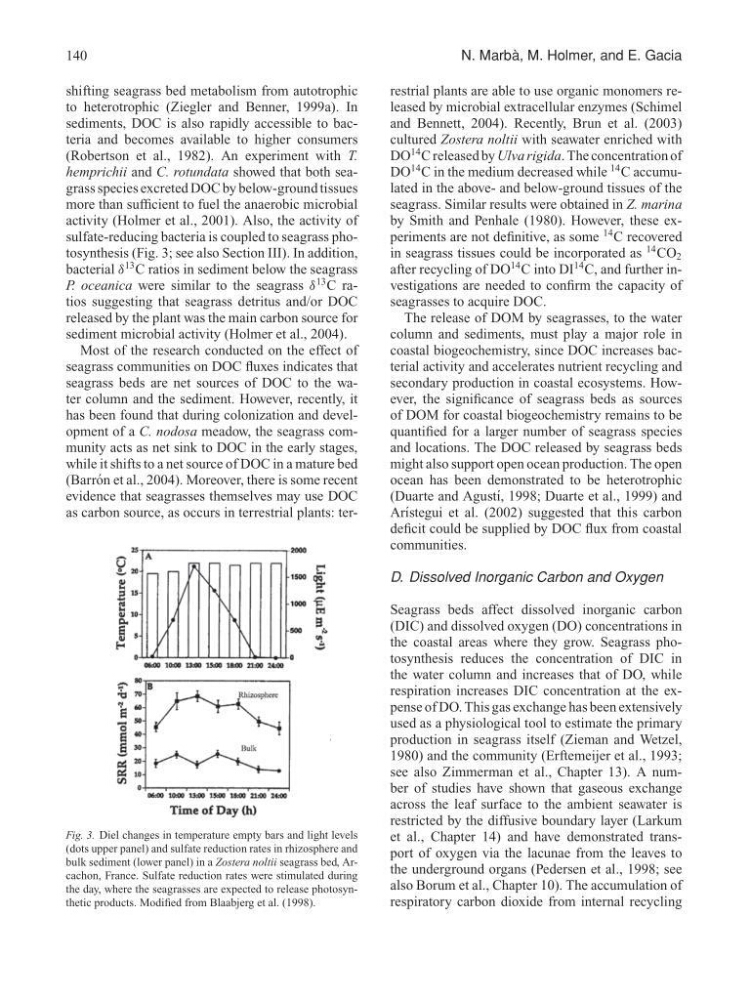
sulfate-reducing bacteria is coupled to seagrass photosynthesis (Fig. 3; see also Section III). In addition,
bacterial δ
13 C ratios in sediment below the seagrass
P. oceanica were similar to the seagrass δ
13 C ratios suggesting that seagrass detritus and/or DOC
released by the plant was the main carbon source for
sediment microbial activity (Holmer et al., 2004).
Most of the research conducted on the effect of
seagrass communities on DOC fluxes indicates that
seagrass beds are net sources of DOC to the water column and the sediment. However, recently, it
has been found that during colonization and development of a C. nodosa meadow, the seagrass community acts as net sink to DOC in the early stages,
while it shifts to a net source of DOC in a mature bed
(Barr´ on et al., 2004). Moreover, there is some recent
evidence that seagrasses themselves may use DOC
as carbon source, as occurs in terrestrial plants: terFig. 3. Diel changes in temperature empty bars and light levels
(dots upper panel) and sulfate reduction rates in rhizosphere and
bulk sediment (lower panel) in a Zostera noltii seagrass bed, Arcachon, France. Sulfate reduction rates were stimulated during
the day, where the seagrasses are expected to release photosynthetic products. Modified from Blaabjerg et al. (1998).
restrial plants are able to use organic monomers released by microbial extracellular enzymes (Schimel
and Bennett, 2004). Recently, Brun et al. (2003)
cultured Zostera noltii with seawater enriched with
DO
14 C released by Ulva rigida. The concentration of
DO
14 C in the medium decreased while
14 C accumulated in the above- and below-ground tissues of the
seagrass. Similar results were obtained in Z. marina
by Smith and Penhale (1980). However, these experiments are not definitive, as some
14 C recovered
in seagrass tissues could be incorporated as
14 CO 2
after recycling of DO
14 C into DI
14 C, and further investigations are needed to confirm the capacity of
seagrasses to acquire DOC.
The release of DOM by seagrasses, to the water
column and sediments, must play a major role in
coastal biogeochemistry, since DOC increases bacterial activity and accelerates nutrient recycling and
secondary production in coastal ecosystems. However, the significance of seagrass beds as sources
of DOM for coastal biogeochemistry remains to be
quantified for a larger number of seagrass species
and locations. The DOC released by seagrass beds
might also support open ocean production. The open
ocean has been demonstrated to be heterotrophic
(Duarte and Agust´ ı, 1998; Duarte et al., 1999) and
Ar´ ıstegui et al. (2002) suggested that this carbon
deficit could be supplied by DOC flux from coastal
communities.
D. Dissolved Inorganic Carbon and Oxygen
Seagrass beds affect dissolved inorganic carbon
(DIC) and dissolved oxygen (DO) concentrations in
the coastal areas where they grow. Seagrass photosynthesis reduces the concentration of DIC in
the water column and increases that of DO, while
respiration increases DIC concentration at the expense of DO. This gas exchange has been extensively
used as a physiological tool to estimate the primary
production in seagrass itself (Zieman and Wetzel,
1980) and the community (Erftemeijer et al., 1993;
see also Zimmerman et al., Chapter 13). A number of studies have shown that gaseous exchange
across the leaf surface to the ambient seawater is
restricted by the diffusive boundary layer (Larkum
et al., Chapter 14) and have demonstrated transport of oxygen via the lacunae from the leaves to
the underground organs (Pedersen et al., 1998; see
also Borum et al., Chapter 10). The accumulation of
respiratory carbon dioxide from internal recycling
N. Marb `
a, M. Holmer, and E. Gacia
shifting seagrass bed metabolism from autotrophic
to heterotrophic (Ziegler and Benner, 1999a). In
sediments, DOC is also rapidly accessible to bacteria and becomes available to higher consumers
(Robertson et al., 1982). An experiment with T.
hemprichii and C. rotundata showed that both seagrass species excreted DOC by below-ground tissues
more than sufficient to fuel the anaerobic microbial
activity (Holmer et al., 2001). Also, the activity of
sulfate-reducing bacteria is coupled to seagrass photosynthesis (Fig. 3; see also Section III). In addition,
bacterial δ
13 C ratios in sediment below the seagrass
P. oceanica were similar to the seagrass δ
13 C ratios suggesting that seagrass detritus and/or DOC
released by the plant was the main carbon source for
sediment microbial activity (Holmer et al., 2004).
Most of the research conducted on the effect of
seagrass communities on DOC fluxes indicates that
seagrass beds are net sources of DOC to the water column and the sediment. However, recently, it
has been found that during colonization and development of a C. nodosa meadow, the seagrass community acts as net sink to DOC in the early stages,
while it shifts to a net source of DOC in a mature bed
(Barr´ on et al., 2004). Moreover, there is some recent
evidence that seagrasses themselves may use DOC
as carbon source, as occurs in terrestrial plants: terFig. 3. Diel changes in temperature empty bars and light levels
(dots upper panel) and sulfate reduction rates in rhizosphere and
bulk sediment (lower panel) in a Zostera noltii seagrass bed, Arcachon, France. Sulfate reduction rates were stimulated during
the day, where the seagrasses are expected to release photosynthetic products. Modified from Blaabjerg et al. (1998).
restrial plants are able to use organic monomers released by microbial extracellular enzymes (Schimel
and Bennett, 2004). Recently, Brun et al. (2003)
cultured Zostera noltii with seawater enriched with
DO
14 C released by Ulva rigida. The concentration of
DO
14 C in the medium decreased while
14 C accumulated in the above- and below-ground tissues of the
seagrass. Similar results were obtained in Z. marina
by Smith and Penhale (1980). However, these experiments are not definitive, as some
14 C recovered
in seagrass tissues could be incorporated as
14 CO 2
after recycling of DO
14 C into DI
14 C, and further investigations are needed to confirm the capacity of
seagrasses to acquire DOC.
The release of DOM by seagrasses, to the water
column and sediments, must play a major role in
coastal biogeochemistry, since DOC increases bacterial activity and accelerates nutrient recycling and
secondary production in coastal ecosystems. However, the significance of seagrass beds as sources
of DOM for coastal biogeochemistry remains to be
quantified for a larger number of seagrass species
and locations. The DOC released by seagrass beds
might also support open ocean production. The open
ocean has been demonstrated to be heterotrophic
(Duarte and Agust´ ı, 1998; Duarte et al., 1999) and
Ar´ ıstegui et al. (2002) suggested that this carbon
deficit could be supplied by DOC flux from coastal
communities.
D. Dissolved Inorganic Carbon and Oxygen
Seagrass beds affect dissolved inorganic carbon
(DIC) and dissolved oxygen (DO) concentrations in
the coastal areas where they grow. Seagrass photosynthesis reduces the concentration of DIC in
the water column and increases that of DO, while
respiration increases DIC concentration at the expense of DO. This gas exchange has been extensively
used as a physiological tool to estimate the primary
production in seagrass itself (Zieman and Wetzel,
1980) and the community (Erftemeijer et al., 1993;
see also Zimmerman et al., Chapter 13). A number of studies have shown that gaseous exchange
across the leaf surface to the ambient seawater is
restricted by the diffusive boundary layer (Larkum
et al., Chapter 14) and have demonstrated transport of oxygen via the lacunae from the leaves to
the underground organs (Pedersen et al., 1998; see
also Borum et al., Chapter 10). The accumulation of
respiratory carbon dioxide from internal recycling