

Chapter 4 Seagrass Sexual Reproduction
103
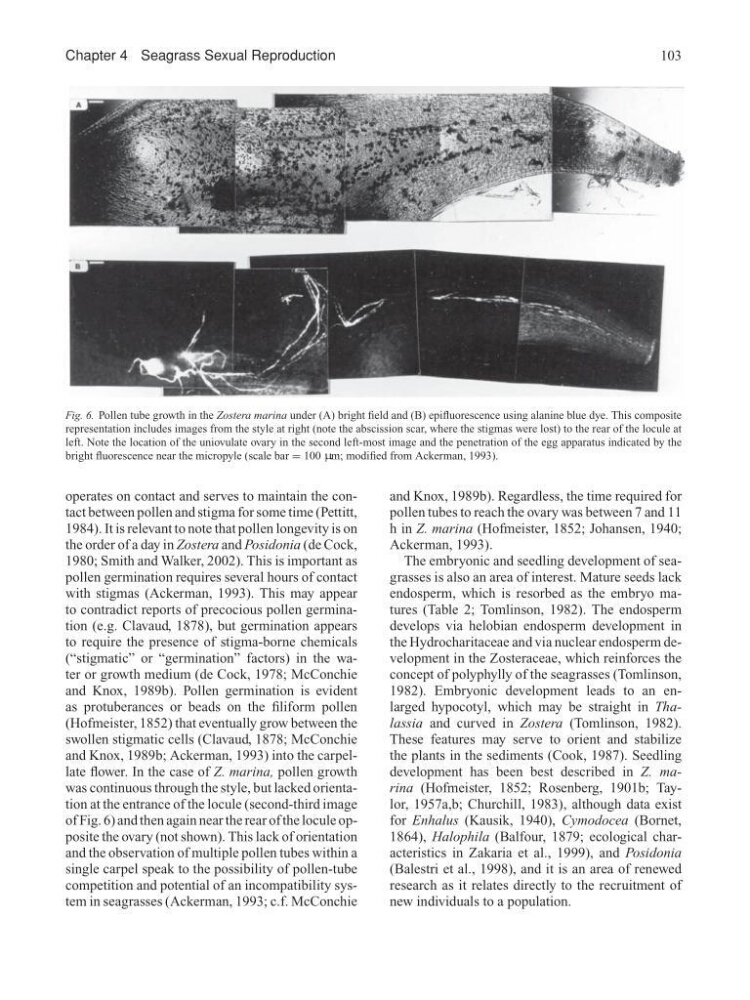
Fig. 6. Pollen tube growth in the Zostera marina under (A) bright field and (B) epifluorescence using alanine blue dye. This composite
representation includes images from the style at right (note the abscission scar, where the stigmas were lost) to the rear of the locule at
left. Note the location of the uniovulate ovary in the second left-most image and the penetration of the egg apparatus indicated by the
bright fluorescence near the micropyle (scale bar = 100 µm; modified from Ackerman, 1993).
operates on contact and serves to maintain the contact between pollen and stigma for some time (Pettitt,
1984). It is relevant to note that pollen longevity is on
the order of a day in Zostera and Posidonia (de Cock,
1980; Smith and Walker, 2002). This is important as
pollen germination requires several hours of contact
with stigmas (Ackerman, 1993). This may appear
to contradict reports of precocious pollen germination (e.g. Clavaud, 1878), but germination appears
to require the presence of stigma-borne chemicals
(“stigmatic” or “germination” factors) in the water or growth medium (de Cock, 1978; McConchie
and Knox, 1989b). Pollen germination is evident
as protuberances or beads on the filiform pollen
(Hofmeister, 1852) that eventually grow between the
swollen stigmatic cells (Clavaud, 1878; McConchie
and Knox, 1989b; Ackerman, 1993) into the carpellate flower. In the case of Z. marina, pollen growth
was continuous through the style, but lacked orientation at the entrance of the locule (second-third image
of Fig. 6) and then again near the rear of the locule opposite the ovary (not shown). This lack of orientation
and the observation of multiple pollen tubes within a
single carpel speak to the possibility of pollen-tube
competition and potential of an incompatibility system in seagrasses (Ackerman, 1993; c.f. McConchie
and Knox, 1989b). Regardless, the time required for
pollen tubes to reach the ovary was between 7 and 11
h in Z. marina (Hofmeister, 1852; Johansen, 1940;
Ackerman, 1993).
The embryonic and seedling development of seagrasses is also an area of interest. Mature seeds lack
endosperm, which is resorbed as the embryo matures (Table 2; Tomlinson, 1982). The endosperm
develops via helobian endosperm development in
the Hydrocharitaceae and via nuclear endosperm development in the Zosteraceae, which reinforces the
concept of polyphylly of the seagrasses (Tomlinson,
1982). Embryonic development leads to an enlarged hypocotyl, which may be straight in Thalassia and curved in Zostera (Tomlinson, 1982).
These features may serve to orient and stabilize
the plants in the sediments (Cook, 1987). Seedling
development has been best described in Z. marina (Hofmeister, 1852; Rosenberg, 1901b; Taylor, 1957a,b; Churchill, 1983), although data exist
for Enhalus (Kausik, 1940), Cymodocea (Bornet,
1864), Halophila (Balfour, 1879; ecological characteristics in Zakaria et al., 1999), and Posidonia
(Balestri et al., 1998), and it is an area of renewed
research as it relates directly to the recruitment of
new individuals to a population.
103
Fig. 6. Pollen tube growth in the Zostera marina under (A) bright field and (B) epifluorescence using alanine blue dye. This composite
representation includes images from the style at right (note the abscission scar, where the stigmas were lost) to the rear of the locule at
left. Note the location of the uniovulate ovary in the second left-most image and the penetration of the egg apparatus indicated by the
bright fluorescence near the micropyle (scale bar = 100 µm; modified from Ackerman, 1993).
operates on contact and serves to maintain the contact between pollen and stigma for some time (Pettitt,
1984). It is relevant to note that pollen longevity is on
the order of a day in Zostera and Posidonia (de Cock,
1980; Smith and Walker, 2002). This is important as
pollen germination requires several hours of contact
with stigmas (Ackerman, 1993). This may appear
to contradict reports of precocious pollen germination (e.g. Clavaud, 1878), but germination appears
to require the presence of stigma-borne chemicals
(“stigmatic” or “germination” factors) in the water or growth medium (de Cock, 1978; McConchie
and Knox, 1989b). Pollen germination is evident
as protuberances or beads on the filiform pollen
(Hofmeister, 1852) that eventually grow between the
swollen stigmatic cells (Clavaud, 1878; McConchie
and Knox, 1989b; Ackerman, 1993) into the carpellate flower. In the case of Z. marina, pollen growth
was continuous through the style, but lacked orientation at the entrance of the locule (second-third image
of Fig. 6) and then again near the rear of the locule opposite the ovary (not shown). This lack of orientation
and the observation of multiple pollen tubes within a
single carpel speak to the possibility of pollen-tube
competition and potential of an incompatibility system in seagrasses (Ackerman, 1993; c.f. McConchie
and Knox, 1989b). Regardless, the time required for
pollen tubes to reach the ovary was between 7 and 11
h in Z. marina (Hofmeister, 1852; Johansen, 1940;
Ackerman, 1993).
The embryonic and seedling development of seagrasses is also an area of interest. Mature seeds lack
endosperm, which is resorbed as the embryo matures (Table 2; Tomlinson, 1982). The endosperm
develops via helobian endosperm development in
the Hydrocharitaceae and via nuclear endosperm development in the Zosteraceae, which reinforces the
concept of polyphylly of the seagrasses (Tomlinson,
1982). Embryonic development leads to an enlarged hypocotyl, which may be straight in Thalassia and curved in Zostera (Tomlinson, 1982).
These features may serve to orient and stabilize
the plants in the sediments (Cook, 1987). Seedling
development has been best described in Z. marina (Hofmeister, 1852; Rosenberg, 1901b; Taylor, 1957a,b; Churchill, 1983), although data exist
for Enhalus (Kausik, 1940), Cymodocea (Bornet,
1864), Halophila (Balfour, 1879; ecological characteristics in Zakaria et al., 1999), and Posidonia
(Balestri et al., 1998), and it is an area of renewed
research as it relates directly to the recruitment of
new individuals to a population.