

94
Josef Daniel Ackerman
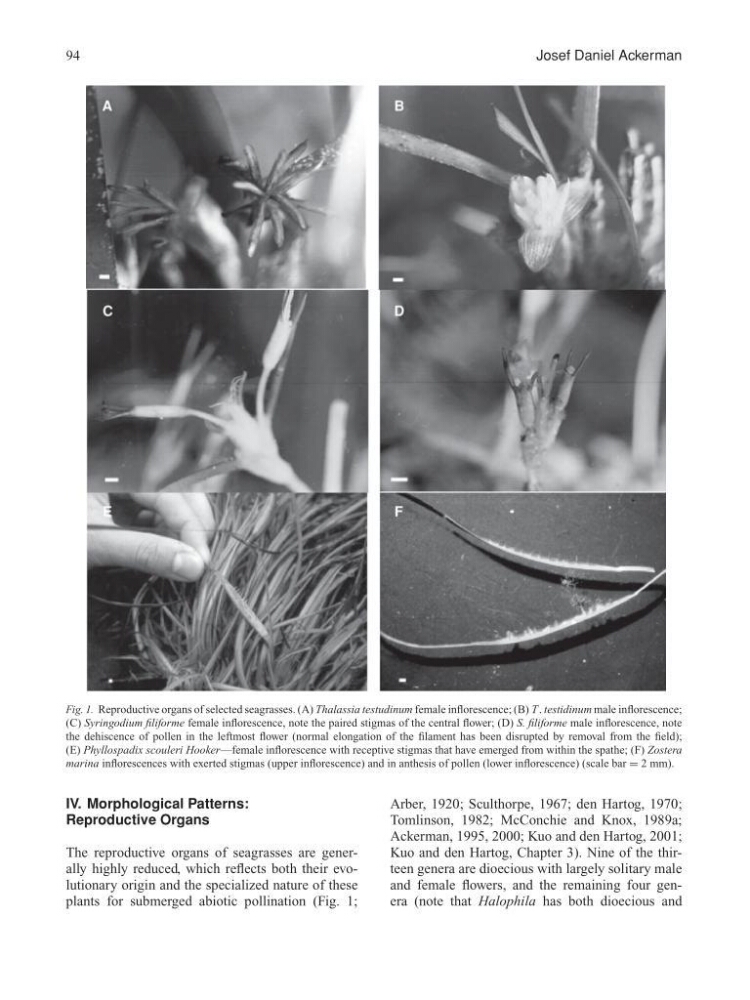
Fig. 1. Reproductive organs of selected seagrasses. (A) Thalassia testudinum female inflorescence; (B) T. testidinum male inflorescence;
(C) Syringodium filiforme female inflorescence, note the paired stigmas of the central flower; (D) S. filiforme male inflorescence, note
the dehiscence of pollen in the leftmost flower (normal elongation of the filament has been disrupted by removal from the field);
(E) Phyllospadix scouleri Hooker—female inflorescence with receptive stigmas that have emerged from within the spathe; (F) Zostera
marina inflorescences with exerted stigmas (upper inflorescence) and in anthesis of pollen (lower inflorescence) (scale bar = 2 mm).
IV. Morphological Patterns:
Reproductive Organs
The reproductive organs of seagrasses are generally highly reduced, which reflects both their evolutionary origin and the specialized nature of these
plants for submerged abiotic pollination (Fig. 1;
Arber, 1920; Sculthorpe, 1967; den Hartog, 1970;
Tomlinson, 1982; McConchie and Knox, 1989a;
Ackerman, 1995, 2000; Kuo and den Hartog, 2001;
Kuo and den Hartog, Chapter 3). Nine of the thirteen genera are dioecious with largely solitary male
and female flowers, and the remaining four genera (note that Halophila has both dioecious and
Josef Daniel Ackerman
Fig. 1. Reproductive organs of selected seagrasses. (A) Thalassia testudinum female inflorescence; (B) T. testidinum male inflorescence;
(C) Syringodium filiforme female inflorescence, note the paired stigmas of the central flower; (D) S. filiforme male inflorescence, note
the dehiscence of pollen in the leftmost flower (normal elongation of the filament has been disrupted by removal from the field);
(E) Phyllospadix scouleri Hooker—female inflorescence with receptive stigmas that have emerged from within the spathe; (F) Zostera
marina inflorescences with exerted stigmas (upper inflorescence) and in anthesis of pollen (lower inflorescence) (scale bar = 2 mm).
IV. Morphological Patterns:
Reproductive Organs
The reproductive organs of seagrasses are generally highly reduced, which reflects both their evolutionary origin and the specialized nature of these
plants for submerged abiotic pollination (Fig. 1;
Arber, 1920; Sculthorpe, 1967; den Hartog, 1970;
Tomlinson, 1982; McConchie and Knox, 1989a;
Ackerman, 1995, 2000; Kuo and den Hartog, 2001;
Kuo and den Hartog, Chapter 3). Nine of the thirteen genera are dioecious with largely solitary male
and female flowers, and the remaining four genera (note that Halophila has both dioecious and