

90
Josef Daniel Ackerman
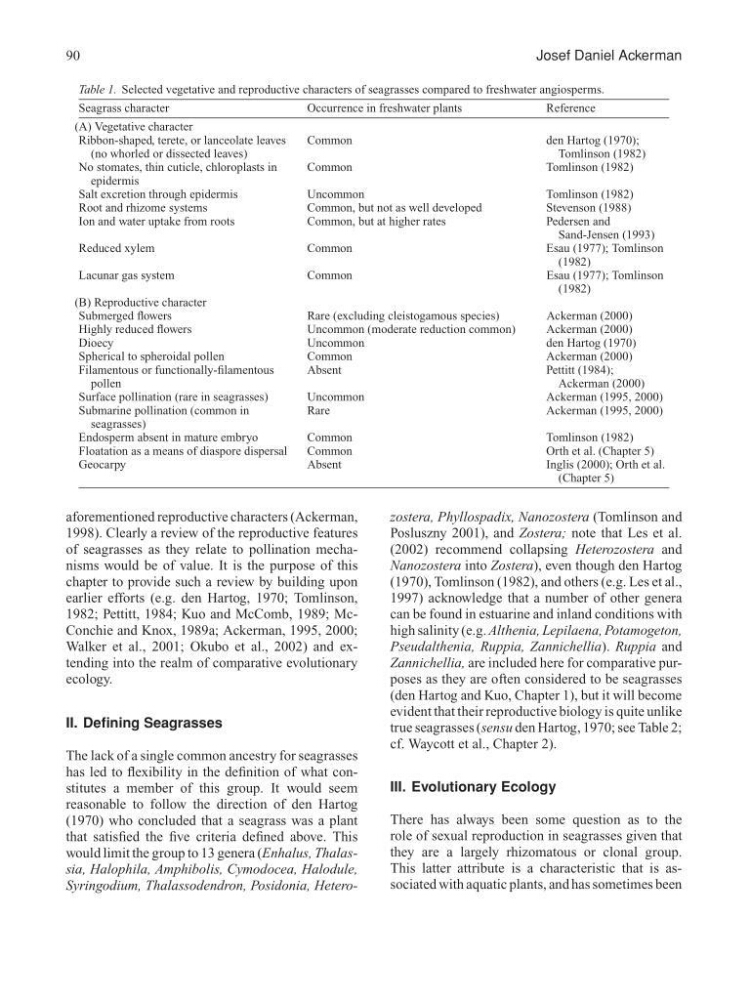
Table 1. Selected vegetative and reproductive characters of seagrasses compared to freshwater angiosperms.
Seagrass character
Occurrence in freshwater plants
Reference
(A) Vegetative character
Ribbon-shaped, terete, or lanceolate leaves
(no whorled or dissected leaves)
Common
den Hartog (1970);
Tomlinson (1982)
No stomates, thin cuticle, chloroplasts in
epidermis
Common
Tomlinson (1982)
Salt excretion through epidermis
Uncommon
Tomlinson (1982)
Root and rhizome systems
Common, but not as well developed
Stevenson (1988)
Ion and water uptake from roots
Common, but at higher rates
Pedersen and
Sand-Jensen (1993)
Reduced xylem
Common
Esau (1977); Tomlinson
(1982)
Lacunar gas system
Common
Esau (1977); Tomlinson
(1982)
(B) Reproductive character
Submerged flowers
Rare (excluding cleistogamous species)
Ackerman (2000)
Highly reduced flowers
Uncommon (moderate reduction common)
Ackerman (2000)
Dioecy
Uncommon
den Hartog (1970)
Spherical to spheroidal pollen
Common
Ackerman (2000)
Filamentous or functionally-filamentous
pollen
Absent
Pettitt (1984);
Ackerman (2000)
Surface pollination (rare in seagrasses)
Uncommon
Ackerman (1995, 2000)
Submarine pollination (common in
seagrasses)
Rare
Ackerman (1995, 2000)
Endosperm absent in mature embryo
Common
Tomlinson (1982)
Floatation as a means of diaspore dispersal
Common
Orth et al. (Chapter 5)
Geocarpy
Absent
Inglis (2000); Orth et al.
(Chapter 5)
aforementioned reproductive characters (Ackerman,
1998). Clearly a review of the reproductive features
of seagrasses as they relate to pollination mechanisms would be of value. It is the purpose of this
chapter to provide such a review by building upon
earlier efforts (e.g. den Hartog, 1970; Tomlinson,
1982; Pettitt, 1984; Kuo and McComb, 1989; McConchie and Knox, 1989a; Ackerman, 1995, 2000;
Walker et al., 2001; Okubo et al., 2002) and extending into the realm of comparative evolutionary
ecology.
II. Defining Seagrasses
The lack of a single common ancestry for seagrasses
has led to flexibility in the definition of what constitutes a member of this group. It would seem
reasonable to follow the direction of den Hartog
(1970) who concluded that a seagrass was a plant
that satisfied the five criteria defined above. This
would limit the group to 13 genera (Enhalus, Thalassia, Halophila, Amphibolis, Cymodocea, Halodule,
Syringodium, Thalassodendron, Posidonia, Heterozostera, Phyllospadix, Nanozostera (Tomlinson and
Posluszny 2001), and Zostera; note that Les et al.
(2002) recommend collapsing Heterozostera and
Nanozostera into Zostera), even though den Hartog
(1970), Tomlinson (1982), and others (e.g. Les et al.,
1997) acknowledge that a number of other genera
can be found in estuarine and inland conditions with
high salinity (e.g. Althenia, Lepilaena, Potamogeton,
Pseudalthenia, Ruppia, Zannichellia). Ruppia and
Zannichellia, are included here for comparative purposes as they are often considered to be seagrasses
(den Hartog and Kuo, Chapter 1), but it will become
evident that their reproductive biology is quite unlike
true seagrasses (sensu den Hartog, 1970; see Table 2;
cf. Waycott et al., Chapter 2).
III. Evolutionary Ecology
There has always been some question as to the
role of sexual reproduction in seagrasses given that
they are a largely rhizomatous or clonal group.
This latter attribute is a characteristic that is associated with aquatic plants, and has sometimes been
Josef Daniel Ackerman
Table 1. Selected vegetative and reproductive characters of seagrasses compared to freshwater angiosperms.
Seagrass character
Occurrence in freshwater plants
Reference
(A) Vegetative character
Ribbon-shaped, terete, or lanceolate leaves
(no whorled or dissected leaves)
Common
den Hartog (1970);
Tomlinson (1982)
No stomates, thin cuticle, chloroplasts in
epidermis
Common
Tomlinson (1982)
Salt excretion through epidermis
Uncommon
Tomlinson (1982)
Root and rhizome systems
Common, but not as well developed
Stevenson (1988)
Ion and water uptake from roots
Common, but at higher rates
Pedersen and
Sand-Jensen (1993)
Reduced xylem
Common
Esau (1977); Tomlinson
(1982)
Lacunar gas system
Common
Esau (1977); Tomlinson
(1982)
(B) Reproductive character
Submerged flowers
Rare (excluding cleistogamous species)
Ackerman (2000)
Highly reduced flowers
Uncommon (moderate reduction common)
Ackerman (2000)
Dioecy
Uncommon
den Hartog (1970)
Spherical to spheroidal pollen
Common
Ackerman (2000)
Filamentous or functionally-filamentous
pollen
Absent
Pettitt (1984);
Ackerman (2000)
Surface pollination (rare in seagrasses)
Uncommon
Ackerman (1995, 2000)
Submarine pollination (common in
seagrasses)
Rare
Ackerman (1995, 2000)
Endosperm absent in mature embryo
Common
Tomlinson (1982)
Floatation as a means of diaspore dispersal
Common
Orth et al. (Chapter 5)
Geocarpy
Absent
Inglis (2000); Orth et al.
(Chapter 5)
aforementioned reproductive characters (Ackerman,
1998). Clearly a review of the reproductive features
of seagrasses as they relate to pollination mechanisms would be of value. It is the purpose of this
chapter to provide such a review by building upon
earlier efforts (e.g. den Hartog, 1970; Tomlinson,
1982; Pettitt, 1984; Kuo and McComb, 1989; McConchie and Knox, 1989a; Ackerman, 1995, 2000;
Walker et al., 2001; Okubo et al., 2002) and extending into the realm of comparative evolutionary
ecology.
II. Defining Seagrasses
The lack of a single common ancestry for seagrasses
has led to flexibility in the definition of what constitutes a member of this group. It would seem
reasonable to follow the direction of den Hartog
(1970) who concluded that a seagrass was a plant
that satisfied the five criteria defined above. This
would limit the group to 13 genera (Enhalus, Thalassia, Halophila, Amphibolis, Cymodocea, Halodule,
Syringodium, Thalassodendron, Posidonia, Heterozostera, Phyllospadix, Nanozostera (Tomlinson and
Posluszny 2001), and Zostera; note that Les et al.
(2002) recommend collapsing Heterozostera and
Nanozostera into Zostera), even though den Hartog
(1970), Tomlinson (1982), and others (e.g. Les et al.,
1997) acknowledge that a number of other genera
can be found in estuarine and inland conditions with
high salinity (e.g. Althenia, Lepilaena, Potamogeton,
Pseudalthenia, Ruppia, Zannichellia). Ruppia and
Zannichellia, are included here for comparative purposes as they are often considered to be seagrasses
(den Hartog and Kuo, Chapter 1), but it will become
evident that their reproductive biology is quite unlike
true seagrasses (sensu den Hartog, 1970; see Table 2;
cf. Waycott et al., Chapter 2).
III. Evolutionary Ecology
There has always been some question as to the
role of sexual reproduction in seagrasses given that
they are a largely rhizomatous or clonal group.
This latter attribute is a characteristic that is associated with aquatic plants, and has sometimes been