

426
H. Giiner and V. Aysel
During winter, westerly winds prevail, while in summer and early
autumn winds generally blow from northwesterly directions.
The Levantine Basin is the second largest basin of the eastern Mediterranean; its volume amounts to 7.5 x 10 km 3 and the maximum water
depth is 4300 m. The water masses in the Levantine basin consist of: (1)
Atlantic water; (2) Levantine intermediate water; and (3) cold water from
deeper areas. During summer, the Atlantic water mass is overtopped by
warmer and more saline surface water down to 40 m water depth. Salinity concentrations during late summer rise to 39.5 PSU. In winter, vertical mixing processes change this distribution pattern of water masses.
The nutrient supply to the eastern Mediterranean is poor. The phosphate concentration of the deep water in the Levantine basin is only
one-sixth of the concentration in the Atlantic Ocean, which in turn is
rather low comapred to the other oceans. The eastern Mediterranean
surface waters are oligotrophic, resulting in occasional limitation of
phytoplankton primary production. Land-based sources, however, such
as agriculture, industries and tourism-related activities, continuously
supply the nearshore waters with new nutrients and pollutants. Further
research is needed to quantify the effects of these discharges.
18.3 The Benthic Flora in Turkish Seas
and Possible Effects of Eutrophication and Pollution
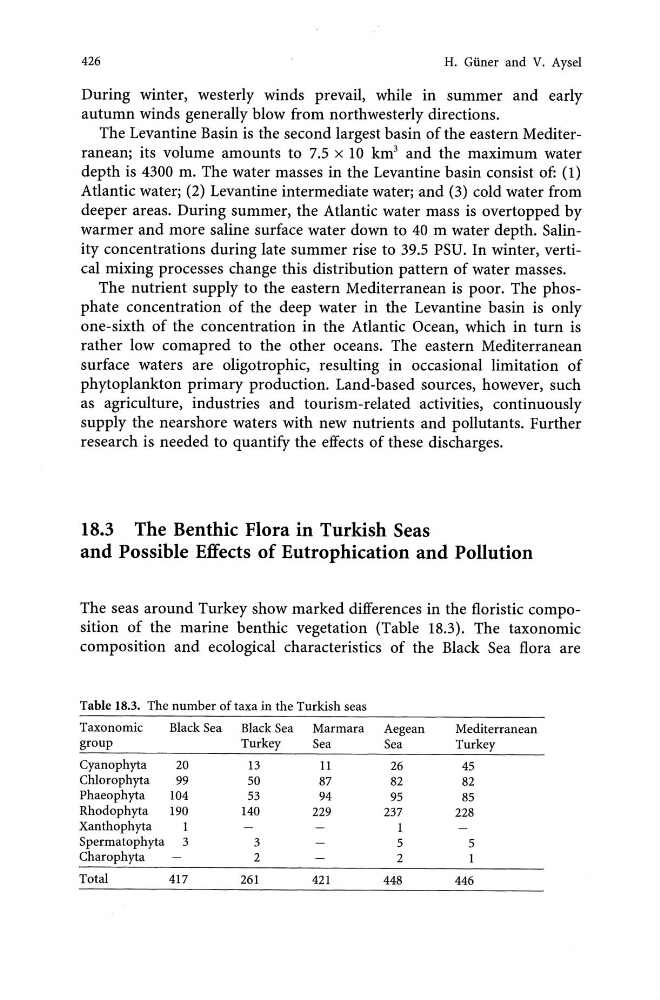
The seas around Turkey show marked differences in the floristic composition of the marine benthic vegetation (Table 18.3). The taxonomic
composition and ecological characteristics of the Black Sea flora are
Table 18.3. The number of taxa in the Turkish seas
Taxonomic
Black Sea Black Sea Marmara Aegean
Mediterranean
group
Turkey
Sea
Sea
Turkey
Cyanophyta
20
13
11
26
45
Chlorophyta
99
50
87
82
82
Phaeophyta
104
53
94
95
85
Rhodophyta
190
140
229
237
228
Xanthophyta
1
1
Spermatophyta 3
3
5
5
Charophyta
2
2
1
Total
417
261
421
448
446
H. Giiner and V. Aysel
During winter, westerly winds prevail, while in summer and early
autumn winds generally blow from northwesterly directions.
The Levantine Basin is the second largest basin of the eastern Mediterranean; its volume amounts to 7.5 x 10 km 3 and the maximum water
depth is 4300 m. The water masses in the Levantine basin consist of: (1)
Atlantic water; (2) Levantine intermediate water; and (3) cold water from
deeper areas. During summer, the Atlantic water mass is overtopped by
warmer and more saline surface water down to 40 m water depth. Salinity concentrations during late summer rise to 39.5 PSU. In winter, vertical mixing processes change this distribution pattern of water masses.
The nutrient supply to the eastern Mediterranean is poor. The phosphate concentration of the deep water in the Levantine basin is only
one-sixth of the concentration in the Atlantic Ocean, which in turn is
rather low comapred to the other oceans. The eastern Mediterranean
surface waters are oligotrophic, resulting in occasional limitation of
phytoplankton primary production. Land-based sources, however, such
as agriculture, industries and tourism-related activities, continuously
supply the nearshore waters with new nutrients and pollutants. Further
research is needed to quantify the effects of these discharges.
18.3 The Benthic Flora in Turkish Seas
and Possible Effects of Eutrophication and Pollution
The seas around Turkey show marked differences in the floristic composition of the marine benthic vegetation (Table 18.3). The taxonomic
composition and ecological characteristics of the Black Sea flora are
Table 18.3. The number of taxa in the Turkish seas
Taxonomic
Black Sea Black Sea Marmara Aegean
Mediterranean
group
Turkey
Sea
Sea
Turkey
Cyanophyta
20
13
11
26
45
Chlorophyta
99
50
87
82
82
Phaeophyta
104
53
94
95
85
Rhodophyta
190
140
229
237
228
Xanthophyta
1
1
Spermatophyta 3
3
5
5
Charophyta
2
2
1
Total
417
261
421
448
446